




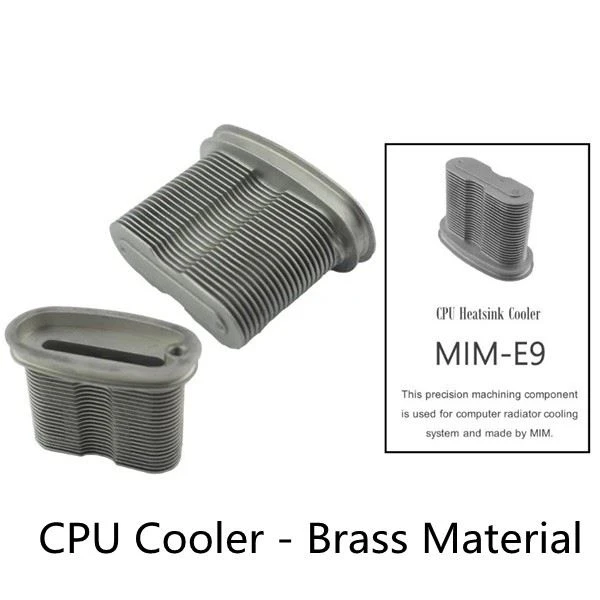


Mim Parts
Abbreviation for metal injection molding. MIM is a molding method in which a plasticized mixture of metal powder and its binder is injected into a mold. It is firstly mixing the selected powder with a binder, then granulating the mixture and then injection molding the desired shape.
Abbreviation for metal injection molding. MIM is a molding method in which a plasticized mixture of metal powder and its binder is injected into a mold. It is firstly mixing the selected powder with a binder, then granulating the mixture and then injection molding the desired shape. Qinhuangdao Zhongwei Precision Machinery Co., Ltd. is a comprehensive company integrating R&D, production and sales of copper alloy, iron base, stainless steel base, aluminum alloy, nickel alloy, cobalt alloy, tungsten alloy, cemented carbide and powder metallurgy structural parts. high-tech enterprises. We are willing to achieve common development with every businessman who needs MIM parts.
Product Description
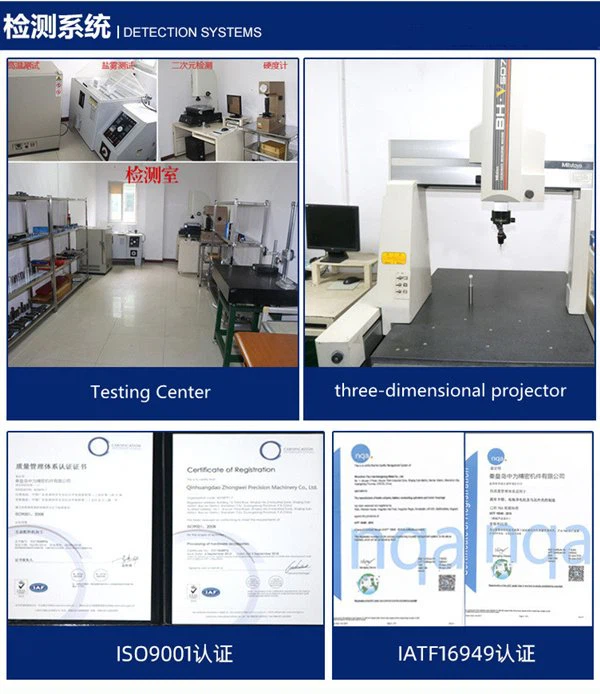
1. Implementation standards: the company strictly implements ISO9001, ISO14001, IATF16949 certification
The products have passed the certification of ROHS, FDA EU, etc.
2. Product material standards: ISO, GB, ASTM, SAE, EN, DIN, BS, AMS, JIS, ASME, DMS, TOCT, GB
3. Main processes: metal injection molding MIM, powder metallurgy PM, investment casting, die-casting aluminum,
4. Available materials for powder metallurgy:
Copper alloy, iron base, titanium alloy, stainless steel base, aluminum alloy, nickel alloy, cobalt alloy, tungsten alloy, cemented carbide, hydroxy alloy, soft magnetic material and 3D printing can be customized according to customer requirements.
Development of MIM Parts
Metal Injection Molding (MIM) is a molding method in which a plasticized mixture of metal powder and its binder is injected into a mold. It is firstly mixing the selected powder with a binder, then granulating the mixture and then injection molding the desired shape. The polymer imparts its viscous flow characteristics to the mix, which aids uniformity in forming, cavity filling and powder filling. After forming, the binder is removed, and the degreased blank is sintered. Some sintered products may also be subjected to further densification, heat treatment or machining. Sintered products not only have the same complex shape and high precision as those obtained by plastic injection molding, but also have physical, chemical and mechanical properties close to forgings. This process technology is suitable for mass production of small, precise, complex three-dimensional shapes and metal parts with special performance requirements.
Metal injection molding can be traced back to the powder injection molding preparation of ceramic spark plugs that began in the 1920s. In the following decades, powder injection molding mainly focused on ceramic injection molding. It was not until 1979 that the metal injection molding products of the Parmatech company established by Wiech and others won two awards, and at that time Wiech and Rivers successively obtained patents, powder injection molding began to be dominated by metal injection molding.
In the past, due to the lack of suitable powder and the high price of raw materials, imperfect knowledge platform, immature technology, short time for people to understand and market acceptance, long production (including mold manufacturing) cycle, insufficient investment, etc., its development and application are relatively low. slow.
In order to solve the difficulties of MIM technology and promote the practical application of MIM technology, in the mid-1980s, the United States formulated an advanced powder engineering plan, and the research content included 18 topics related to injection molding. Subsequently, Japan, Germany, etc. also actively carried out the development and research of MIM.
Wiech established Witec in 1980. In 1982, Brunswick entered the MIM industry and acquired Witec, and then gradually registered subsidiaries such as Omark Industries, Remington Military Products, and Rocky Dental. In 1986, the Japanese company Nippon Seison introduced the Wiech process. In 1990, Israel Metalor2000 Company introduced Wiech technology from Parmatech Company and established MIM production line.
With the continuous in-depth research of MIM parts and the development of new binders, the continuous progress of milling technology and degreasing technology, industrialization has been realized in the early 1990s. After more than 20 years of hard work, MIM has now become a new type of near-net-shape technology with rapid development and the most promising in the international powder metallurgy field, and is known as one of the "most popular metal parts forming technologies in the world".
Product Selection
As a near-net-shape technology for manufacturing high-quality precision parts, MIM technology has incomparable advantages over conventional powder metallurgy, machining and precision casting methods.
●It can produce small metal parts (0.1-500g) with complex shapes like plastic products;
●All parts of the workpiece have uniform organization, high dimensional accuracy and high relative density (≥95%);
●Good surface finish;
●The product quality is stable, the production efficiency is high, and it is easy to realize large-scale and large-scale production.
MIM parts suitable materials: iron-based alloy steel, stainless steel, nickel-based alloy, tungsten alloy, cemented carbide, titanium alloy, magnetic material, Kovar alloy, fine ceramics, etc.
Applicable materials
Table 1 Common materials and their application fields:
Material system | Alloy grade and composition | Application Field |
Low-alloy steel | Fe-2Ni, Fe-8Ni | Various structural parts in automobile, machinery and other industries |
Stainless steel | 316L ,17-4PH, 420, 440C | Medical equipment, watch parts |
Carbide | WC-Co | Various knives, clocks, watches |
Ceramics | Al 2O3 , ZrO2 , SiO2 | IT electronics, daily necessities, clocks |
Heavy alloy | W-Ni-Fe, W-Ni-Cu, W-Cu | Military industry, communication, daily necessities |
Titanium alloy | Ti,Ti-6Al-4V | Medical and military structural parts |
Magnetic material | Fe, NdFeB, SmCo5,Fe-Si | Various magnetic performance parts |
Tool steel | CrMo4,M2 | Various tools |
Table 2 Properties of several typical materials:
Material | Density | Hardness | Tensile | Elongation | |
g/cm3 | Rockwell | MPa | % | ||
Iron-based | PIM-2200 (Sintered) | 7.65 | 45HRB | 290 | 40 |
PIM-2700 (Sintered) | 7.65 | 69HRB | 440 | 26 | |
PIM-4605 (Sintered) | 7.62 | 62HRB | 415 | 15 | |
PIM-4605 (quenching, tempering) | 7.62 | 48HRC | 1655 | 2 | |
Stainless steel | PIM - 316L (Sintered) | 7.92 | 67HB | 520 | 50 |
PIM- 17-4PH (as sintered) | 7.5 | 27HRC | 900 | 6 | |
PIM- 17-4PH (as sintered) | 7.5 | 40HRC | 1185 | 6 | |
PIM - 430L (Sintered) | 7.5 | 65HRB | 415 | 25 | |
Tungsten Alloy | 95%W-Ni-Fe | 18.1 | 30 | 960 | 25 |
97%W-Ni-Fe | 18.5 | 33 | 940 | 15 | |
Carbide | YG8X | 14.9 | HRA90 | Bending strength 2300 | |
Fine ceramics | Al2O3 | 3.98 | HRA92 | Bending strength 530 | |
Post Casting Process
1. Heat treatment: annealing, carbonization, tempering, quenching, normalizing, surface tempering
2. Processing equipment: CNC, WEDM, lathe, milling machine, drilling machine, grinder, etc.;
3. Surface treatment: powder spraying, chrome plating, painting, sandblasting, nickel plating, galvanizing, blackening, polishing, bluing, etc.

Product Feature
MIM parts combines the advantages of powder metallurgy and plastic injection molding technology, breaking through the limitations of traditional metal powder molding technology on product shape, and using plastic injection molding technology to form parts with complex shapes in large quantities and efficiently It has become a near-net-shape technology for modern manufacturing of high-quality precision parts, and has incomparable advantages over conventional powder metallurgy, machining and precision casting.
◇Produce small metal parts with complex shapes like plastic products, usually weighing 0.1-200g;
◇Forming various complex shapes like plastic products, such as external grooves, external threads, tapered outer surfaces, cross through holes, blind holes, concave tables, key pins, rib plates, surface knurling, etc.;
◇Good surface finish, high dimensional accuracy, the usual tolerance is ±0.3%~0.5%;
◇The material is suitable for a wide range, the product has a high density (up to 95% to 99%), and has a uniform structure and excellent performance;
◇With stable product quality and high production efficiency, it can realize automatic, large-scale and large-scale production.
Table 1 Comparison of MIM and Precision Casting Formability
Features | Precision Casting | MIM |
Minimum hole diameter | 2mm | 0.4mm |
2mm diameter blind hole maximum depth | 2mm | 20mm |
Minimum wall thickness | 2mm | <1mm |
Maximum wall thickness | Unlimited | 10mm |
4mm diameter tolerance | ±0.2mm | ±0.06mm |
Surface roughness (Ra) | 5um | 1um |
Table 2 Comprehensive comparison of MIM process and other processes
Project | MIM | Powder Metallurgy | Precision Casting | Machining |
Density | 98% | 86% | 98% | 100% |
Tensile Strength | High | Low | High> | High |
Finish | High | Middle | Middle | High |
Miniaturization ability | High | Middle | Low | Middle |
Thin wall capability | High | Middle | Middle | Low |
Complexity | High | Low | Middle | High |
Design Tolerance | High | Middle | Middle | Middle |
Material range | High | High | Middle | High |
Moulds and Inspection Fixtures
1. Mold service life: usually semi-permanent. (except for lost foam)
2. Mold delivery time: 10-25 days, (according to product structure and product size).
3. Tooling and mold maintenance: Zhongwei is responsible for precision parts.

Quality Control
1. Quality control: the defective rate is less than 0.1%.
2. Samples and trial run will be 100% inspected during production and before shipment, sample inspection for mass production according to ISDO standards or customer requirements
3. Testing equipment: flaw detection, spectrum analyzer, golden image analyzer, three-coordinate measuring machine, hardness testing equipment, tensile testing machine.
Application
The application field of MIM parts has been involved in various fields of the national economy, and the market prospect is broad. like:
Computer and auxiliary facilities: such as printer parts, magnetic cores, striker pins, drive parts;
Tools: parts used for gun drills, drill chucks, power tools, hand tools, wrenches, etc., milling cutter heads, nozzles, etc.;
Household appliances: such as watch cases, watch chains, electric toothbrushes, scissors, fans, golf heads, imitation jewelry, knife heads, electronic cigarettes and other parts;
Medical device parts: such as orthodontic frame, scissors, tweezers;
Military ordnance parts: missile tail, gun parts, warheads, drug cover, fuze parts;
Electrical parts: such as micro motor parts, electronic parts, sensor parts, mobile phones, parts for BP machines;
Mechanical parts: small and complex parts of various machinery such as cotton loosening machines, textile machines, sewing machines, office machinery, etc.;
Automobile and marine parts: such as clutch inner ring, rocker arm insert, shift fork cover, distributor cover, automobile airbag parts, automobile locks;
All kinds of special-shaped hard alloy nozzles used in oil field drilling, etc.


Send Inquiry
