



Tool Steel Hot Forgings
Hot work die steel refers to alloy tool steel suitable for making dies for hot deformation processing of metals, such as hot forging dies, hot extrusion dies, die casting dies, hot upsetting dies, etc.
Hot work die steel refers to alloy tool steel suitable for making dies for hot deformation processing of metals, such as hot forging dies, hot extrusion dies, die casting dies, hot upsetting dies, etc. Since the hot work die works under high temperature and high pressure conditions for a long time, the die material is required to have high strength, hardness and thermal stability, especially high thermal strength, thermal fatigue, toughness and wear resistance.
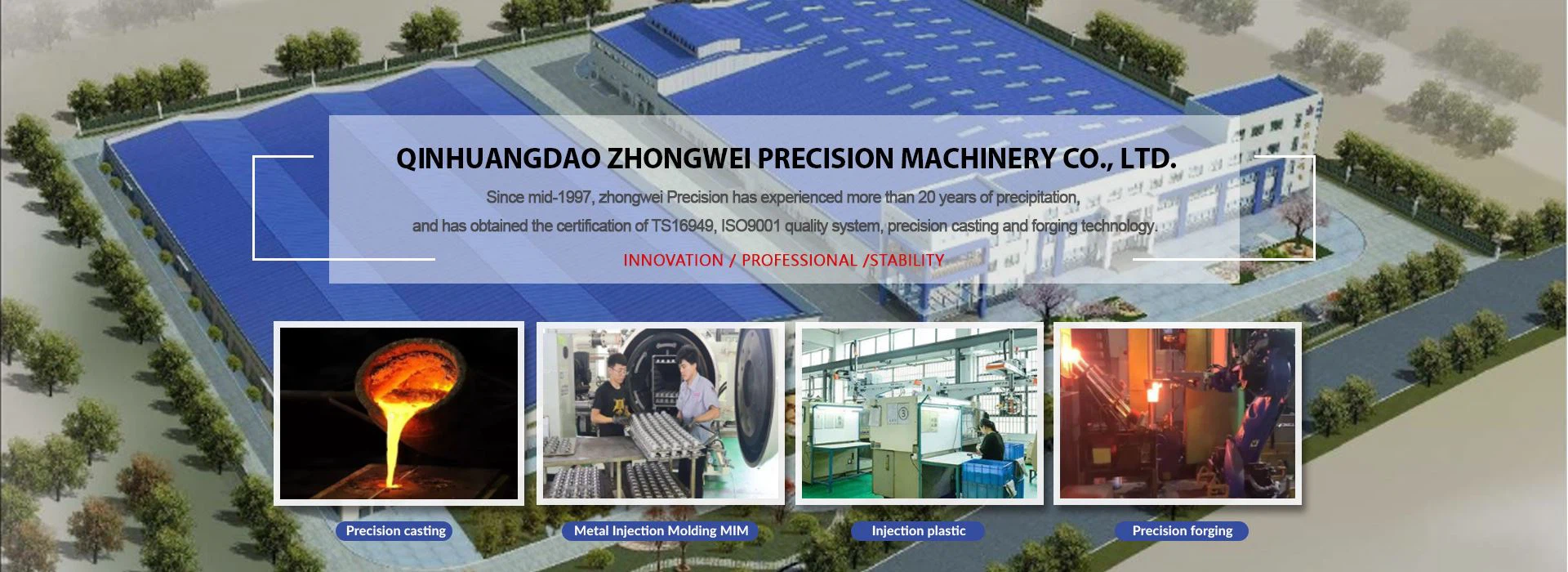
Qinhuangdao Zhongwei Precision Machinery Co., Ltd. is an enterprise specializing in forging, processing and production of forgings. Products can be produced according to drawings and chemical compositions, and the integration of free forging, die forging, rough machining, heat treatment and finishing is completed. Long-term cooperation with crane, petroleum, chemical, mining, metallurgy, hydraulic, coking, train, construction machinery and other enterprises.
Product Dsecription
1. Implementation standards: the company strictly implements ISO9001, ISO14001, IATF16949 certification
The products have passed the certification of ROHS, FDA EU, etc.
2. Product material standards: ISO, GB, ASTM, SAE, EN, DIN, BS, AMS, JIS, ASME, DMS, TOCT, GB
3. Main process: cold forging, hot forging, free forging, fetal membrane forging, die forging and special die forging. And has die casting process, investment casting, shell casting, deburring, sand blasting, machining, heat treatment, leak testing, surface treatment, etc.
4. Available materials for Tool Steel Hot Forgings:
Copper, titanium alloy, high manganese steel, high chromium steel, high nickel steel, carbon steel, aluminum alloy, alloy steel, stainless steel, gray iron, cast iron, cast steel, etc. are customized according to customer requirements.
Product Ingredient Characteristics
1. Tool Steel Hot Forgings Carbon Content
Generally, it is medium carbon, and the mass fraction of carbon is 0.3% to 0.6%. Ensure that the material has high strength and hardness, high hardenability and good plasticity and toughness.
2. Tool Steel Hot ForgingsAlloying Elements
The added alloying elements include Cr, Mn, Si, Ni, W, Mo, V and other alloying elements. Among them, the role of Cr, Mn, Si, Ni alloying elements is to strengthen the ferrite and improve the hardenability. W and Mo alloy elements are used to prevent temper brittleness, and Cr, W, Si alloy elements can increase the phase transition temperature, so that the mold will not undergo phase transition during the alternate heating and cooling process and a large volume change will occur, thereby improving its resistance. The ability to thermal fatigue. In addition, W, Mo, V, etc. are precipitated in the form of carbides during tempering to produce secondary hardening, so that the hot work die steel still maintains a relatively high hardness at higher temperatures, which is an important factor for the normal operation of the hot work die steel. One of the conditions, Cr and Si can improve the oxidation resistance of steel.
Standard Steel Grade

Product Category
There are many classification methods for hot work die steel, which can be classified according to the content of alloying elements and the properties after heat treatment, according to the use, or according to the alloying elements.
(1) According to the application, it can be divided into steel for hot forging dies, steel for hot extrusion dies, steel for die casting dies, and steel for hot blanking dies.
(2) According to the heat resistance, it can be divided into low heat-resistant steel (350 ~ 370 ° C), medium heat-resistant steel (550 ~ 600 ° C), and high heat-resistant steel.
(3) According to the unique properties, it is divided into high toughness hot work die steel, high heat and strength hot work die steel, and high wear-resistant hot work die steel.
(4) According to the classification of alloying elements, it can be divided into low alloy hot work die steel (tungsten series, chromium series and molybdenum series), medium alloy hot work die steel and high alloy hot work die steel (tungsten and molybdenum series and chromium molybdenum series); Or divided into tungsten-based hot-die steel, chromium-based hot-die steel and chromium-tungsten-molybdenum-based hot die steel. The high-temperature strength and thermal stability of chromium-tungsten series high-alloy hot work die steel are not as good as those of tungsten-molybdenum series, while the thermal fatigue resistance and toughness are higher than those of tungsten-molybdenum series.
Post Casting Process
1. Heat treatment: annealing, carbonization, tempering, quenching, normalizing, surface tempering
2. Processing equipment: CNC, WEDM, lathe, milling machine, drilling machine, grinder, etc.;
3. Surface treatment: powder spraying, chrome plating, painting, sandblasting, nickel plating, galvanizing, blackening, polishing, bluing, etc.

Moulds and Inspection Fixtures
1. Mold service life: usually semi-permanent. (except for lost foam)
2. Mold delivery time: 10-25 days, (according to product structure and product size).
3. Tooling and mold maintenance: Zhongwei is responsible for precision parts.

Quality Control
1. Quality control: the defective rate is less than 0.1%.
2. Samples and trial run will be 100% inspected during production and before shipment, sample inspection for mass production according to ISDO standards or customer requirements
3. Testing equipment: flaw detection, spectrum analyzer, golden image analyzer, three-coordinate measuring machine, hardness testing equipment, tensile testing machine;
4. Provide after-sales service.

Application
High-speed Tool Steel Hot Forgings has high hardness, compressive strength and wear resistance. It is mainly used to manufacture medium and high-speed cutting tools, such as turning tools, milling cutters, reamers, broaches, twist drills, etc. High-speed steels include W18Cr4V, W6Mo5Cr4V2, W9Mo3Cr4V and W12Cr4V5Co5, etc.
W18Cr4V steel has the characteristics of high hardness, high strength, high compression resistance, high wear resistance and high thermal stability. Hardness, compressive strength and wear resistance are required to withstand high loads, and cold work dies for processing hard materials, such as heavy-duty punches and cold extrusion dies.
W6Mo5Cr4V2 steel is a general high-speed steel of tungsten and molybdenum series. The toughness, wear resistance and thermoplasticity of this steel are better than those of W18Cr4V steel, and its hardness, hot hardness and high temperature hardness are comparable to those of W18Cr4V steel. Due to its high strength and good wear resistance, high-load wear-resistant cold work dies, such as cold extrusion dies, can be made. It is also possible to manufacture hot working dies that can withstand a certain impact load.
W9Mo3Cr4V steel combines the advantages of W18Cr4V and W6Mo5Cr4V2 high-speed steel, with high yield and low production cost. Very suitable for making high-load molds, especially cold extrusion molds.
W12Cr4V5Co5 steel is a high-carbon, high-vanadium, cobalt-containing high-speed steel with good wear resistance, high hardness, good stability against tempering, and high high temperature hardness and hot hardness. It is suitable for processing difficult-to-machine materials, such as high-strength steel, medium-strength steel, cold-rolled steel, cast alloy steel, etc.


Send Inquiry
