



Non-standard Customized Hot Forgings
Products can be produced according to drawings and chemical compositions, and the integration of free forging, die forging, rough machining, heat treatment and finishing is completed. Long-term cooperation with crane, petroleum, chemical, mining, metallurgy, hydraulic, coking, train, construction machinery and other enterprises.
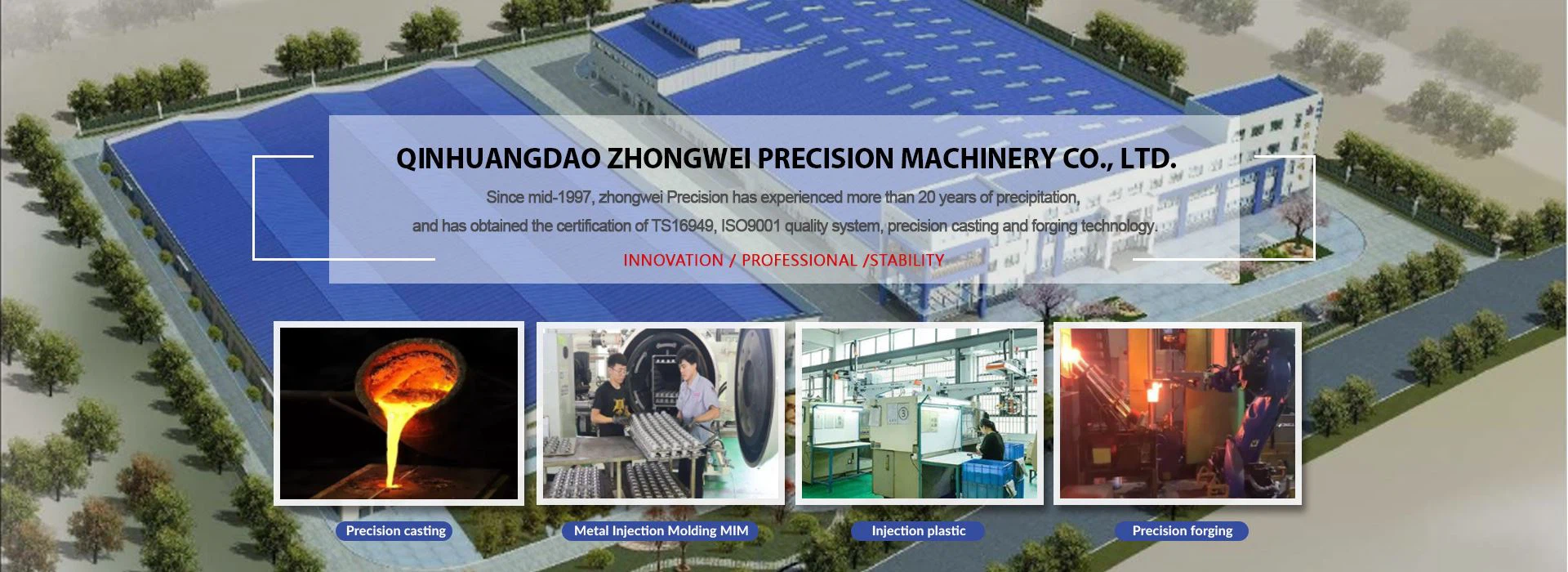
Qinhuangdao Zhongwei Precision Machinery Co., Ltd. is an enterprise specializing in forging, processing and production of forgings. Products can be produced according to drawings and chemical compositions, and the integration of free forging, die forging, rough machining, heat treatment and finishing is completed. Long-term cooperation with crane, petroleum, chemical, mining, metallurgy, hydraulic, coking, train, construction machinery and other enterprises.
Product Dsecription
1. Implementation standards: the company strictly implements ISO9001, ISO14001, IATF16949 certification
The products have passed the certification of ROHS, FDA EU, etc.
2. Product material standards: ISO, GB, ASTM, SAE, EN, DIN, BS, AMS, JIS, ASME, DMS, TOCT, GB
3. Main process: cold forging, hot forging, free forging, fetal membrane forging, die forging and special die forging. And has die casting process, investment casting, shell casting, deburring, sand blasting, machining, heat treatment, leak testing, surface treatment, etc.
4. Materials available for Non-standard customized hot forgings:
Copper, titanium alloy, high manganese steel, high chromium steel, high nickel steel, carbon steel, aluminum alloy, alloy steel, stainless steel, gray iron, cast iron, cast steel, etc. are customized according to customer requirements.
Heat Treatment Process
The heat treatment technologies of Non-standard customized hot forgings mainly include annealing, normalizing, quenching, tempering, quenching and tempering, solution treatment and aging treatment. Among them, annealing also includes incomplete annealing, complete annealing, isothermal annealing, general spheroidizing annealing, isothermal spheroidizing annealing, rapid spheroidizing annealing (normalizing-spheroidizing annealing); normalizing includes ordinary normalizing and two-stage normalizing. In addition, there are forging heat quenching, normalizing using part of the waste heat, quenching using part of the waste heat, isothermal annealing using part of the waste heat, and high temperature tempering.
1. Incomplete annealing
Heat the steel to between Ac1 and Ac3 (or Acm), a short time, a heat treatment process of slow cooling after holding for a short time to obtain spherical pearlite and spherical carbide structure, reduce hardness and improve machinability, mainly used for tool steel , Bearing steel cold die steel.
2. Complete annealing (usually called annealing)
The hypoeutectoid steel is heated to 30-50°C above A c3, and the austenitization is completed by heat preservation, and the composition is basically uniform. In order to obtain a balanced structure, the forging stress is eliminated, the hardness is reduced, the plasticity is improved, and the cutting performance is improved; the coarse grains are eliminated, the structure is improved, and the structure is prepared for the subsequent heat treatment of the parts. Generally used for hypoeutectoid steel, such as 5CrMnMo, etc.
3. Isothermal annealing
Heat the steel to 20-30℃ above Ac3 (hypo-eutectoid steel) or between Ac1 and Acm (hyper-eutectoid steel), keep the temperature until it is completely austenitized and uniform, and then rapidly cool to below Ar1 A certain temperature (that is, the most unstable temperature of austenite) is kept isothermally until the austenite is completely transformed, and then it is air-cooled or cooled with furnace, oil, and water to obtain a more uniform structure than complete annealing, effectively Eliminate the forging stress, shorten the annealing time and improve the productivity by complete annealing. It is suitable for hypoeutectoid steel, eutectoid steel and hypereutectoid steel, such as 20CrMnTi, 5CrMnMo, Cr12MoV, T8, etc.
4. General spheroidizing annealing
The steel is heated to between Ac1 and Acm (or Ac3), and after sufficient heat preservation, it is slowly cooled to 500-650 ° C for cooling, so that the steel can obtain a fine-grained (spherical) carbide structure dispersed on the ferrite matrix. It will improve the cutting performance and reduce the tendency of deformation and cracking during quenching, so that the steel can obtain a fairly uniform final performance. For pre-heat treatment of bearing parts, tools, cold work dies, etc.
5. Isothermal spheroidizing annealing
Heat the eutectoid steel or hypereutectoid steel to Ac1+ (20-30°C) (if the reticulated carbide in the original structure is serious, it needs to be heated to a little higher than Acm), keep it for a suitable time, and then cool it to a temperature slightly lower than Ar1. The temperature is isothermal until the austenite transformation is completed, then furnace cooling or air cooling, and spheroidizing annealing. Commonly used in carbon steel and alloy steel tools, cold work dies and bearing parts. Better carbide spheroidization quality and less process time can be obtained.
6. Rapid spheroidizing annealing (normalizing - spheroidizing annealing)
The hypereutectoid steel is heated to Acm+ (20-30°C), air-cooled (normalized) after heat preservation, to obtain flaky pearlite. Then spheroidizing annealing or isothermal spheroidizing annealing is performed with spheroidizing annealing. It is used for forging steel parts with thick pearlite flakes, serious reticulated carbides and difficult spheroidization, such as T12, bearing steel, etc.
7. Normalizing (ordinary normalizing)
Hypo-eutectoid steel is heated to Ac3+ (30-50°C), eutectoid steel and hypereutectoid steel are heated to Acm+ (30-50°C), kept for a certain period of time and then air-cooled to obtain heat treatment of pearlite structure, refine the structure, eliminate The Widmandarin structure of medium carbon steel or the reticulated carbide of hypereutectoid steel reduces stress and improves machinability. For heat treatment of hypoeutectoid, eutectoid and hypereutectoid steels.
8. Second stage normalizing
After heating and heat preservation by ordinary normalizing, firstly cool the workpiece to about 550 ℃ below Ar1, and then put it into the furnace or ash for slow cooling heat treatment to reduce deformation and eliminate abnormal tissue. It is used for workpieces with complex shapes or large differences in cross-sectional dimensions or steels that are prone to abnormal structures.
9. Quenching
Heat the steel to Ac3+30-50℃ (hypo-eutectoid steel) or between Ac1 and Acm (hyper-eutectoid steel), keep warm until the corresponding high temperature phase is obtained, and then quench at a rate greater than the critical cooling rate to obtain the martensite structure . For steel, quenching is used to obtain uneven structure to improve strength and hardness. For austenitic stainless steel, quenching is solution treatment, and quenching is used to improve the corrosion resistance and high temperature oxidation resistance of steel.
10. Forging heat quenching (belonging to high temperature deformation heat treatment)
After the forging is formed by hot forging (the temperature of the workpiece during final forging is generally about 900 °C), it is immediately quenched in a quenching medium to obtain a quenched structure. It is a heat treatment process that combines hot forging and heat treatment. In order to improve the strength of forgings, improve plasticity and toughness, and can simplify the process, save energy and improve labor productivity. Mainly used for hypoeutectoid steel, such as 45 steel and 40Cr and other steel hot forgings.
11. Forging hot isothermal annealing
After the forging is formed by hot forging, controlled cooling is used, generally cooling to a certain temperature below Ac1 in about 5 minutes and isothermal, using supercooled austenite to completely transform into ferrite and pearlite structure, and heat treatment for random cooling after proper heat preservation. In order to obtain a uniform balanced structure, eliminate forging stress, and improve machinability, for some materials, the transformation time can be shortened and energy can be saved. It is mainly used for pre-heat treatment of alloy carburized steel forgings, and can also be used for tool steels such as CrWMn.
12. Use part of the waste heat to normalize
After the forging is hot forged, air-cooled to about 500 ℃, the austenite has been completely transformed, and then heated to the warm annealing temperature, followed by heat preservation, rapid cooling, isothermal cooling, and isothermal annealing process. In addition to saving some energy, its purpose is annealing at the same temperature.
13. Tempering
Heat the quenched or normalized workpiece to a certain temperature below Ac1, hold it for a certain period of time, and then cool it to room temperature at an appropriate speed to transform the unstable structure obtained by quenching into a more stable structure; appropriately reduce the hardness and Strength, improve plasticity and toughness, reduce or eliminate residual stress.
14. High temperature tempering
Heat the steel to a certain temperature below Ac1, (usually between 500-700 ℃) and air-cool after heat preservation to reduce hardness, improve plasticity, reduce or eliminate internal stress, some alloy steels have too high hardness after normalizing, use high temperature Tempering reduces the hardness, and the medium carbon structure is tempered at high temperature after quenching.
15. Tempering
The heat treatment process of normal quenching and high temperature tempering of medium carbon structural steel can obtain good comprehensive mechanical properties.
16. Solution treatment
Heat the aging-strengthened alloy or stainless steel and heat-resistant steel to a certain high temperature (1000-1150 °C for stainless steel and heat-resistant steel) to dissolve all or most of the strengthening phase into the solid solution, adjust the grain size, and then at a relatively fast speed (water , air, etc.) cooling, improve the uneven distribution of the strengthening phase in the forging state, reduce the hardness, improve the plasticity, corrosion resistance and electrical conductivity or prepare for the subsequent aging treatment. For stainless steel, heat-resistant steel and age-strengthened alloys.
17. Aging treatment
The supersaturated solid solution obtained by solid solution treatment stays at room temperature or for a certain period of time, so that the supersaturated dissolved matter in the matrix is uniformly precipitated. Stabilizes the tissue and increases strength and hardness. It is used for the treatment of aging-strengthened alloys, stainless steel and heat-resistant steel after solution treatment.
Category 4: Australian Standard
1. AS 4991-2004 Lifting devices
2. AS 2076-1996 R2014 Wire Rope Slings
3. AS 1666.1-2009 Wire Rope Slings Part 1 Product Specifications
4 AS 1666.2-2009 Silk rope slings - Part 2 care and use
Post Casting Process
1. Heat treatment: annealing, carbonization, tempering, quenching, normalizing, surface tempering
2. Processing equipment: CNC, WEDM, lathe, milling machine, drilling machine, grinder, etc.;
3. Surface treatment: powder spraying, chrome plating, painting, sandblasting, nickel plating, galvanizing, blackening, polishing, bluing, etc.

Moulds and Inspection Fixtures
1. Mold service life: usually semi-permanent. (except for lost foam)
2. Mold delivery time: 10-25 days, (according to product structure and product size).
3. Tooling and mold maintenance: Zhongwei is responsible for precision parts.

Quality Control
1. Quality control: the defective rate is less than 0.1%.
2. Samples and trial run will be 100% inspected during production and before shipment, sample inspection for mass production according to ISDO standards or customer requirements
3. Testing equipment: flaw detection, spectrum analyzer, golden image analyzer, three-coordinate measuring machine, hardness testing equipment, tensile testing machine;
4. Provide after-sales service.


Send Inquiry
