



Forged Auto Parts
Among the automotive metal materials, Forged auto parts have better heat treatment performance than castings and profiles, making it have higher strength and good impact and wear resistance.
Among the automotive metal materials, Forged auto parts have better heat treatment performance than castings and profiles, making it have higher strength and good impact and wear resistance.
Various gears and shafts in connecting rods, crankshafts, gearboxes in automobiles, ball joints at the ends of tie rods, and brackets in suspensions, etc. More trucks (such as axles, half shafts, hub axle heads, propeller shaft forks, tow hooks, etc.).
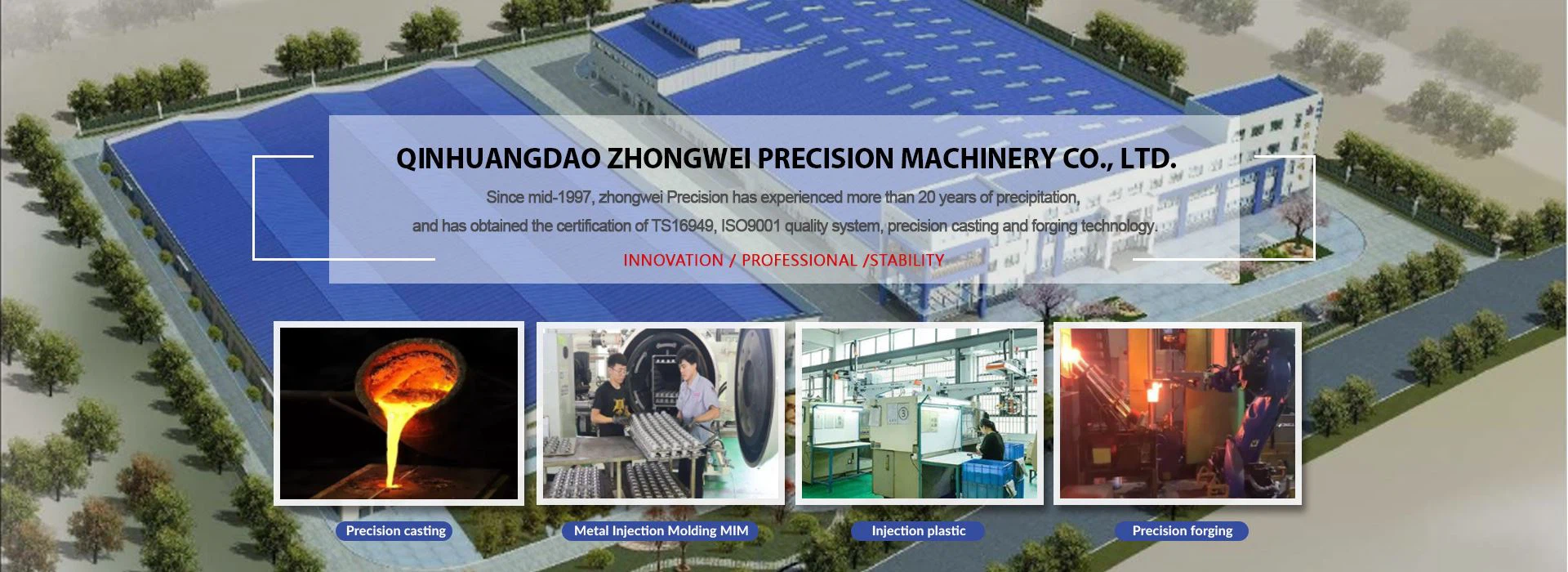
Qinhuangdao Zhongwei Precision Machinery Co., Ltd. is an enterprise specializing in forging, processing and production of forgings. Products can be produced according to drawings and chemical compositions, and the integration of free forging, die forging, rough machining, heat treatment and finishing is completed. Long-term cooperation with crane, petroleum, chemical, mining, metallurgy, hydraulic, coking, train, construction machinery and other enterprises.
Product Dsecription
1. Implementation standards: the company strictly implements ISO9001, ISO14001, IATF16949 certification
The products have passed the certification of ROHS, FDA EU, etc.
2. Product material standards: ISO, GB, ASTM, SAE, EN, DIN, BS, AMS, JIS, ASME, DMS, TOCT, GB
3. Main process: cold forging, hot forging, free forging, fetal membrane forging, die forging and special die forging. And has die casting process, investment casting, shell casting, deburring, sand blasting, machining, heat treatment, leak testing, surface treatment, etc.
4. Forged auto parts available materials:
Copper, titanium alloy, high manganese steel, high chromium steel, high nickel steel, carbon steel, aluminum alloy, alloy steel, stainless steel, gray iron, cast iron, cast steel, etc. are customized according to customer requirements.
Process characteristics and classification of forged auto parts
1. Engine connecting rod forging process equipment
There are two main forging processes of car engine connecting rod, one is to use hot die forging press production line, and the other is to use electro-hydraulic die forging hammer production line. The former is suitable for mass production, while the latter is suitable for medium and small batches and multi-variety production. The basic components of the hot die forging press production line are the bar warehouse, the bar automatic arrangement and feeding device, the induction heating furnace, the discharging device, the bar shearing mechanism and the hot die forging press. The hot die forging press production line adopts the forging process of one die and two pieces, the productivity can be as high as 800-1200 pieces/hour, and the material utilization rate is more than 95%. Although the hot die forging press production line has economic and technical advantages, it is restricted by factors such as large investment, high degree of specialization, high mold manufacturing and maintenance costs, and must have a start-up rate of more than 70%, which makes many manufacturers daunted. The electro-hydraulic die forging hammer production line produces connecting rod forgings of passenger cars. It adopts a forging process of one die and one piece. The bar is cut into billets, heated and then forged. The basic components of the electro-hydraulic die forging hammer production line are bar shearing machine, induction heating furnace, feeding device, cross wedge rolling mill or roll forging machine, electro-hydraulic die forging hammer, trimming correction machine, etc. With the development of control technology, the electro-hydraulic die hammer can control and adjust the process parameters such as striking energy, striking times, striking interval, etc., so as to meet the energy requirements of forging forming with the best striking force, which can not only improve the quality of forgings, but also prolong the the life of the mold. Although the productivity of the electro-hydraulic die forging hammer production line is usually only about one-half of that of the hot die forging press production line, its investment is only equivalent to one-third of the latter. favored by manufacturers.
The technical development trend of car engine connecting rod forging is to improve the mechanization and automation level of the forging production line and to adopt new forging process methods. Obviously, improving the mechanization and automation level of the forging production line is the consensus of the industry. It is a common practice in developed countries to use mechanized loading and unloading devices, mechanized conveying devices, manipulators and automatic control technology to technically transform the assembly line, reduce manual operation links, and realize automatic or semi-automatic production. There are two attempts at new forging process methods. One is the powder forging process, that is, the metal powder sintered billet is heated for die forging; the other is high-speed forging on a multi-station automatic hot heading machine. The former has the advantages of small weight deviation of forgings and the ability to produce forgings with complex shapes, etc. It is especially suitable for advanced engines with high dynamic balance requirements and is used by many manufacturers; accepted by the manufacturer.
2. Forging process equipment for disc gear blanks
The disc gear blank is a typical representative of the car disc forgings. Due to the large quantity, it is required to be produced by a high-precision, high-efficiency and low-cost process. The early production process used a forging hammer, a mechanical press, a screw press or a hot die forging press as the main machine. The bar was cut into a billet and then heated, which was completed in several processes. Large quantity and low material utilization rate. Since the concept of blank refinement appeared, the automatic production line of high-speed hot heading machine has become the most ideal choice for the production of disc gear blanks. The typical configuration of the high-speed hot heading machine automatic production line is a material rack, an automatic feeding device, an induction heating furnace, a roller feeding mechanism and a multi-station high-speed hot heading machine. After the heated bar enters the high-speed hot upsetting machine, all processes such as blank cutting, shaping, pre-forging, final forging, and punching are completed in turn. The transfer of forgings between stations is automatically completed by the robot. The automatic production line of high-speed hot heading machine can realize real roughness refinement. The size and shape of forgings are close to machined parts, which improves material utilization and saves machining time. Forgings have more ideal metallographic structure and mechanical properties, and the productivity is ordinary forging. The method is several times or even ten times, and its comprehensive economic benefits are very significant.
3. Gear shaft forging process equipment
The car gear shaft is an important part of the gearbox and is a typical car shaft with the characteristics of slenderness and multiple steps. The traditional process of producing shaft parts is die forging on a die forging hammer or a hot die forging press, but the forgings produced by this process have low precision, low material utilization, and large machining allowance. The emergence of the cross wedge rolling process effectively solves the problem. this problem. The cross wedge rolling process is a new technology of high efficiency, energy saving and material saving. The heated bar enters the cross wedge rolling mill, and the cross wedge rolling die continuously extrudes and distributes the metal in one working cycle to form stepped shaft forgings that meet the shape and size requirements. , and hollow shaft forgings can be produced with tubes as blanks. Since the cross wedge rolling process is suitable for processing symmetrical parts, a pair of parts are often arranged symmetrically to design the mold, which benefits both the manufacturability and productivity. The characteristics of the cross wedge rolling process are that one or a pair of parts can be obtained in one stroke, with high production efficiency; continuous metal deformation, small deformation force, and high die life; The composition of the cross wedge rolling automatic production line is relatively simple, usually composed of an automatic feeding device, an induction heating furnace and a cross wedge rolling mill. The cross wedge rolling mill has two-roll and flat structure forms. The flat cross wedge rolling mill is driven by machinery or hydraulic pressure, and the two flat plate templates are used for linear reciprocating motion to roll the billet; Rollers, blanks are formed in rotating rolls. The advantages of the former are simple structure, easy adjustment, low cost of molds, and high precision of forgings; the disadvantages are limited travel, small deformation, empty travel, and low production efficiency; the latter has a compact structure, which can realize continuous production and production efficiency. The disadvantage is that the mold is difficult to manufacture and the precision of the forging is low.
Post Casting Process
1. Heat treatment: annealing, carbonization, tempering, quenching, normalizing, surface tempering
2. Processing equipment: CNC, WEDM, lathe, milling machine, drilling machine, grinder, etc.;
3. Surface treatment: powder spraying, chrome plating, painting, sandblasting, nickel plating, galvanizing, blackening, polishing, bluing, etc.

Moulds and Inspection Fixtures
1. Mold service life: usually semi-permanent. (except for lost foam)
2. Mold delivery time: 10-25 days, (according to product structure and product size).
3. Tooling and mold maintenance: Zhongwei is responsible for precision parts.

Quality Control
1. Quality control: the defective rate is less than 0.1%.
2. Samples and trial run will be 100% inspected during production and before shipment, sample inspection for mass production according to ISDO standards or customer requirements
3. Testing equipment: flaw detection, spectrum analyzer, golden image analyzer, three-coordinate measuring machine, hardness testing equipment, tensile testing machine;
4. Provide after-sales service.

Application
The automotive industry is the most important user of forgings manufacturers, because more than 60% of forgings are used in the automotive industry. Compared with the mechanical industry, the automotive industry pays more attention to the precision of forgings, the formation of microstructures and hollow parts of forgings, and the maximum weight reduction. Due to the high strength and high reliability of Forged auto parts, forgings have always been used as blanks for important parts of the car. Steering knuckle parts, etc. The forging of typical car forgings can be divided into two categories, namely ordinary die forging and special die forging. Ordinary die forging is carried out on forging hammers and hot die forging presses by the process of small flash and no flash, and special die forging adopts cross wedge rolling process, swing rolling process and radial forging process.


Send Inquiry
