



Stainless Steel Forgings
Through forging, defects such as as-cast looseness produced in the smelting process can be eliminated, and the microstructure can be optimized. The mechanical properties of forgings are generally better than those of castings of the same material.
Through forging, defects such as as-cast looseness produced in the smelting process can be eliminated, and the microstructure can be optimized. The mechanical properties of forgings are generally better than those of castings of the same material.
For important parts in machinery with high load and severe working conditions, forgings are mostly used in addition to rolling plates, profiles or welded parts with simple shapes.
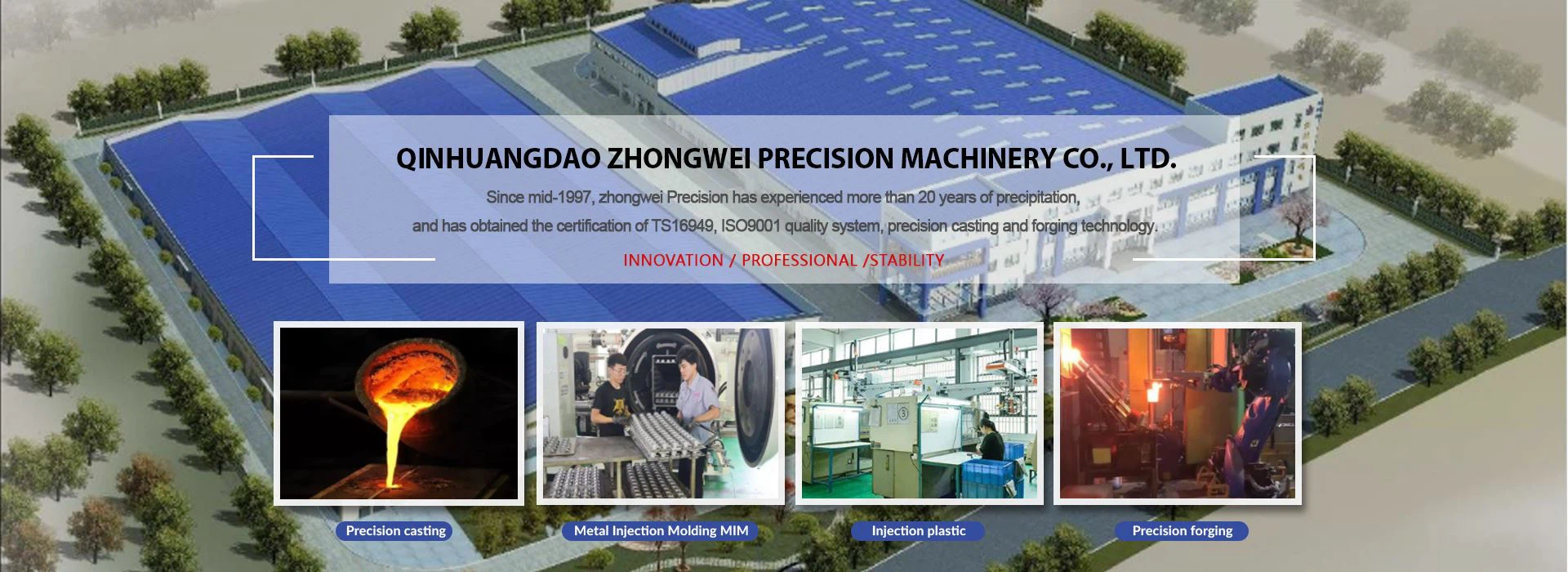
Qinhuangdao Zhongwei Precision Machinery Co., Ltd. is an enterprise specializing in forging, processing and production of forgings. Products can be produced according to drawings and chemical compositions, and the integration of free forging, die forging, rough machining, heat treatment and finishing is completed. Long-term cooperation with crane, petroleum, chemical, mining, metallurgy, hydraulic, coking, train, construction machinery and other enterprises.
Product Dsecription
1. Implementation standards: the company strictly implements ISO9001, ISO14001, IATF16949 certification
The products have passed the certification of ROHS, FDA EU, etc.
2. Product material standards: ISO, GB, ASTM, SAE, EN, DIN, BS, AMS, JIS, ASME, DMS, TOCT, GB
3. Main process: cold forging, hot forging, free forging, fetal membrane forging, die forging and special die forging. And has die casting process, investment casting, shell casting, deburring, sand blasting, machining, heat treatment, leak testing, surface treatment, etc.
4. Forging available materials:
Copper, titanium alloy, high manganese steel, high chromium steel, high nickel steel, carbon steel, aluminum alloy, alloy steel, stainless steel, gray iron, cast iron, cast steel, etc. are customized according to customer requirements.
Product Category
1. According to the moving method of the billet, forging can be divided into free forging, closed die forging and closed upsetting.
Free forging. Using impact force or pressure to deform the metal between the upper and lower irons to obtain the required forgings, there are two types of manual forging and mechanical forging. Die forging is divided into open die forging and closed die forging, and can be divided into cold heading, roll forging, radial forging and extrusion, etc.
According to the deformation temperature, forging can be divided into hot forging. Between 300 and 800 ℃, it is called warm forging or semi-hot forging.
Product Features
Forging method After hot working deformation, due to the deformation and recrystallization of stainless steel, the coarse dendrites and columnar grains become equiaxed recrystallized structures with finer grains and uniform size, so that the original segregation, looseness, slag inclusion, etc. Compaction and welding improve mechanical properties.
It can ensure the mechanical properties and long service life of the parts. Die forging is used, which is unmatched by castings.
① Martensitic (20Crl3, 40Crl3, 14Crl7N12, etc.) stainless steel undergoes allotropic transformation in the process of heating and cooling. For this type of steel, there is no special requirement for the final-fire deformation.
②The formation of 8-ferrite should be avoided during forging and heating of martensitic stainless steel, because the appearance of ferrite will cause cracks in the forgings, and it is necessary to avoid overheating caused by excessive heating of the metal. Surface decarburization of forgings can cause excessive ferrite formation, so surface decarburization should be minimized.
③ Martensitic stainless steel is prone to cracking after forging. This is because martensite and carbide structures will appear during air cooling after forging, and the resulting internal stress is large, so it should be cooled slowly after forging, generally at about 200 ℃ sand Slow cooling in the pit or slag, and annealing should be carried out in time after being taken out from the sand pit to prevent breakage.
Various Stainless Steel Forgings temperatures, see table.
Stainless steel forging temperature | ||||||
Stainless steel type | Chemical Composition | Forging temperature | ||||
C | Cr | Ni | Warm up | Initial forging temperature | Final forging temperature | |
Austenitic stainless steel | <0.20 | 17~20 | 8~9 | 815 | 1175~1205 | 870~925 |
Ferritic stainless steel | >0.12 | 14~16 | 760 | 1040~1120 | 705~790 | |
Martensitic stainless steel | >0.15 | 12~14 | 815 | 1095~1150 | 870~925 | |
Post Casting Process
1. Heat treatment: annealing, carbonization, tempering, quenching, normalizing, surface tempering
2. Processing equipment: CNC, WEDM, lathe, milling machine, drilling machine, grinder, etc.;
3. Surface treatment: powder spraying, chrome plating, painting, sandblasting, nickel plating, galvanizing, blackening, polishing, bluing, etc.

Moulds and Inspection Fixtures
1. Mold service life: usually semi-permanent. (except for lost foam)
2. Mold delivery time: 10-25 days, (according to product structure and product size).
3. Tooling and mold maintenance: Zhongwei is responsible for precision parts.

Quality Control
1. Quality control: the defective rate is less than 0.1%.
2. Samples and trial run will be 100% inspected during production and before shipment, sample inspection for mass production according to ISDO standards or customer requirements
3. Testing equipment: flaw detection, spectrum analyzer, golden image analyzer, three-coordinate measuring machine, hardness testing equipment, tensile testing machine;
4. Provide after-sales service.

Application
1. Application of Stainless Steel Forgings in the shipbuilding industry:
Ships run in water for many years, especially in marine transportation. The working environment is harsh and corrosive. Therefore, stainless steel is widely used in ships. As early as the 1950s, speedboat propeller shafts have been forged with 20Crl3 type martensitic stainless steel, manufacture. Later, large ships began to use 06Crl7Nil2M02, austenitic stainless steel, 06Cr25Ni5Mo2 duplex stainless steel and 07Crl7Ni7Al precipitation hardening stainless steel to make propellers; ship engine exhaust systems were made of 06Crl7Nil2Mo2 steel; turbine blades were made of 12CrMo and 05Crl7Ni4Cu4Nb precipitation hardening steel; Made of Cr-Ni austenitic stainless steel; made of 06Crl9Nil0 and 06Crl7 steel for kitchen equipment; made of 06Crl8Ni9 and 06CH7 steel for transporting food, chemical tankers and refrigerated ship shells; Cr-Ni austenite with good low temperature performance for LNG carriers Made of stainless steel; minesweeper submarines are made of 022Cr21Nil7Mo2N and 022Cr22Nil3Mo3N steel; marine shafts and heat exchangers are made of 022Cr22Nil3Mo2N steel; patrol boat propellers, propulsion shafts, rudders, etc. are made of 06Cr25Ni6Mo3CuN steel.
2. Application of Stainless Steel Forgings in aerospace and aviation:
Aerospace and aviation have harsh environments and strong corrosiveness, so stainless steel is widely used in aerospace and aviation industries. Most parts on airplanes and spaceships are made of stainless steel. In the aerospace industry, austenitic stainless steel 06Crl8Ni9, 12Crl7Ni7, 06Crl8NillNb, 06Crl8Nil0Ti, 06Cr21Ni6Mn9N, etc. can be used for large liquid launch vehicles, high-strength low-temperature pressure vessels and low-pressure fluid vessels; exhaust passages around the engine, rocket fuel storage tanks and high-hardness parts (such as rods, claws, pins, etc.) can choose martensitic stainless steel 12Crl3, 20Crl3, 14Crl7Ni2 and 102Crl7Mo (9Crl8Mo) and so on.
In the aviation industry, a large number of precipitation hardening stainless steels are used in the mechanical system of the aircraft, such as 04Crl3Ni8Mo2Al, 05Crl5Ni5CuNb, 05Crl7Ni4Cu4Nb, AM350, A-286, etc. XB-70 large aircraft wing spars use 05Crl5Ni5CuNb steel. Austenitic stainless steel forgings such as 20Crl3Mn9Ni4 and 06Crl9Nil0NbN can be used in aero-engine exhaust manifolds, branch pipes, and turbo compressor hot air pipes, and Cr-Ni such as 12021 NiSTi can be used in aero-engine casings, rocket engine combustion chamber walls and aircraft parts. Duplex stainless steel replaces austenitic stainless steel such as 12Crl8Ni9Ti.


Send Inquiry
