




5G Base Station Isolator MIM Parts
The entire mobile communication system generally consists of three major parts: mobile communication infrastructure, mobile communication coverage system, and mobile communication terminal products (as shown in the figure).
Product Introduction
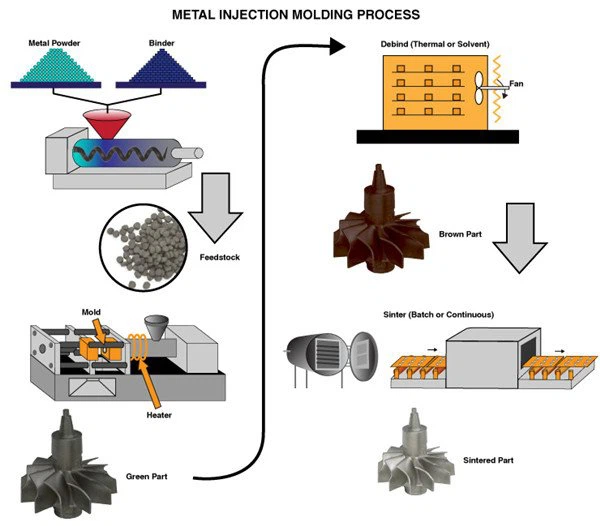
5G base station isolator MIM Parts | |||||||||
Item | Material | Production Process | Sintering Temperature | Mold | Custom | ||||
5G base station isolator | 316 | Metal Injection Molding | 1350°C-1500°C | To be customized | Yes | ||||
Chemical Composition | C:≤0.08 | ||||||||
Available Materials | Low carbon stainless steel, titanium alloy (Ti, TC4), copper alloy, tungsten alloy, hard alloy, high temperature alloy (718, 713) | ||||||||
Finish | Dimensional Accuracy | Product Density | Appearance Treatment | Appropriate Weight | |||||
Roughness 1~5μm | (±0.1%~±0.5%) | 92~95% | Mirror Reflection | 0.03g~400g) | |||||
Mechanical behavior | • 316 Annealed • 316L annealed • 316/316L spring tempered | ||||||||
Product Details
1. Base station core components
The entire mobile communication system generally consists of three major parts: mobile communication infrastructure, mobile communication coverage system, and mobile communication terminal products (as shown in the figure).

• The base station belongs to the basic equipment of mobile communication. A standard base station usually consists of iron towers, base station antennas, feeders and base station systems.
• Construct tall towers so that radio signals are received by base station antennas with minimal interference.
• The antenna converts received electromagnetic signals into alternating current.
• The feeder, also known as the cable, is the radio frequency transmission line that connects the base station antenna and the base station transceiver equipment. It can only transmit signals, but not process them.
• The base station system usually consists of RF front-end, base transceiver station and base station controller. Among them, the RF front-end is responsible for signal filtering and isolation, the base station transceiver is responsible for signal reception, transmission, amplification and reduction, and the base station controller is responsible for signal analysis, processing and base station control.
See the figure below for details.

• The tower top amplifier is an amplifier arranged on the antenna tower next to the antenna. Its main function is to expand the coverage of the signal, deepen the penetration depth of the signal, and improve the signal strength in areas with weak or no signal. The difficulty in its design is to adapt to harsh environments such as outdoor direct sunlight, wind, rain, lightning, and salt spray, and at the same time require high reliability due to difficult maintenance. This product is mainly composed of duplexer, low noise amplifier and AISG communication unit.
• Digital microwave can provide point-to-point mass data transmission within 50 km. In the base station system data return application, it plays the role of data connection between base stations or between base stations and communication networks. Compared with optical fiber interconnection, it has the advantages of flexible configuration, not limited by geographical conditions, quick network deployment, immediate installation and immediate communication.
• A filter is a frequency-selective device for radio frequency signals in mobile communication equipment, and is mainly used to filter out interference and clutter in the receiving or transmitting channel.

The duplexer is composed of a receiving filter and a transmitting filter, which realizes sharing of receiving/transmitting, and can reduce one antenna in the receiving/transmitting process, reducing the cost of the entire base station. The duplexer is a key component to separate the signals of the two parties in the communication process, filter out interference and clutter, and ensure that the voice of the other party can be heard clearly at the same time in an extremely crowded electromagnetic wave environment without intercom switching.

In addition to filters and duplexers, the RF subsystem also includes isolators, power dividers, combiners, couplers, VSWR alarms, low-noise amplifiers and other components.

• Isolator: Make the microwave signal transmitted in the forward direction pass with a small loss, and the microwave signal transmitted in the reverse direction cannot pass through.
• A power divider is a device that divides the energy of one input signal into two or more outputs with equal or unequal energy. A certain degree of isolation should be guaranteed between the output ports of a power divider.
• Combiner: Combine two or more input signals into one. The combiner is generally used at the transmitting end. Its function is to combine two or more radio frequency signals from different transmitters into one and send it to the antenna for transmission. RF devices, while avoiding the mutual influence between each port signal. A combiner generally has two or more input ports and only one output port.
• Standing wave ratio alarm: composed of directional coupler and detection control circuit, used to monitor the matching state of the antenna system, can indicate faults, and protect the system from equipment damage caused by excessive reflection.
• Low Noise Amplifier: After the weak signal received is filtered by a filter, it is linearly amplified for subsequent frequency conversion equipment and baseband processing. It has a certain frequency selection function and its own noise is small.
2. Base station processing mobile signal mechanism
The base station transmits the signal received from the mobile phone to the switching processing device, and the switching processing device sends it to the base station after processing, and then the base station sends it to the target mobile phone, and a communication is completed. A typical base station schematic diagram is as follows:

The mechanism of the base station processing mobile communication signals: For the communication signal uplink channel transmitted by the mobile phone and received by the base station: after the antenna of the main set (RXA and TX) and the antenna of the diversity (RXB) receive the transmitted signal of the mobile phone, it is amplified by the tower top amplifier The signal is transmitted to the integrated duplexer in the computer room, and the signal is filtered by the filter in the duplexer and then sent to the low noise amplifier for amplification through RXA (receiving port of the uplink channel) and RXB (diversity port of the uplink channel), and then amplified by the RF The /IF inverter converts the radio frequency signal into an intermediate frequency signal and sends it to the demodulation circuit for data (Data) demodulation. The data stream is processed by the baseband processing circuit and then transmitted by twisted pair (E1), microwave transmission outdoor unit (ODU) or optical cable. to the exchange processing device.
For the base station transmission, the downlink path of the communication signal received by the mobile phone: the signal sent by the switching processing device is processed by the baseband processing circuit and then transmitted to the modulator for signal modulation, and the modulated intermediate frequency signal is frequency shifted and converted by the IF/RF converter After the radio frequency signal is amplified by the power amplifier, it is sent to the transmission filter in the integrated duplexer for filtering through the TX (the transmission port of the downlink channel) after being combined, and then sent to the sky after being combined with other carriers by the alarm detection circuit. Feedback system for signal transmission.
Fundamental
The circulator is also called a circulator, and its notable feature is that it can transmit high-frequency signal energy in one direction. A general circulator has several ports, and the signal is transmitted to the next port sequentially according to the direction determined by the static bias magnetic field. It can only propagate along this determined direction and cannot be transmitted in reverse order. In view of this characteristic, the circulator is used for the isolation between the transmitted signal and the received signal, and is commonly used in the fields of radar, active electronically scanned antenna (AESA) array, satellite communication and telecommunications.
The principle of one-way transmission of the circulator is due to the use of ferrite gyromagnetic material. This material produces gyromagnetic properties (also known as tensor permeability properties) under the combined action of an external high-frequency wave field (measurement signal from a network analyzer) and a constant magnetic field.
It is this gyromagnetic property that causes the rotation of the polarization of electromagnetic waves propagating in ferrite (Faraday effect), and the strong absorption of electromagnetic wave energy (ferromagnetic resonance), precisely because ferrite isolators utilize electromagnetic waves in The Faraday rotation effect in which the plane of polarization rotates during transmission in a gyromagnetic ferrite material with an external DC magnetic field.
After proper design, the electromagnetic wave polarization plane is perpendicular to the grounding resistive board during forward transmission, so the attenuation is very small. During reverse transmission, the electromagnetic wave polarization plane is parallel to the grounding resistance board and is almost completely absorbed. Gyromagnetic phenomenon, make a junction circulator, and add a load (attenuation sheet) to any end of the circulator to form an isolator.
If two or more isolators and circulators are connected in series or in parallel, they are called ring isolation components. It has the characteristics of small size, wide frequency band and low insertion loss, so it is widely used.

In the wireless access network, the circulator is mainly used to isolate the output signal of the base station antenna from the input signal. For specific purposes, the circulator cooperates with other devices to achieve the following functions:
(1) Used as an antenna duplexer;
(2) Combined with BPF with rapid attenuation for splitting circuit;
(3) Connect the terminal resistor to the outside of the circulator as an isolator, that is, the signal is input and output from the designated port;
(4) Connect an external ATT and use it as a circulator with reflected power detection function.

Industry chain
The upstream and downstream industrial chains corresponding to circulators and isolators are shown in the figure below:
Upstream industry | Circulators and Isolators | Downstream industry |
Aluminum industry Silver industry Copper industry Machinery, electronic parts industry | Mobile communication base station RF device industry | Mobile communication Main equipment supplier |
Aluminum, silver, and copper are important raw materials in the manufacturing process of the radio frequency device industry, accounting for about 20% of the production cost. Fluctuations in raw material prices have a greater impact on the production costs of the radio frequency device industry. The supply of non-ferrous metals can guarantee the production needs of the industry. However, the formation of non-ferrous metal prices is mainly affected by the futures market, the industry has no bargaining power, and the price of related non-ferrous metal materials fluctuates greatly.
Due to the high concentration of the downstream communication equipment industry, the customer concentration of mobile communication base station radio frequency devices is relatively high. From the perspective of the distribution of global shares, the current global communication main equipment market has evolved from the original competition of more than a dozen heroes to the current four-legged competition pattern of Huawei, Ericsson, New Nokia, and ZTE.
Market size
The 5G key technology Massive MIMO (Multi Input Multi Output multiple input multiple output) channels doubled, resulting in a significant increase in the use of circulators. Theoretically, the spacing between antenna elements must be greater than half a wavelength, and the signal wavelength is inversely proportional to the spectrum.
China's 5G mainstream mid-frequency bands of 3.5GHz and 4.9GHz determine the higher wavelength and longer frequency, making it difficult to further miniaturize 5G network antenna products. Based on this, it can be reasonably speculated that 5G base stations will be dominated by 64-channel (64T64R) Massive MIMO, which is 8-16 times more than 4G 4T4R-FDD or 8T8R-TDD channels.
In the 5G era, the demand for circulators will increase significantly with the application of Massive MIMO. In the 4G era, the mainstream macro base station antenna solution is the 8T8R 8-channel solution; in the 5G era, the mainstream macro base station antenna solution may integrate a single-sided antenna with a 64-channel Massive MIMO solution, and in some scenarios a larger-scale antenna solution may be used. antenna array.
After calculation: in the 5G period, the market space of circulators at the domestic base station end is expected to reach 11.5 billion yuan. Assumptions and inferences for the calculation:
According to the frequency and networking method adopted by 5G, the number of 5G macro base stations will be 1.3-1.5 times that of the 4G period. Assuming that the construction rhythm of 5G base stations is similar to that of the 4G period, the construction of 5G macro base stations will be basically completed in 2025, and the total number of base stations will be 2025. Up to 5 million stations;
Each base station has 3 antenna sectors;
The mainstream antenna scheme is 64 channels. If a larger-scale antenna array is adopted in the future, the actual market space will be larger than the estimated value;
The circulator ensures the isolation between the output signal of the base station antenna and the input signal. The current value of a single-channel circulator is about 14 yuan. Referring to the declining gross profit rate of circulator manufacturers in the 4G period, the price of circulators has dropped at a certain speed.
In summary, it is estimated that within the construction period (2019-2025), the domestic 5G base station circulator market space is expected to reach 11.5 billion yuan, and the peak market size will reach 3 billion yuan.
Our Service
Pre-sale | Evaluate according to the drawings or products, calculate the price, and submit it to the buyer for confirmation. |
On sale | The production process of all products is supported by the production system, and they are delivered according to the mutually agreed time. (If the size of the drawing needs to be changed in the middle, the purchaser is responsible for the discrepancy with the original drawing. If the requirements are not met according to the drawing, Zhongwei Precision is responsible for the modification. If we fail to meet the customer's requirements during the modification process, a full refund will be issued) |
After sales | After the product is handed over, all the buyer's molds will be sealed and kept. |
Why choose Zhongwei Precision as a partner?
• Win with high-intensity R&D investment and professional management
Strong R&D capabilities, large R&D investment, and strong differentiated customization capabilities; the management and technical teams have more than 10 years of experience in powder metallurgy R&D, production, and sales; the company's products have spread throughout the Pearl River Delta and major domestic economic regions, and are sold overseas.
• Win with quality assurance
Production of various high-precision and complex mechanical hardware parts. Main business: copper base, iron base, stainless steel, powder metallurgy precision press molding (PM), precision dewaxing casting and injection molding (MIM), stainless steel and bronze powder porous sintered filter elements, etc.
• Win with timely delivery and logistics distribution capabilities
Adopt the quick response mechanism of placing an order and arranging production, and strive to complete the delivery in the fastest time. Greatly improve the production efficiency of your business! The company implements a door-to-door mechanism to make your business feel more intimate!
• Win with quality service
The backbone management team and technical team have many years of management experience, and at the same time have 10 years of experience in powder metallurgy research and development, production, quality, etc.; strive to achieve beyond the customer's expectations, from the customer's order to product delivery to the door, to provide customers with technical support, Data analysis and flexible and high-quality butler service!
• Win with reasonable price and cost-effective advantages
The concept of high-end products and mid-range prices is the core, and we insist on cost control from raw materials to the production process.
Provide customers with high-quality and reasonable prices, and surpass prices with value.
Process after sintering
1. Heat treatment: annealing, carbonization, tempering, quenching, normalizing, surface tempering
2. Processing equipment: CNC, slow wire cutting, lathes, milling machines, drilling machines, grinding machines, etc.;
3. Surface treatment: anodizing, powder spraying, chrome plating, painting, sandblasting, nickel plating, galvanizing, blackening, polishing, bluing, etc.
Mold and Gage
1. Mold service life: usually semi-permanent. (except lost foam)
2. Mold delivery time: 10-25 days, (according to product structure and product size).
3. Tooling and mold maintenance: Zhongwei is responsible for precision parts.
Quality Control
1. Quality control: The defective rate is less than 0.1%.
2. Samples and trial runs will be 100% inspected during production and before shipment, sample inspection for mass production according to ISDO standards or customer requirements
3. Testing equipment: flaw detection, spectrum analyzer, golden image analyzer, three-coordinate measuring machine, hardness testing equipment, tensile testing machine.




Send Inquiry
