




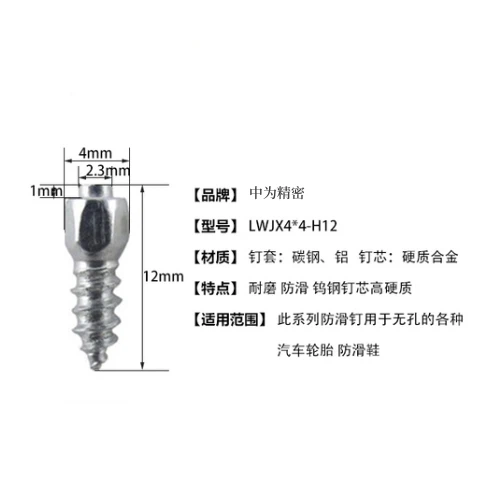


Bicycle Threaded Anti-skid Shoe Spikes Metal Injection Molding Parts
The threaded anti-skid spikes for perforated tires include standard threaded anti-skid spikes, large threaded anti-skid spikes, racing threaded anti-skid spikes and other series.

There are many types of anti-skid spikes, including anti-skid shoes and car tires.
The 6.5-1 series is universal for anti-skid shoes.
There are many types of snow tire anti-skid spikes. The flat head anti-skid spikes universal for perforated tires include 8-1 series, 9-1 series, 12-1 series, 8-11-2 series, 9-11-2 series, etc.
The threaded anti-skid spikes for perforated tires include standard threaded anti-skid spikes, large threaded anti-skid spikes, racing threaded anti-skid spikes and other series.
Research progress of cemented carbide MIM technology
As early as 1977, Curry obtained a patent for cemented carbide injection molding technology using paraffin as a binder, which was later transferred to Leco Company and became the Leco process. However, due to the fact that the single-component paraffin as a binder will lead to a long degreasing time and easy to produce defects, the scope of influence of this patent is not large. However, after entering the 1980s, with the breakthrough progress of MIM technology in binder formulation, degreasing technology, etc., it provided strong technical support for the increasing maturity of cemented carbide injection molding technology. Coupled with the unique advantages of cemented carbide injection molding technology itself, a group of manufacturers and research institutions engaged in cemented carbide injection molding production and research have emerged worldwide since the early 1980s.
A branch of Leco Carbide Company of the United States, the company is the first company to produce cemented carbide products by injection molding. The company uses two methods to produce WC-based cemented carbide, one is the traditional pressing-sintering method, and the products account for 60% of sales; the other is the new cemented carbide injection molding method (Cemented Carbide Injection Molding), and the products account for 40% of sales. The weight of CCIM products produced by the company is in the range of 0.3-2kg, and the maximum product diameter is 10.59 inches. It is said that the company is currently the largest cemented carbide injection molding product manufacturer in the world. Degussa of Germany began MIM research in the 1980s and officially launched products in 1986. They use a mixture of thermoplastics such as polyethylene, polypropylene, polystyrene, wax, resin and other special additives as a forming agent, mix it with WC-Co alloy powder of about 0.8μm, and then granulate, injection mold, remove the binder and finally sinter. This company is mainly engaged in the production of feed racks and cutting tools as a whole or cutter head. Now they can produce small batches of multiple varieties and multiple materials according to user requirements. The largest product volume is 1000cm3, the longest is 100mm, the heaviest is about 100g, the product deviation is ±0.3%, the thickness is 1-5mm, and the final density can reach more than 95% of the theoretical density. In addition, Forn Physics Company produces tungsten carbide-based cemented carbide rotary chisels, which use a binder of more than two components. The first component is extracted and removed by chemical solvents, and the remaining thermoplastic binder is removed during sintering. Many other manufacturers, such as Singapore Phimax, IBM, Shandong Jinzhu Powder Injection Manufacturing Co., Ltd., Shanghai Fuchi High-tech Co., Ltd., Qingdao Tongxiang Special Powder Metallurgy Co., Ltd., Beijing Iron and Steel Research Institute, and Central South University Powder Metallurgy Institute, have invested in the research and production of CCIM technology, and the output value is steadily increasing.
The Institute of Polymer Technology and Materials Engineering at Loughborough Polytechnic University in the UK has been studying cemented carbide injection molding technology since 1985 with the support of the British Science and Engineering Research Council, the British Cemented Carbide Association and the British Nonferrous Metals Technology Center. The focus is on powder properties, binder technology, mixing, rheology, flow and deformation, ejection speed, sintering and molded product integrity. The research involves many related fields. The following are their research results [39], which also represent the main achievements in the past CCIM technology research.
(1) Due to the poor rheological properties of cemented carbide powder, it is not suitable to use a mixture with a volume percentage of cemented carbide powder higher than 65% for injection molding;
(2) Polar waxes, mainly lignite ester waxes, can be used to produce mixtures with higher volume percentages of powder that meet the requirements due to their rheological properties suitable for powder injection molding. This type of wax also has favorable volatility kinetics, which can be carried out under controlled degreasing operations, while the less polar paraffin waxes tend to segregate from the lower volume percentage mixture under the influence of shear stress. The use of crystalline lignite ester waxes also has a tendency to produce cracks in the molded blank, but this can be adjusted by mixing different types of waxes in appropriate proportions;
(3) High shear melt mixing technology can most effectively produce a uniform mixture;
(4) The formability of various formulations was effectively evaluated by analyzing the rheological behavior and the apparent activation energy of viscous flow. Process parameters that affect temperature have a significant effect on formability. The design of the mold plays a key role in the integrity of the formability. Avoid the formation of injection behavior during mold filling, otherwise it is easy to produce injection defects;
(5) The degreasing atmosphere has a key influence on the microstructure of the sintered product. Inert atmosphere produces serious carbon defects, while reducing atmosphere can make the sintered product have a clearer microstructure;
(6) The shrinkage after sintering is related to the mold geometry and injection pressure, but the shrinkage is consistent in each batch of formed products. The general linear shrinkage rate is 17%, but it is not isotropic. The reason may be that the gradient of the pressure field and temperature field in the mold cavity during forming should play a role. The density of the sintered product is greater than 99% of the theoretical density.
Mu-Jen-Yang et al. of Pennsylvania State University in the United States also systematically carried out research on cemented carbide injection molding technology, and achieved phased results in the injection molding technology of nano and ultrafine cemented carbide powders, and found a more suitable way to increase the loading capacity of cemented carbide powders.
MIM is the abbreviation of Metal Injection Molding, which is a near-net-shape molding technology that injects metal powder into a mold after mixing and kneading with a binder. Zhongwei Precision MIM Project was established in 2003, mainly engaged in the research and development and production of tungsten alloy MIM and titanium alloy MIM. As the project continues to grow, production lines for metals such as stainless steel have been added. At present, the project has MIM processing platforms and production lines for tungsten alloy, stainless steel, iron-based alloy, copper alloy, soft magnetic material, non-magnetic steel and other materials, as well as sintering equipment such as atmosphere-protected push plate furnace and vacuum furnace, with a monthly production capacity of more than 50 million pieces.
Bicycle threaded anti-skid shoe spikes metal injection molding parts



Send Inquiry
