



Anti-skid And Wear-resistant Spikes For Motorcycles Metal Injection Molding Parts
Ultrafine W-Cu composite powder is used as a liner material, and its Cu content needs to be optimized through experiments and numerical calculations. As a preliminary exploratory study on liner materials, this paper selected W-25Cu for research. In W-25Cu composite powder, Cu accounts for 42% by volume, and high copper content is crucial as a tough matrix in the formation of W-Cu particle jet.

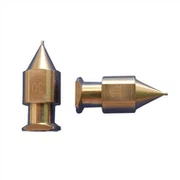
There are many types of anti-skid spikes, including those for anti-skid shoes and car tires.
The 6.5-1 series is universal for anti-skid shoes.
There are many types of snow tire anti-skid spikes. The flat head anti-skid spikes universal for perforated tires include 8-1 series, 9-1 series, 12-1 series, 8-11-2 series, 9-11-2 series, etc.
The threaded anti-skid spikes for perforated tires include standard threaded anti-skid spikes, large threaded anti-skid spikes, racing threaded anti-skid spikes and other series.
Ultrafine W-Cu composite powder is used as a liner material, and its Cu content needs to be optimized through experiments and numerical calculations. As a preliminary exploratory study on liner materials, this paper selected W-25Cu for research. In W-25Cu composite powder, Cu accounts for 42% by volume, and high copper content is crucial as a tough matrix in the formation of W-Cu particle jet.
A paraffin-polymer system is selected as a binder for W-25Cu ultrafine composite powder injection molding feed, in which the mass fraction of paraffin accounts for 51%, polypropylene 30%, polyethylene 16%, and stearic acid 3%. The XS-300 torque rheometer of Shanghai Kechuang Company is used to determine the volume fraction of metal powder in the mixture, in which the stirring temperature in the chamber is set to 155 ℃ and the screw speed is 60 r/min. Considering the poor fluidity of W-25Cu composite powder, 875 g W-25Cu composite powder and 80 g binder was added to the stirring chamber of the torque rheometer to make the initial volume fraction of metal powder 40%. After that, the volume fraction was increased by 1% each time by precisely controlling the amount of metal powder added until the stirring torque was unstable or increased sharply.
The mixed W-25Cu feed with a volume fraction of 50% of the metal powder was injected into the mold to prepare the tensile specimen. The specimen design was based on ISO 2740:2009 standard. The specimens were molded using the Allrounder 360S injection molding machine of Arburg Company in Germany. The injection molded specimens were solvent degreased and thermally degreased in turn [11]. Among them, 49.2% (mass fraction) of the binder was removed from the molded specimens after 10 h of solvent degreasing in a heptane atmosphere at 37 °C. The thermal degreasing process in a hydrogen atmosphere was as follows: the temperature was raised to 500 °C at a heating rate of 1.5 °C/min for 90 min, and then the temperature was raised to 900 °C at a heating rate of 2 °C/min and kept at a temperature of 90 min. The degreased specimen was sintered in another sintering furnace, with a sintering peak temperature of 1 200 ℃, 120 min of heat preservation, a heating rate of about 5 ℃/min, and a sintering atmosphere of hydrogen. The tensile strength of the sintered parts was tested, and their microstructure was studied by SEM.
After the above MIM process, the W-25Cu ultrafine composite powder liner was prepared according to the pre-design.
MIM is the abbreviation of Metal Injection Molding, which is a near-net-shape molding technology that injects metal powder into a mold after mixing and kneading with a binder. Zhongwei Precision MIM Project was established in 2003, mainly engaged in the research and development and production of tungsten alloy MIM and titanium alloy MIM. As the project continues to grow, production lines for metals such as stainless steel have been added. At present, the project has MIM processing platforms and production lines for tungsten alloy, stainless steel, iron-based alloy, copper alloy, soft magnetic material, non-magnetic steel and other materials, as well as sintering equipment such as atmosphere protection push plate furnace and vacuum furnace, with a monthly production capacity of more than 50 million pieces.




Send Inquiry
