



FGS370-17 Ductile Iron Castings
Pig iron is an iron-carbon alloy with a carbon content of more than 2%, and the carbon content of industrial pig iron is generally 2.11%-4.3%, and contains C, Si, Mn, S, P and other elements, which is the product of smelting iron ore by blast furnace.
Product Introduction
|
FGS370-17 Ductile iron castings |
|||||||
|
Item |
Material |
Production Process |
Sintering Temperature |
Mold |
Custom |
||
|
FGS370-17 Ductile iron castings |
FGS370-17 |
Molten mold casting |
1380℃ |
To be customized |
Yes |
||
|
Available Materials |
Carbon steel, alloy steel, aluminum alloy, low -carbon stainless steel, titanium alloy (TI, TC4), copper alloy, high temperature alloy (718, 713) |
||||||
|
Smoothness |
Dimensional accuracy |
Product density |
Appearance treatment |
Appropriate weight |
|||
|
Roughness 1~5μm |
(±0.1%~±0.5%) |
7.3-7.6/CM³ |
According to customer requirements |
0.03g~400g |
|||
FGS370-17 lost wax investment casting of ductile iron
Pig iron is an iron-carbon alloy with a carbon content of more than 2%, and the carbon content of industrial pig iron is generally 2.11%-4.3%, and contains C, Si, Mn, S, P and other elements, which is the product of smelting iron ore by blast furnace. According to the different forms of carbon in pig iron, it can be divided into steelmaking pig iron, cast pig iron and ductile iron. The properties of pig iron are hard, wear-resistant and good castability, but the pig iron is brittle and cannot be forged.
1. Pig iron is an iron-carbon alloy with a carbon content greater than 2.11%, and the carbon content of industrial pig iron is generally 2.11%--4.3%, and contains C, Si, Mn, S, P and other elements. It is a product of iron ore smelting by blast furnace. According to the different forms of carbon in pig iron, it can be divided into steelmaking pig iron and casting pig iron.
(1) The silicon content of steelmaking pig iron is low, generally not more than 1.75%. It is the main raw material of open-hearth and converter steelmaking, accounting for 80% to 90% of pig iron production. Steelmaking pig iron is hard and brittle, iron and carbon are in a combined state, in the form of cementite (Fe3C), and its fracture is silver-white, so it is also called white iron. Roll, pear share iron and so on are white iron.
(2) The silicon content of cast iron is very large, generally 1.25% to 3.6%. Due to its low melting point and good fluidity, it is commonly used to cast various castings, so it is also called cast iron. The carbon in cast iron exists in the form of graphite, and its fracture is gray, soft and easy to cut, so it is also called gray cast iron. Such as the bed, box, pipe, pipe fittings and various connectors are made of cast pig iron.
2. Classification: Pig iron is an iron-carbon alloy with a carbon content of 2.11%-6.69% and contains more non-iron impurities. It can be refined into steel by reducing the carbon content. The impurity elements of pig iron are mainly silicon, sulfur, manganese, phosphorus and so on. Raw iron is hard and brittle, lack of toughness, almost no plastic deformation ability, so it can not be processed by forging, rolling, drawing and other methods. However, the casting and cutting properties of pig iron (gray iron) with high silicon content are good. Pig iron is a blast furnace product, according to its use can be divided into steelmaking pig iron and casting pig iron two categories. It is customary to call steelmaking pig iron pig iron, casting pig iron referred to as cast iron. Casting pig iron through forging, metamorphism, nodulation and other methods can change its internal structure, improve and improve its mechanical properties, therefore, casting pig iron can be divided into white cast iron, gray cast iron, malleable cast iron, ductile cast iron and special cast iron and other varieties.
Pig iron can also be divided into ordinary pig iron and alloy pig iron, the former including steelmaking pig iron and cast pig iron, the latter is mainly ferro manganese and ferrosilicon. Alloy pig iron is used as an auxiliary material for steelmaking, such as deoxidizer and alloying element additive. Ordinary pig iron accounts for more than 98% of blast furnace smelting products, and refined steel accounts for more than 80% of China's ordinary pig iron, with the improvement of the level of industrialization, this proportion will gradually increase.
In a broad sense, iron is also divided into chemical pure iron (containing almost zero C), industrial pure iron (containing less than 0.0218% C), and sponge iron, granular iron and so on. However, they are not blast furnace iron smelting products, and their uses are different. When the C content in iron is in the range of 0.03%-1.2%, it is steel, and the iron containing C1.2%-2.5% is not practical, and it is generally not used for industrial production.
Pig iron properties: pig iron is hard, wear-resistant, good castability, but pig iron is brittle and cannot be forged.
In addition to iron, pig iron also contains carbon, silicon, manganese, phosphorus and sulfur and other elements.
3. Characteristics: The carbon in the pig iron is mainly in the form of iron carbide, and its cross section is white, usually called white iron. This kind of pig iron is hard and brittle, and is generally used as a raw material for steelmaking.
The carbon in cast pig iron exists in the form of flake graphite, and its fracture is gray, usually called gray iron. Due to the soft graphite and lubricating effect, cast pig iron has good cutting, wear resistance and casting properties. However, its tensile strength is not enough, so it can not be forged and rolled, and can only be used to manufacture various castings, such as casting various machine tool beds, iron pipes and so on.
The carbon in ductile iron exists in the form of spherical graphite, its mechanical properties are far better than gray iron and close to steel, it has excellent casting, cutting and wear resistance, has a certain degree of elasticity, widely used in the manufacture of crankshaft, gear, piston and other advanced castings and a variety of mechanical parts.
In addition, there are pig iron containing silicon, manganese, nickel or other elements with a particularly high amount, called alloy pig iron, such as ferrosilicon, ferromanganese, etc., commonly used as raw materials for steelmaking, adding some alloy pig iron in steelmaking can improve the performance of steel.
Zhongwei Precision has the following services
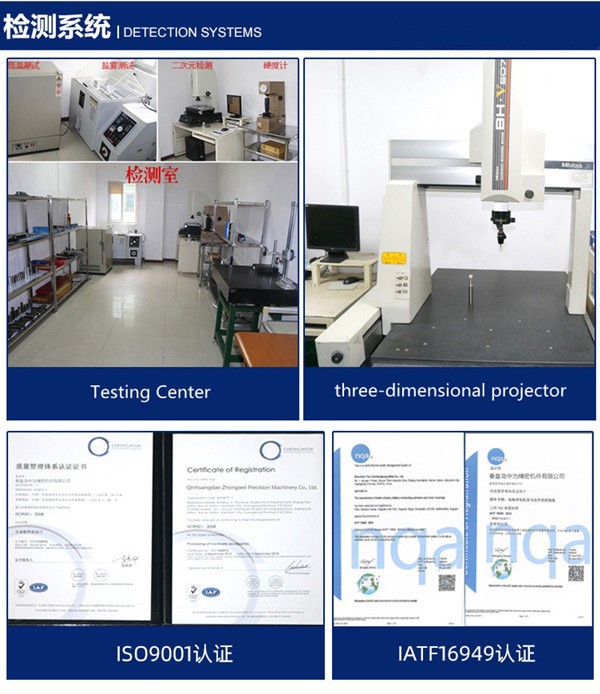
Detection Systems
Copper Silica Sol Investment Casting


We are the manufacturer of "FGS370-17 Ductile iron castings", if you need more information please contact us!


Send Inquiry
