



Carbon Steel Lost Wax Castings
Carbon cast steel is a kind of steel material, and carbon is the main element that affects the mechanical properties of carbon cast steel. With the increase of carbon content, both the yield point and tensile strength of carbon cast steel increased, and the tensile strength increased more than the yield point.
Carbon cast steel is a kind of steel material, and carbon is the main element that affects the mechanical properties of carbon cast steel. With the increase of carbon content, both the yield point and tensile strength of carbon cast steel increased, and the tensile strength increased more than the yield point. In addition, as the carbon content increases, the ductility and toughness of carbon cast steel decrease. When the carbon content in carbon cast steel exceeds 0.45%, the yield point rises very little, while the ductility and toughness decrease significantly. As the carbon content increases, the solidification temperature of Carbon Steel Lost Wax Castings decreases, and the fluidity and casting properties of molten steel become better.
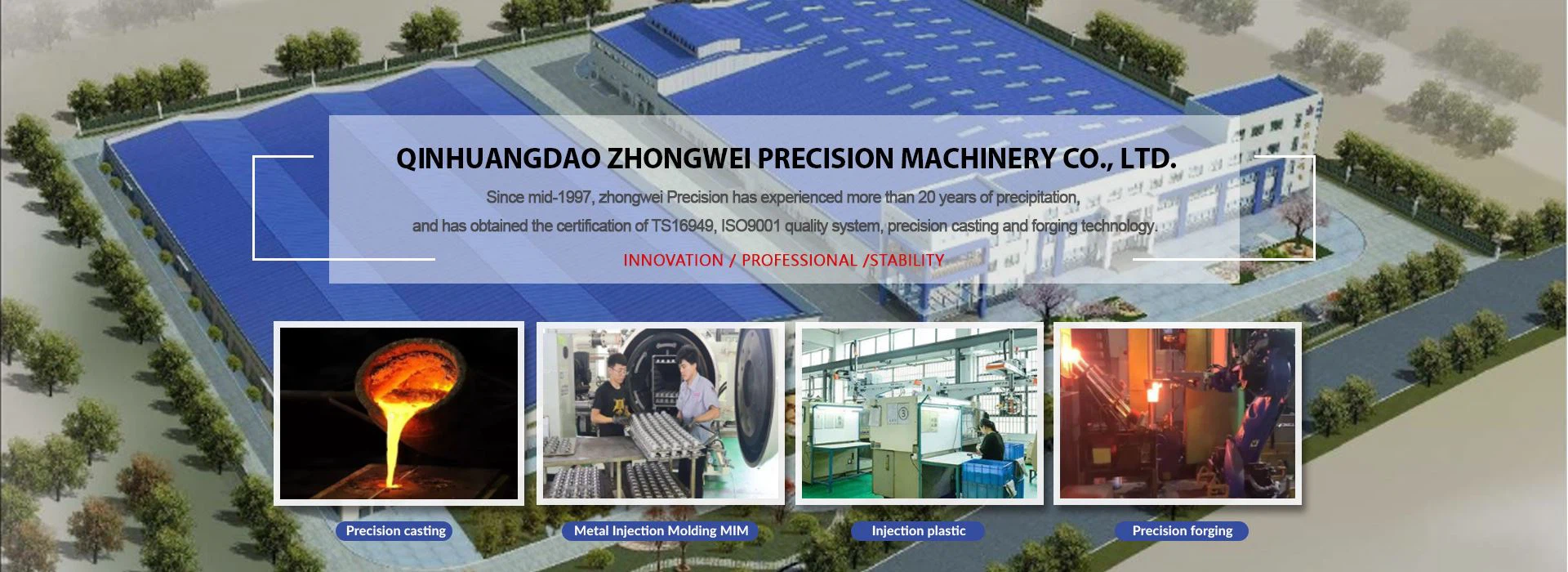
After more than ten years of precipitation, Qinhuangdao Zhongwei Precision Machinery Co., Ltd. has rich production experience in water glass lost wax precision casting, lost foam precision casting technology, silica sol precision casting technology, and shell sand casting technology. We expect manufacturers from all over the world to consult and negotiate business.
Product Description
Carbon Steel Lost Wax Castings Basics
1. Implementation standards: The company strictly implements ISO9001 & TS 16949 certification.
2. Product material standards: ISO, GB, ASTM, SAE, ISO, EN, DIN, JIS, BS
3. Main processes: sand casting, silica sol investment casting, water glass investment casting,shell casting,deburring, sand blasting, machining, heat treatment, leak testing, surface treatment, etc.
4. Properties:
Application range: mining machinery, metallurgical machinery, rolling stock
ZG200-400: base, gearbox housing
ZG230-450: Bearing caps, various shells, valve bodies, etc.
ZG270-500: rolling stand, bearing housing
ZG310-570: roller, cylinder block, large gear
ZG40Cr1: High-strength gear and high-strength shaft
High manganese steel, high chromium steel, high nickel steel, carbon steel, alloy steel, stainless steel, gray iron, cast iron, cast steel, cast aluminum, cast copper, etc. can be customized according to customer requirements.
Carbon Steel Lost Wax Castings National Grades
High quality carbon structural steel
Item | China | U.S | Japan | Germany | International Organization for Standardization |
GB | ASTM | JIS | DIN、DINEN | ISO 630 | |
Grade | Grade | Grade | Grade | -- | |
High quality carbon structural steel | 08F | 1008 | SPHD; | -- | -- |
10 | 1010 | S10C; | CK10 | C101 | |
15 | 1015 | S15C; | CK15; | C15E4 | |
20 | 1020 | S20C; | C22 | -- | |
25 | 1025 | S25C; | C25 | C25E4 | |
40 | 1040 | S40C; | C40 | C40E4 | |
45 | 1045 | S45C; | C45 | C45E4 | |
50 | 1050 | S50C | C50 | C50E4 | |
15Mn | 1019 | -- | -- | -- |

Production Process
Carbon Steel Lost Wax Castings Technology and Process For machine parts that require higher strength, plasticity and toughness, steel castings are required. The output of steel castings is second only to cast iron, accounting for about 15% of the total output of castings.
1. Classification
According to the chemical composition, cast steel can be divided into two categories: carbon cast steel and alloy cast steel. Among them, carbon cast steel is the most widely used, accounting for more than 80% of the total output of cast steel.
(1) Carbon cast steel
In general, low-carbon steel ZG15 has a high melting point and poor casting performance, and is only used to manufacture motor parts or carburized parts; medium-carbon steel ZG25~ZG45 has comprehensive properties higher than various types of cast iron, that is, high strength, excellent Therefore, it is suitable for the manufacture of parts with complex shapes and high strength and toughness requirements, such as train wheels, forging hammer frames and anvils, rolls and high-pressure valves, etc. It is the most widely used type of carbon cast steel; High carbon steel ZG55 has a low melting point, and its casting performance is better than that of medium carbon steel, but its plasticity and toughness are poor, and it is only used to manufacture a few wear-resistant parts.
(2) Alloy cast steel
According to the total amount of alloying elements, alloy cast steel can be divided into two categories: low alloy steel and high alloy steel.
1) Low alloy cast steel, manganese series, manganese silicon series and chromium series are mainly used in my country. Such as ZG40Mn, ZG30MnSi1, ZG30Cr1MnSi1 and so on. It is used to manufacture parts such as gears, hydraulic press working cylinders and hydraulic turbine rotors, while ZG40Cr1 is often used to manufacture important stress parts such as high-strength gears and high-strength shafts.
2) High alloy cast steel with special properties such as wear resistance, heat resistance or corrosion resistance. Such as high manganese steel ZGMn13, is a kind of anti-wear steel, mainly used to manufacture parts used under dry friction working conditions, such as the front wall of the grab bucket and the bucket teeth of the excavator, the crawler of the tractor and the tank, etc.; chrome-nickel stainless steel ZG1Cr18Ni9 and chromium stainless steel ZG1Cr13 and ZGCr28 have high corrosion resistance to nitric acid, and are mainly used in the manufacture of chemical, petroleum, chemical fiber and food equipment parts.
2. Process characteristics
Casting process characteristics of cast steel The mechanical properties of cast steel are higher than that of cast iron, but its casting performance is worse than that of cast iron. Because of the high melting point of cast steel, the molten steel is easy to oxidize, the fluidity of molten steel is poor, and the shrinkage is large. The volume shrinkage rate is 10~14%, and the linear shrinkage is 1.8~2.5%. In order to prevent defects such as insufficient pouring, cold isolation, shrinkage cavity and shrinkage porosity, cracks and sand sticking in steel castings, more complex technological measures than cast iron must be taken:
(1) Due to the poor fluidity of molten steel, in order to prevent cold insulation and insufficient pouring of steel castings, the wall thickness of steel castings should not be less than 8mm; the structure of the pouring system should be simple, and the section size is larger than that of cast iron; dry casting is used. Mold or hot casting mold; appropriately increase the pouring temperature, generally 1520 ° ~ 1600 ° C, because the pouring temperature is high, the superheat of the molten steel is large, and the liquid remains for a long time, and the fluidity can be improved. However, if the pouring temperature is too high, it will cause defects such as coarse grains, thermal cracking, pores and sticky sand. Therefore, for small, thin-walled and complex-shaped castings, the pouring temperature is about the melting point of steel + 150 °C; the pouring temperature of large and thick-walled castings is about 100 °C higher than the melting point.
(2) Since the shrinkage of cast steel greatly exceeds that of cast iron, in order to prevent shrinkage cavities and shrinkage porosity defects in castings, measures such as risers, cold iron and subsidies are mostly used in the casting process to achieve sequential solidification. In addition, in order to prevent shrinkage cavities, shrinkage porosity, pores and cracks in steel castings, the wall thickness should be uniform, sharp and right-angle structures should be avoided, sawdust should be added to the casting sand, coke should be added to the core, and Use hollow cores and oil sand cores to improve the concession and air permeability of sand or cores.
The melting point of cast steel is high, and the corresponding pouring temperature is also high. The interaction between molten steel and casting material at high temperature is very easy to produce sticky sand defects. Therefore, artificial quartz sand with higher refractoriness should be used as the mold, and the coating made of quartz powder or zirconium sand powder should be brushed on the surface of the mold. In order to reduce the source of gas, improve the fluidity of molten steel and the strength of the casting mold, most steel castings are cast with dry or quick-drying molds, such as water glass sand molds hardened by CO2.
3. Heat treatment of carbon steel castings
Steel castings should be used after heat treatment. Because there are casting defects such as pores, cracks, shrinkage cavities and shrinkage porosity, coarse grains, uneven structure and residual internal stress in the as-cast steel castings, the strength, especially the plasticity and toughness of the steel castings are greatly reduced. In order to refine grains, uniform structure and eliminate internal stress, steel castings must be normalized or annealed. Normalized steel has higher mechanical properties and lower cost than annealed steel, so it is widely used. However, since normalizing will cause greater internal stress than annealing, it is only suitable for steel castings with a carbon content of less than 0.35%. Because of the good plasticity of low carbon steel castings, it is not easy to crack when cooled. In order to reduce the internal stress, the steel castings should be tempered at high temperature after normalizing. For steel castings with carbon content ≥ 0.35%, complex structure and prone to cracks, only annealing treatment can be performed. Castings should not be quenched, otherwise they are easy to crack.
4. Melting of carbon cast steel
The smelting of cast steel generally adopts open hearth furnace, electric arc furnace and induction furnace. Open hearth is characterized by large capacity, can use scrap steel as raw material, can accurately control the composition of steel and can smelt high-quality steel and low-alloy steel. The three-phase electric arc furnace is easy to open and shut down, it can ensure the composition and quality of molten steel, the requirements for the charge are not very strict, and it is easy to heat up, so it can make high-quality steel, high-grade alloy steel and special steel. Common equipment for steel castings. In addition, a power frequency or medium frequency induction furnace can be used to smelt various high-grade alloy steels and steels with extremely low carbon content. The induction furnace has fast smelting speed, small burning loss of alloy elements, low energy consumption, and high quality of molten steel, that is, less impurities and less inclusions, and is suitable for small steel casting workshops.
Magnetic Discrimination
People often think that magnets attract stainless iron to verify its pros and cons and its authenticity. If it does not attract non-magnetic materials, it is considered to be good and genuine. If it is magnetic, it is considered to be counterfeit. In fact, this is an extremely one-sided, unrealistic and wrong identification method.
There are many kinds of stainless iron, which can be divided into several categories according to the organizational structure at room temperature:
1. Austenitic type: such as 304, 321, 316, 310, etc.;
2. Martensite or ferrite type: such as 430, 420, 410, etc.;
The austenitic type is non-magnetic or weakly magnetic, and the martensite or ferrite is magnetic.
Post Casting Process
1. Heat treatment: annealing, carbonization, tempering, quenching, normalizing, surface tempering
2. Processing equipment: CNC, WEDM, lathe, milling machine, drilling machine, grinder, etc.;
3. Surface treatment: powder spraying, chrome plating, painting, sandblasting, nickel plating, galvanizing, blackening, polishing, bluing, etc.

Moulds and Inspection Fixtures
1. Mold service life: usually semi-permanent. (except for lost foam).
2. Mold delivery time: 10-25 days, (according to product structure and product size).
3. Tooling and mold maintenance: Zhongwei is responsible for precision parts.
Quality Control
1. Quality control: the defective rate is less than 0.1%.
2. Samples and trial run will be 100% inspected during production and before shipment, sample inspection for mass production according to ISDO standards or customer requirements
3. Testing equipment: flaw detection, spectrum analyzer, golden image analyzer, three-coordinate measuring machine, hardness testing equipment, tensile testing machine;
4. Provide after-sales service.
5. The quality can be traced back.
Application
Carbon steel for casting. Carbon Steel Lost Wax Castings are widely used in mining machinery, metallurgical machinery, rolling stock, ships, hydraulic presses, turbines and other large steel parts and other steel parts with complex shapes.


Send Inquiry
