



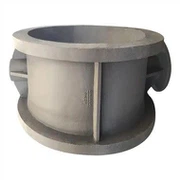
Armored Vehicle Water Glass Lost Wax Casting
On the basis of manganese boron cast martensite + bainitic steel, solid solution strengthening alloy elements are added, carbon content is appropriately increased, strength is increased, and wear resistance is improved, while maintaining a certain toughness to meet the requirements of track shoe fatigue toughness.
Armored vehicle water glass lost wax casting:Tracks should have high strength and high wear resistance. At present, most tanks use cast high-manganese steel track shoes. High-manganese steel is austenitic and suitable for use under higher impact conditions, and the hardness is increased through work hardening. The average service life of such track shoes is about 3700km.
On the basis of manganese boron cast martensite + bainitic steel, solid solution strengthening alloy elements are added, carbon content is appropriately increased, strength is increased, and wear resistance is improved, while maintaining a certain toughness to meet the requirements of track shoe fatigue toughness. Casting, after heat treatment, the tensile strength reaches 1550 MPa; the yield strength reaches 1260 MPa; the elongation reaches: 8.8%; the U-notch impact toughness reaches: 40J/cm2. The life of such track shoes is expected to exceed 6000km.
Product Description
Bucket tooth water glass lost wax castingBasic situation
1. Implementation standards: The company strictly implements ISO9001 & TS 16949 certification.
2. Product material standards: ISO, GB, ASTM, SAE, ISO, EN, DIN, JIS, BS
3. Main processes: sand casting, silica sol investment casting, water glass investment casting,shell casting,deburring, sand blasting, machining, heat treatment, leak testing, surface treatment, etc.
4. Available materials:
High manganese steel, high chromium steel, high nickel steel, carbon steel, alloy steel, stainless steel, gray iron, cast iron, cast steel, cast aluminum, cast copper, etc. can be customized according to customer requirements.
Lost Wax Casting Process
The main processes and processes in the shell making process of lost wax castings are:
1) Degreasing and degreasing of modules
In the case of wax-based molding compounds, in order to improve the ability of the coating to wet the surface of the module, the oil on the surface of the module needs to be removed.
2) Coating and sanding on the module
Before the paint is applied, the paint should be mixed evenly, the precipitation of the refractory material in the paint bucket should be minimized, and the viscosity or specific gravity of the paint should be adjusted to the investment casting process.
The coating fills and wets the investment mold well. When the paint hangs, the module is dipped into the paint and shakes left and right so that the paint can well wet the mould and cover the module surface evenly. After painting, it can be sanded.
3) Shell drying and hardening
After each coat of shell is applied, it is dried and hardened, allowing the binders in the coating to change from sols to gels and gels and to join the refractories together.
4) Investment losses from self-shell
After the shell is fully hardened, the module needs to be melted from the shell. This process is also known as dewaxing, as modules are usually made from wax-based molding materials. Depending on the heating method, there are many dewaxing methods, and the hot water method and the same pressure steam method are used more.
5) Baked shell
If a mold (sand filling) is required, before baking, the demolded mold is buried in the sand in the box, and then calcined. If the shell has high temperature strength and does not require casting, the demolded shell can be sent directly to the furnace for baking. During roasting, the furnace temperature is gradually increased, and the shell is heated to 800-1000°C for a period of time for casting.
Commonly used casting methods in investment casting are
1) There are several types of hot gravity casting methods.
This is the most widely used form of casting, that is, after the shell is removed from the oven, it is dumped at high temperature. At this time, the metal cools slowly in the shell and can fill the mold with high fluidity, so that the casting can well replicate the shape of the cavity and improve the accuracy of the casting. However, slow cooling of the casting in hot castings leads to grain coarsening, which reduces the mechanical properties of the casting. When casting carbon steel castings, the surfaces of slower castings are also prone to oxidation and decarburization, thereby reducing the surface hardness, finish and dimensional accuracy of the casting.
2) Vacuum suction pouring
The shell is placed in a vacuum casting box, and the gas in the cavity is inhaled through the micro-holes in the shell, so that the liquid metal can better fill the cavity, replicate the shape of the cavity, and improve the casting accuracy. , preventing pores and pouring. Insufficient defects. This law has been applied abroad.
3) Crystallize under pressure
Place the case in a pressure tank for dumping. Immediately after completion, the pressure tank is closed and high pressure air or inert gas is introduced into the tank to solidify the casting under pressure to increase the density of the casting. Foreign pressure has reached 150atm.
4) Directional crystallization (directional solidification)
Some investment castings such as turbine blades, magnetic steel, etc., if their crystal structure is columnar crystals arranged in a certain direction, their working performance can be greatly improved, so the directional crystallization technology of investment casting is developing rapidly.

Post Casting Process
1. Heat treatment: annealing, carbonization, tempering, quenching, normalizing, surface tempering
2. Processing equipment: CNC, WEDM, lathe, milling machine, drilling machine, grinder, etc.;
3. Surface treatment: powder spraying, chrome plating, painting, sandblasting, nickel plating, galvanizing, blackening, polishing, bluing, etc.
Moulds and Inspection Fixtures
1. Mold service life: usually semi-permanent. (except for lost foam)
2. Mold delivery time: 10-25 days, (according to product structure and product size).
3. Tooling and mold maintenance: Zhongwei is responsible for precision parts.
Quality Control
1. Quality control: the defective rate is less than 0.1%.
2. Samples and trial run will be 100% inspected during production and before shipment, sample inspection for mass production according to ISDO standards or customer requirements
3. Testing equipment: flaw detection, spectrum analyzer, golden image analyzer, three-coordinate measuring machine, hardness testing equipment, tensile testing machine;
4. Provide after-sales service.
5. The quality can be traced back.




Send Inquiry
