



Copper Alloy Lost Wax Casting
Copper alloy is an alloy composed of pure copper as the matrix and one or several other elements added. According to the material formation method, it can be divided into cast copper alloy and deformed copper alloy.
Copper alloy is an alloy composed of pure copper as the matrix and one or several other elements added. According to the material formation method, it can be divided into cast copper alloy and deformed copper alloy. Cast copper alloys cannot be deformed by forging, extrusion, deep drawing and drawing. Cast copper alloy and deformed copper alloy can be subdivided into pure copper, brass, bronze and cupronickel for casting. Most cast copper alloys cannot be press worked, such as cast beryllium bronze and cast tin bronze (Cu5Sn5Zn5Pb), these alloys have extremely poor plasticity and cannot be press worked.
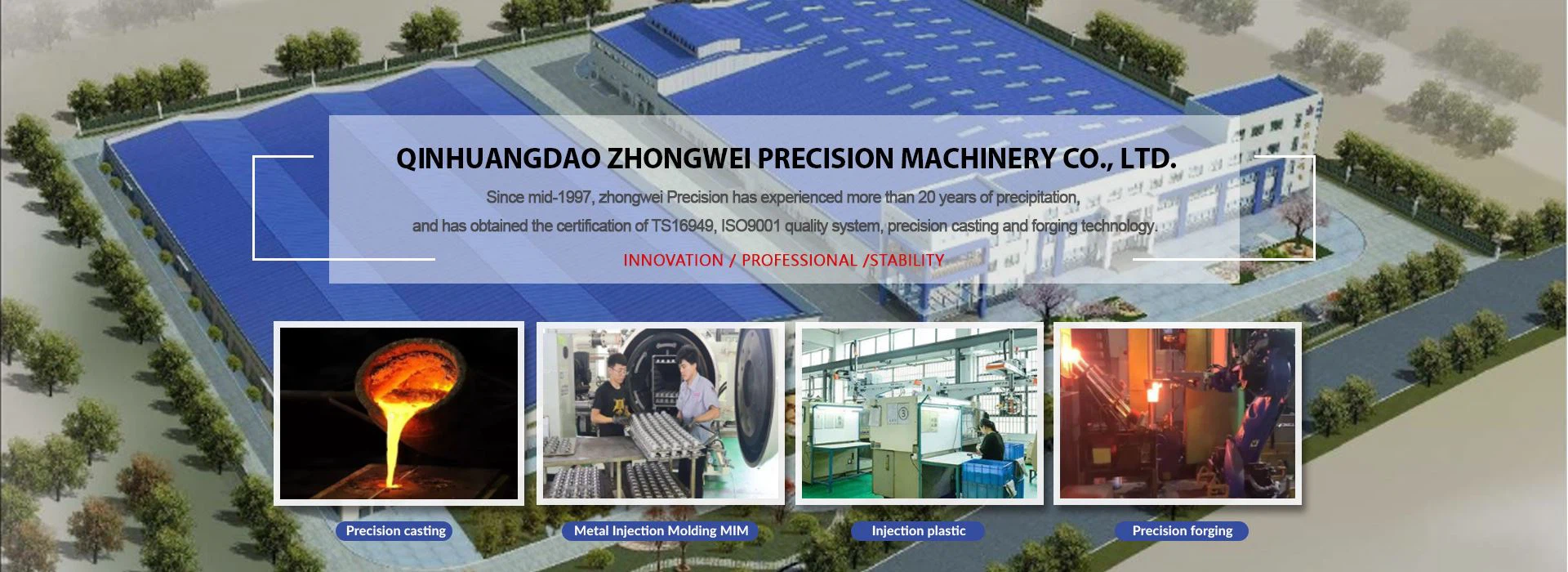
After more than ten years of precipitation, Qinhuangdao Zhongwei Precision Machinery Co., Ltd. has rich production experience in water glass lost wax precision casting, lost foam precision casting technology, silica sol precision casting technology, and shell sand casting technology. We expect manufacturers from all over the world to consult and negotiate business.
Product Description
Copper Alloy Lost Wax Casting Basic Information
1. Implementation standards: The company strictly implements ISO9001 & TS 16949 certification.
2. Product material standards: ISO, GB, ASTM, SAE, ISO, EN, DIN, JIS, BS
3. Main processes: sand casting, silica sol investment casting, water glass investment casting,shell casting,deburring, sand blasting, machining, heat treatment, leak testing, surface treatment, etc.
4. Available materials:
Cast copper, tin bronze, red copper, brass, silicon bronze, aluminum bronze, etc., high manganese steel, high chromium steel, high nickel steel, carbon steel, alloy steel, stainless steel, gray iron, cast iron, cast steel, cast aluminum And so on according to customer requirements.
Pure copper is commonly known as red copper. Its electrical conductivity, thermal conductivity, corrosion resistance and plasticity are excellent, but its strength and hardness are low, and it is expensive. Therefore, it is rarely used to make parts. Copper alloys are widely used in machinery.
Brass is a copper alloy with zinc as the main element. With the increase of zinc content, the strength and plasticity of the alloy increase significantly, but its mechanical properties will decrease significantly when it exceeds 47%, so the zinc content of brass is less than 47%. In addition to zinc, cast brass often contains alloying elements such as silicon, manganese, aluminum, and lead. The mechanical properties of cast brass are higher than those of bronze, but the price is lower than that of bronze. Cast brass is often used in general-purpose bearing bushes, bushings, gears and other wear-resistant parts and valves and other corrosion-resistant parts.

Product Performance
Alloys composed of elements other than copper and zinc are collectively referred to as bronze. Among them, the alloy of copper and tin is the most common bronze, called tin bronze. Tin bronze has low linear shrinkage and is not easy to produce shrinkage cavities, but it is easy to produce microscopic shrinkage. The addition of zinc, lead and other elements to tin bronze can improve the compactness and wear resistance of the casting, save the amount of tin, and add phosphorus for deoxidation. Its wear resistance and corrosion resistance are better than brass, but it is easy to produce micro-shrinkage, so copper alloy lost wax casting is suitable for wear-resistant and corrosion-resistant parts that do not require high compactness. In addition to tin bronze, aluminum bronze has excellent mechanical properties and wear and corrosion resistance, but its castability is poor, so it is only used for important wear and corrosion resistance parts.
Classification
Copper alloys can be divided into cast copper alloys and deformed copper alloys according to the method of material formation. In fact, many copper alloys can be used for both casting and texturing. Usually wrought copper alloys can be used for casting, while many cast copper alloys cannot be deformed such as forging, extrusion, deep drawing and drawing. Cast copper alloy and deformed copper alloy can be subdivided into pure copper, brass, bronze and cupronickel for casting.
Applied Materials
Cast beryllium bronze is mainly used as explosion-proof tools, molds, structural parts of submarine cable repeaters, welding electrodes, etc. Cast tin bronze, cast aluminum bronze, and cast brass are mainly used as bearing bushes, bushings, bushings, bearings, gears, pipe fittings, etc. Copper Alloy Lost Wax Casting is widely used in arts and crafts, ancient bronzes being a typical example.
ZCuZn38Mn2Pb2
Standard: GB/T 1176-1987
• Features and scope of application:
It has high mechanical properties and corrosion resistance, good wear resistance and good machinability.
• chemical composition:
Copper Cu: 57.0~60.0
Tin Sn: ≤2.0 (not included in the sum of impurities)
Zinc Zn: rest
Lead Pb: 1.5~2.5
Lead Pb: 1.5~2.5
Aluminum Al: ≤1.0 (not included in the sum of impurities)
Iron Fe: ≤0.8 (impurities)
Manganese Mn: 1.5~2.5
Beryllium Sb: ≤0.1 (impurity)
Note: The sum of impurities is less than or equal to 2.0
• Mechanical properties:
Tensile strength σb (MPa): ≥245
Elongation δ5 (%): ≥10
Hardness: ≥685HB
• Heat treatment specification: heating temperature 1050~1100℃; pouring temperature 980~1000℃.
• Casting method:
S-sand casting, J-metal casting, La-continuous casting, Li centrifugal casting
The representation method of cast copper alloy grade is "ZCu+ main addition alloying element symbol and mass fraction+ other elements and mass fraction+.... For example, ZCuZn38 represents cast copper-zinc alloy (brass), in which the mass fraction of zinc is 38%, the remainder is copper.
Post Casting Process
1. Heat treatment: annealing, carbonization, tempering, quenching, normalizing, surface tempering
2. Processing equipment: CNC, WEDM, lathe, milling machine, drilling machine, grinder, etc.;
3. Surface treatment: powder spraying, chrome plating, painting, sandblasting, nickel plating, galvanizing, blackening, polishing, bluing, etc.

Moulds and Inspection Fixtures
1. Mold service life: usually semi-permanent. (except for lost foam).
2. Mold delivery time: 10-25 days, (according to product structure and product size).
3. Tooling and mold maintenance: Zhongwei is responsible for precision parts.
Quality Control
1. Quality control: the defective rate is less than 0.1%.
2. Samples and trial run will be 100% inspected during production and before shipment, sample inspection for mass production according to ISDO standards or customer requirements
3. Testing equipment: flaw detection, spectrum analyzer, golden image analyzer, three-coordinate measuring machine, hardness testing equipment, tensile testing machine;
4. Provide after-sales service.
5. The quality can be traced back.
Application
Copper Alloy Lost Wax Casting is mainly used for explosion-proof tools, molds, structural parts of submarine cable repeaters, welding electrodes, etc. Cast tin bronze, cast aluminum bronze, and cast brass are mainly used as bearing bushes, bushings, bushings, bearings, gears, pipe fittings, etc. Cast copper alloys are widely used in arts and crafts, ancient bronzes being a typical example.


Send Inquiry
