



Alloy Steel Silica Sol Investment Casting
The main alloying elements of alloy steel are silicon, manganese, chromium, nickel, molybdenum, tungsten, vanadium, titanium, niobium, zirconium, cobalt, aluminum, copper, boron, rare earth, etc.
The main alloying elements of alloy steel are silicon, manganese, chromium, nickel, molybdenum, tungsten, vanadium, titanium, niobium, zirconium, cobalt, aluminum, copper, boron, rare earth, etc.
Among them, vanadium, titanium, niobium, zirconium, etc. are strong carbide forming elements in steel. As long as there is enough carbon, under appropriate conditions, their respective carbides can be formed. When carbon is lacking or under high temperature conditions, atomic. The state enters the solid solution; manganese, chromium, tungsten, and molybdenum are carbide forming elements, some of which enter the solid solution in an atomic state, and the other part forms a substitutional alloy cementite; aluminum, copper, nickel, cobalt, silicon, etc. are not formed. Carbide elements generally exist in solid solution in an atomic state.
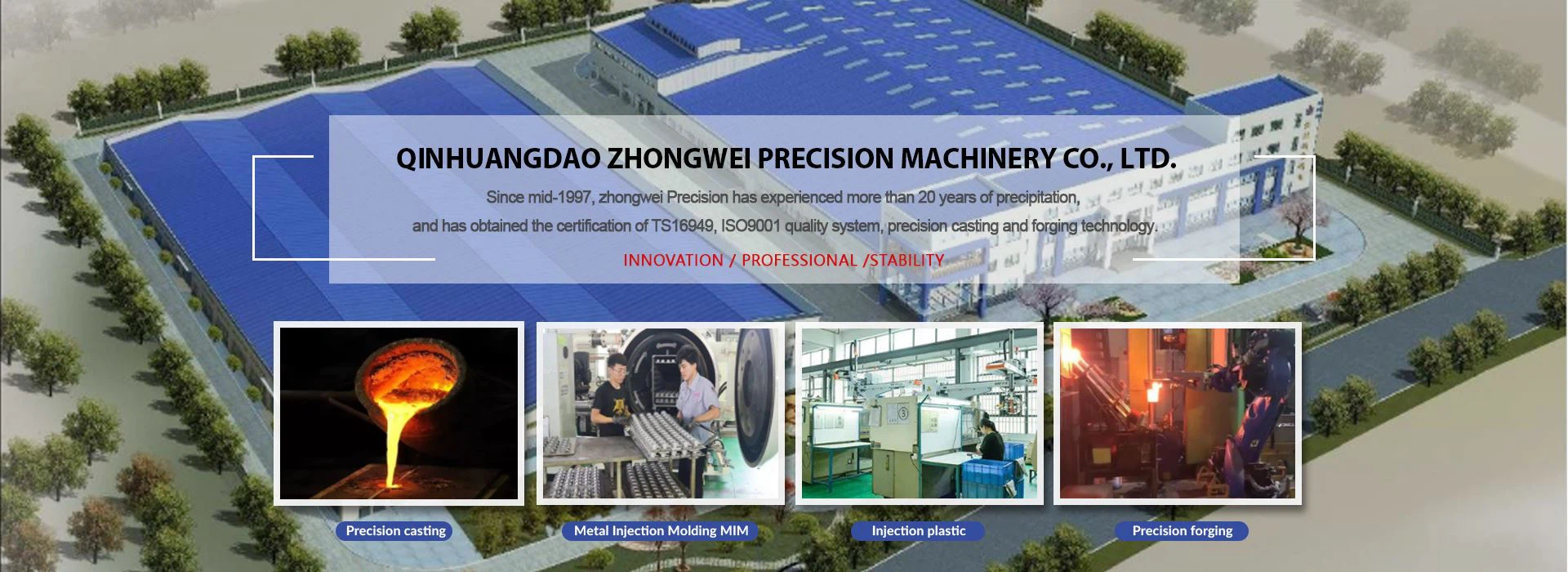
After more than ten years of precipitation, Qinhuangdao Zhongwei Precision Machinery Co., Ltd. has rich production experience in water glass lost wax precision casting, lost foam precision casting technology, silica sol precision casting technology, and shell sand casting technology. We expect manufacturers from all over the world to consult and negotiate business.
Product Description
Basic Information of Alloy Steel Silica Sol Investment Casting
1. Implementation standards: The company strictly implements ISO9001 & TS 16949 certification.
2. Product material standards: ISO, GB, ASTM, SAE, ISO, EN, DIN, JIS, BS
3. Main processes: sand casting, silica sol investment casting, water glass investment casting,shell casting,deburring, sand blasting, machining, heat treatment, leak testing, surface treatment, etc.
4. Available materials:
High manganese steel, high chromium steel, high nickel steel, carbon steel, alloy steel, stainless steel, gray iron, cast iron, cast steel, cast aluminum, cast copper, etc. can be customized according to customer requirements.
Composition Of Alloy Steel Investment Castings
1. Carbon (C): The carbon content in the steel increases, the yield point and tensile strength increase, but the plasticity and impact increase.
Alloy Structural Steel
When the carbon content exceeds 0.23%, the welding performance of the steel deteriorates, so the low-alloy structural steel used for welding generally does not contain more than 0.20% carbon. High carbon content will also reduce the atmospheric corrosion resistance of steel, and high carbon steel in the open stock yard is easy to rust; in addition, carbon can increase the cold brittleness and aging sensitivity of steel.
2. Silicon (Si): Silicon is added as a reducing agent and deoxidizer in the steelmaking process, so killed steel contains 0.15-0.30% silicon. If the silicon content in the steel exceeds 0.50-0.60%, silicon is considered an alloying element. Silicon can significantly improve the elastic limit, yield point and tensile strength of steel, so it is widely used as spring steel. Adding 1.0-1.2% silicon to quenched and tempered structural steel can increase the strength by 15-20%. The combination of silicon and molybdenum, tungsten, chromium, etc. can improve corrosion resistance and oxidation resistance, and can manufacture heat-resistant steel. Low carbon steel with silicon content of 1-4% has extremely high magnetic permeability, and is used in electrical industry to make silicon steel sheets. An increase in the amount of silicon will reduce the weldability of the steel.
3. Manganese (Mn): In the process of steelmaking, manganese is a good deoxidizer and desulfurizer. Generally, manganese in steel is 0.30-0.50%. When more than 0.70% is added to carbon steel, it is considered "manganese steel". Compared with ordinary steel, it not only has sufficient toughness, but also has higher strength and hardness, which can improve the hardenability of steel and improve the hot working performance of steel. For example, the yield point of 16Mn steel is 40% higher than that of A3. Steel containing 11-14% manganese has extremely high wear resistance and is used for excavator buckets, ball mill lining plates, etc. The increase of manganese content weakens the corrosion resistance of steel and reduces the welding performance.
4. Phosphorus (P): In general, phosphorus is a harmful element in steel, which increases the cold brittleness of steel, makes welding performance worse, reduces plasticity, and makes cold bending performance worse. Therefore, the phosphorus content in steel is usually required to be less than 0.045%, and the requirements for high-quality steel are lower.
5. Sulfur (S): Sulfur is also a harmful element under normal circumstances. It makes the steel hot brittle, reduces the ductility and toughness of the steel, and causes cracks during forging and rolling. Sulfur is also detrimental to weldability, reducing corrosion resistance. Therefore, the sulfur content is usually required to be less than 0.055%, and the high-quality steel is required to be less than 0.040%. Adding 0.08-0.20% sulfur to steel can improve machinability, usually called free-cutting steel.
6. Chromium (Cr): In structural steel and tool steel, chromium can significantly improve strength, hardness and wear resistance, but at the same time reduce plasticity and toughness. Chromium can also improve the oxidation resistance and corrosion resistance of steel, so it is an important alloying element of stainless steel and heat-resistant steel.
7. Nickel (Ni): Nickel can improve the strength of steel while maintaining good plasticity and toughness. Nickel has high corrosion resistance to acid and alkali, rust and heat resistance at high temperature. However, since nickel is a relatively scarce resource, other alloying elements should be used instead of nickel-chromium steel.
8. Molybdenum (Mo): Molybdenum can refine the grains of steel, improve hardenability and thermal strength, and maintain sufficient strength and creep resistance at high temperatures (long-term stress at high temperature, deformation occurs, called creep). Molybdenum is added to structural steel to improve mechanical properties. The brittleness of alloy steel due to quenching can also be suppressed. It can improve redness in tool steel.
9. Titanium (Ti): Titanium is a strong deoxidizer in steel. It can make the internal structure of steel dense, refine the grain force; reduce aging sensitivity and cold brittleness. Improve welding performance. Adding appropriate titanium to the chromium 18 nickel 9 austenitic stainless steel can avoid intergranular corrosion.

10. Vanadium (V): Vanadium is an excellent deoxidizer for steel. Adding 0.5% vanadium to the steel can refine the microstructure and grains and improve the strength and toughness. Carbides formed by vanadium and carbon can improve the resistance to hydrogen corrosion under high temperature and high pressure.
11. Tungsten (W): Tungsten has a high melting point and a large specific gravity. It is a precious alloy element. Tungsten and carbon form tungsten carbide with high hardness and wear resistance. Adding tungsten to tool steel can significantly improve red hardness and thermal strength, and can be used for cutting tools and forging dies.
12. Niobium (Nb): Niobium can refine the grains and reduce the overheating sensitivity and temper brittleness of the steel, and improve the strength, but the plasticity and toughness decrease. Adding niobium to ordinary low alloy steel can improve the resistance to atmospheric corrosion and hydrogen, nitrogen and ammonia corrosion at high temperature. Niobium improves weldability. The addition of niobium to austenitic stainless steel can prevent intergranular corrosion.
13. Cobalt (Co): Cobalt is a rare precious metal, which is mostly used in special steels and alloys, such as heat-strength steels and magnetic materials.
14. Copper (Cu): The steel smelted by WISCO with Daye ore often contains copper. Copper can improve strength and toughness, especially atmospheric corrosion performance. The disadvantage is that it is easy to produce hot brittleness during hot working, and the plasticity is significantly reduced when the copper content exceeds 0.5%. When the copper content is less than 0.50%, it has no effect on the weldability.
15. Aluminum (Al): Aluminum is a deoxidizer commonly used in steel. Adding a small amount of aluminum to the steel can refine the grains and improve the impact toughness, such as 08Al steel for deep-drawing thin plates. Aluminum also has anti-oxidation and anti-corrosion properties. The combination of aluminum and chromium and silicon can significantly improve the high-temperature peeling properties and high-temperature corrosion resistance of steel. The disadvantage of aluminum is that it affects the hot workability, weldability and machinability of steel.
16. Boron (B): Adding a small amount of boron to the steel can improve the compactness and hot rolling properties of the steel and increase the strength.
17. Nitrogen (N): Nitrogen can improve the strength, low temperature toughness and weldability of steel, and increase aging sensitivity.
18. Rare earth (Xt): Rare earth elements refer to the 15 lanthanoid elements with atomic numbers 57-71 in the periodic table. These elements are all metals, but their oxides are like "earth", so they are customarily called rare earths. Adding rare earth to steel can change the composition, shape, distribution and properties of inclusions in steel, thereby improving various properties of steel, such as toughness, weldability, and cold workability. Rare earth is added to plowshare steel to improve wear resistance.
Post Casting Process
1. Heat treatment: annealing, carbonization, tempering, quenching, normalizing, surface tempering
2. Processing equipment: CNC, WEDM, lathe, milling machine, drilling machine, grinder, etc.;
3. Surface treatment: powder spraying, chrome plating, painting, sandblasting, nickel plating, galvanizing, blackening, polishing, bluing, etc.

Moulds and Inspection Fixtures
1. Mold service life: usually semi-permanent. (except for lost foam).
2. Mold delivery time: 10-25 days, (according to product structure and product size).
3. Tooling and mold maintenance: Zhongwei is responsible for precision parts.
Quality Control
1. Quality control: the defective rate is less than 0.1%.
2. Samples and trial run will be 100% inspected during production and before shipment, sample inspection for mass production according to ISDO standards or customer requirements
3. Testing equipment: flaw detection, spectrum analyzer, golden image analyzer, three-coordinate measuring machine, hardness testing equipment, tensile testing machine;
4. Provide after-sales service.
5. The quality can be traced back.
Application
The company adopts advanced precision casting technology to produce castings of carbon steel, alloy steel and other materials. It is a large-scale professional production base for casting, integrating casting and CNC machining. The application of the products is very extensive, covering almost the applicable fields of the entire machinery manufacturing and machining industries, mainly including mining machinery, construction machinery, petroleum parts, ship parts, auto parts, agricultural machinery parts, forklift parts, construction machinery, pump valves , hardware tools, electrical equipment and other industries.
If you need Alloy Steel Silica Sol Investment Casting, feel free to contact us!


Send Inquiry
