



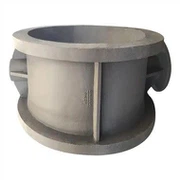
Tool Steel Lost Wax Castings
High hardness and can maintain high hardness and red hardness at high temperature, as well as high wear resistance and appropriate toughness. Tool steel is generally divided into carbon tool steel, alloy tool steel and high-speed tool steel.
Tool steel is an alloy tool steel material. Tool steel is the steel used to manufacture cutting tools, measuring tools, dies and wear-resistant tools. Tool steel has high.
High hardness and can maintain high hardness and red hardness at high temperature, as well as high wear resistance and appropriate toughness. Tool steel is generally divided into carbon tool steel, alloy tool steel and high-speed tool steel.
After more than ten years of precipitation, Qinhuangdao Zhongwei Precision Machinery Co., Ltd. has rich production experience in water glass lost wax precision casting, lost foam precision casting technology, silica sol precision casting technology, and shell sand casting technology. We expect manufacturers from all over the world to consult and negotiate business.
Product Description
Tool Steel Lost Wax Castings Basics
1. Implementation standards: The company strictly implements ISO9001 & TS 16949 certification.
2. Product material standards: ISO, GB, ASTM, SAE, ISO, EN, DIN, JIS, BS
3. Main processes: sand casting, silica sol investment casting, water glass investment casting,shell casting,deburring, sand blasting, machining, heat treatment, leak testing, surface treatment, etc.
4. Available materials:
High manganese steel, high chromium steel, high nickel steel, carbon steel, alloy steel, stainless steel, gray iron, cast iron, cast steel, cast aluminum, cast copper, etc. can be customized according to customer requirements.
Tool steel is represented by the phonetic letter "Q" of the yield point, the yield point value and the specified quality grade deoxidation method, etc., and the grades are formed in sequence. For example, carbon structural steel grades are Q235AF, Q235BZ, etc.; low alloy steel high-strength structural steel grades are Q345C, Q345D, etc.
Quality grades are increased from A to E with phosphorus and sulfur content. In carbon structural steel grades, the symbol "Z" representing killed steel and the symbol "TZ" representing special killed steel can be omitted. Low-alloy high-strength structural steels are all killed steels or special killed steels, and there is no deoxidation method in their grades. symbol.
According to needs, the grades of low-alloy high-strength structural steels can also be represented by two Arabic numerals (representing the average carbon content in ten thousandths) and chemical element symbols, such as 16Mn, etc.
Product Advantages
High-speed tool steel is mainly used to manufacture high-efficiency cutting tools. Due to its high red hardness, good wear resistance and high strength, Tool Steel Lost Wax Castings is also used to manufacture molds, rolls, high temperature bearings and high temperature springs with high performance requirements.
The hardness of high-speed tool steel after heat treatment can reach above HRC63, and it can still maintain high hardness at a working temperature of about 600 °C, and its toughness, wear resistance and heat resistance are good.
The main alloying elements of high-speed tool steel in annealed state are many, molybdenum, chromium, vanadium, and some high-speed tool steels are added with cobalt, aluminum and other elements. This type of steel is a high-carbon high-alloy ledeburite steel, and one of its main organizational characteristics is that it contains a large amount of carbides.
Tool Steel Lost Wax Castings Grade Representation Method
Tool steel grades are divided into three categories: carbon tool steel, alloy tool steel, and high-speed tool steel
1) Carbon tool steel is represented by SK××. XX represents the average value of carbon mass fraction, and there are 11 grades such as SK140 in JIS 4401:2000 "Carbon Tool Steel".
2) In JIS G4404:2000 "Alloy Tool Steel", SKSx (×) (one or two digits) means steel for cutting tools and steel for impact-resistant tools; SKD× and SKT× means hot work die steel; cold work tools There are two grades of steel, SKSx(x) and SKD×(×).
This standard has begun to coexist with international standard grades, such as SKT4 (55NiCrV7) and SKD10 (X153CrMoV12).
3) JIS G4403-2000 "High Speed Tool Steel" is divided into tungsten series high speed tool steel, powder metallurgy high speed tool steel and tungsten series high speed tool steel. The grades are composed of SKH plus one or two digits.
Representation method of spring steel grades JIS G4801:2005 "Spring Steel" uses SUP × (×) to represent the spring steel grade, and x (×) is the numerical serial number. For two grades with the same serial number, A can be added at the end of one grade to show the difference.
High carbon bearing steel grade representation method JIS G4805: 1999 "High Carbon Ming Bearing Steel" uses SUJ × to represent the high carbon chromium bearing steel grade, of which there are a total of 5 grades. Among them, the Si and Mn contents of SUJ3 and SUJ5 are higher.

Post Casting Process
1. Heat treatment: annealing, carbonization, tempering, quenching, normalizing, surface tempering
2. Processing equipment: CNC, WEDM, lathe, milling machine, drilling machine, grinder, etc.;
3. Surface treatment: powder spraying, chrome plating, painting, sandblasting, nickel plating, galvanizing, blackening, polishing, bluing, etc.

Moulds and Inspection Fixtures
1. Mold service life: usually semi-permanent. (except for lost foam)
2. Mold delivery time: 10-25 days, (according to product structure and product size).
3. Tooling and mold maintenance: Zhongwei is responsible for precision parts.
Quality Control
1. Quality control: the defective rate is less than 0.1%.
2. Samples and trial run will be 100% inspected during production and before shipment, sample inspection for mass production according to ISDO standards or customer requirements
3. Testing equipment: flaw detection, spectrum analyzer, golden image analyzer, three-coordinate measuring machine, hardness testing equipment, tensile testing machine;
4. Provide after-sales service.
5. The quality can be traced back.
Application
Tool Steel Lost Wax Castings are used to manufacture various cutting tools, measuring tools, molds, etc. T7 and T8 have high hardness and toughness, and can be used to manufacture punches, chisels, hammers and other tools. T9, T10, T11 have high hardness and moderate toughness, and can be used to manufacture cutting tools such as drill bits, planers, taps, hand saw blades, and cold work dies. T12 and T13 have high hardness, low toughness, and good wear resistance. They can be used to make cutting tools such as files and scrapers, as well as measuring tools such as gauges and sample sets. Carbon tool steel must be heat treated before use.




Send Inquiry
