




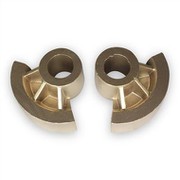
Alloy Steel Lost Wax Castings
The former is low and medium alloy cast steel, which is mainly used to make general mechanical structural parts. The latter are mostly high-alloy cast steel, such as wear-resistant cast steel, stainless and acid-resistant cast steel, heat-resistant cast steel, and cast alloy tool steel.
The alloy steel used in the casting state is also called cast alloy steel. According to its use, alloy cast steel is divided into Alloy Steel Lost Wax Castings steel and special-purpose alloy cast steel. The former is low and medium alloy cast steel, which is mainly used to make general mechanical structural parts. The latter are mostly high-alloy cast steel, such as wear-resistant cast steel, stainless and acid-resistant cast steel, heat-resistant cast steel, and cast alloy tool steel.
After more than ten years of precipitation, Qinhuangdao Zhongwei Precision Machinery Co., Ltd. has rich production experience in water glass lost wax precision casting, lost foam precision casting technology, silica sol precision casting technology, and shell sand casting technology. We expect manufacturers from all over the world to consult and negotiate business.
Product Description
Alloy Steel Lost Wax Castings Basic Facts
1. Implementation standards: The company strictly implements ISO9001 & TS 16949 certification.
2. Product material standards: ISO, GB, ASTM, SAE, ISO, EN, DIN, JIS, BS
3. Main processes: sand casting, silica sol investment casting, water glass investment casting,shell casting,deburring, sand blasting, machining, heat treatment, leak testing, surface treatment, etc.
4. Available materials:
High manganese steel, high chromium steel, high nickel steel, carbon steel, alloy steel, stainless steel, gray iron, cast iron, cast steel, cast aluminum, cast copper, etc. can be customized according to customer requirements.
The alloy steel used in the casting state is also called cast alloy steel. Alloy cast steel is divided into cast alloy structural steel and special purpose alloy cast steel according to its use. The former is low and medium alloy cast steel, which is mainly used to make general mechanical structural parts. The latter are mostly high-alloy cast steel, such as wear-resistant cast steel, stainless and acid-resistant cast steel, heat-resistant cast steel, and cast alloy tool steel.
The casting properties of cast alloy structural steel and special-purpose low-alloy cast steel are similar to those of carbon cast steel. Chromium and molybdenum in steel reduce the fluidity of molten steel. Copper, manganese, nickel, etc. improve fluidity. The volume shrinkage of steel is mainly related to the carbon content. The higher the carbon content, the greater the shrinkage rate, and the alloying elements have less influence on it. Manganese and elements such as vanadium, titanium, and zirconium that refine the crystal structure can reduce the tendency of hot cracking, while chromium and molybdenum increase the tendency of hot cracking. Alloying elements reduce thermal conductivity and increase casting stress, which increases the tendency of cold cracking of steel castings, especially for steels containing manganese, chromium, molybdenum and other elements.
Alloy Steel Lost Wax Castings Categories
1. Cast alloy structural steel
According to the alloying elements, there are manganese alloy cast steel, chromium alloy cast steel and nickel-containing cast alloy steel.
Manganese alloy cast steel This type of steel uses manganese as the main alloying element, and uses silicon and molybdenum as auxiliary alloying elements. Commonly used Chinese grades are ZG30Mn, ZG40Mn, ZG40Mn2, ZG45Mn, ZG50Mn, zG50Mn2, ZG65Mn and so on. It is often used for gears, cranes and mining machinery wheels, anti-addiction parts, etc., of which the manganese content is 1.05% to 1.80%. Manganese can significantly improve the hardenability, refine the pearlite structure, improve the hardness and wear resistance, reduce the plastic-brittle transition temperature of steel, and improve the strength without reducing the plasticity. This type of steel has good weldability when the carbon content is not high. However, the solid solution strengthening effect of manganese is small, which often causes coarse grains and temper brittleness. In order to improve the strength, silicon (0.60% to 1.40%) is often added to the steel to improve the hardenability and enhance the solid solution strengthening effect. Commonly used manganese silicon steel grades in China are ZG30Mnsi, ZG35MnSi, ZG35SiMn, ZG50SiMn, ZG20MnSi, etc., which can be used as train side frames, bolsters, gears, wheels, etc. In order to reduce the temper brittleness of manganese steel, 0.15% to 0.30% molybdenum is often added. Commonly used in China are ZG20MnMo and ZG50MnMo. Diversified manganese alloy cast steels include ZG35SiMnMo, ZG35SiMnMoV, ZG42MnMoV, etc. in China. These steels can be used as excavator parts and components, large gears, and crane sleeves. Adding a small amount of chromium (0.50% to 0.80%) to manganese-silicon steel can improve hardenability, strength and wear resistance, and can produce impacted and worn castings, such as gears, linings, etc. Commonly used brands in China are ZG30CrMnSi and ZG35CrMnSi. However, this kind of steel is prone to deformation and cracking during casting and heat treatment.
Chromium alloy cast steel This type of steel uses chromium as the main alloying element, with manganese, molybdenum, nickel and other auxiliary elements. Chromium can be solid solution strengthened and significantly improve hardenability, strength and wear resistance. Commonly used unit chromium alloy cast steels in China are ZG40Cr and ZG70Cr. The former can be used for high-strength castings such as gears and wheel rims, while the latter is mainly used for wear-resistant steel castings. Chromium steel is temper brittle, and molybdenum is often added, which can further improve the strength and prevent temper brittleness. Medium carbon chromium molybdenum cast steel has good strength and wear resistance, such as ZG35CrMo can be used to make sprockets, excavator support wheels, bushings, etc. Chromium-manganese-molybdenum steel is mainly used for wear-resistant steel castings, such as ZG30CrMnMo, which can withstand large loads and is wear-resistant. Due to the formation of stable carbides, high-carbon chromium-manganese steel has high hardness and wear resistance, and can be used as casting mold steel, such as ZG5CrMnMo.
Nickel-Containing Cast Alloy Steel There are very few cast steels with nickel as the main alloying element in the low-alloy cast steel. Nickel is often combined with chromium and molybdenum to greatly improve the hardenability, and is used to make high-strength large-scale steel castings.
2. Special purpose low alloy cast steel
Refers to low alloy cast steel with special performance other than cast alloy structural steel.
Heat-resistant low-alloy cast steel The commonly used heat-resistant low-alloy cast steels in China are ZG20CrMo, ZG15Cr1M01V. They can work in superheated steam and have high high temperature endurance strength and creep limit. Chromium and molybdenum in steel play a role in solid solution strengthening and hardenability, and vanadium can refine the structure and prevent grain growth. Molybdenum and vanadium increase the high temperature strength of the steel. The above two kinds of steel can be used to make steam chambers, valves, diaphragm sleeves, etc. that work below 570 °C.
Low-temperature low-alloy cast steel This type of steel has low carbon content and an appropriate amount of manganese. The commonly used grades in China are ZG06MnNb and ZG06AlNbCuN, and the operating temperature of the two can reach -90℃ and -120℃. In foreign countries, nickel-containing cast steel with nickel content of 2.0% to 3.0% or 3.0% to 4.0% is mainly used, which can be used at -70 °C and -100 °C respectively. However, nickel-containing low-temperature steel is prone to hydrogen embrittlement and thermal cracking, and the production process is complicated.
Precipitation Enhanced Copper Steel Copper can improve the corrosion resistance of steel. The solid solubility of copper in ferrite decreases with temperature drop, and the strength and hardness can be improved by aging treatment. This type of steel includes copper-nickel type, copper-manganese type and copper-manganese-silicon type, and the steel contains 0.85% to 1.80% copper. It is often used in the logging industry, and can also be used in large steel castings such as turbine blades with complex wall thicknesses and shapes that require no deformation.
Wear Resistant Low Alloy Cast Steel Steel should have high hardness and toughness under abrasive wear conditions. Such steels have martensitic and bainitic types. In addition, austenitic-bainite steel (abbreviated as austenitic steel) developed in the 1990s is a high-carbon (0.60%-0.90%) high-silicon (2.30%-2.40%) austempered steel grade. The bainite transformation is incomplete, and there are still dispersed austenite in the structure, which can be deformed and strengthened under the action of external force, and has good anti-wear performance.
High-strength low-alloy cast steel High-strength low-alloy cast steel refers to cast steel with a tensile strength in the range of 1205 to 2070 MPa, and is often used in steel castings for military products, such as gun bolt rings, centrifugal casting gun barrels, tank frames and mining shovels Steel castings that require high strength, toughness and wear resistance on transport machines and bulldozers. Typical grades are 4330 steel (US grade).
3. Special purpose high alloy cast steel
High-alloy cast steel refers to alloy cast steel with a total alloying element content of more than 10%. According to its use, it is divided into: cast stainless steel, heat-resistant cast steel and wear-resistant and corrosion-resistant alloy cast steel.
Cast stainless steel (1) Ferritic stainless cast steel. This type of steel uses chromium as the main alloying element. The commonly used grades in China are ZG1Cr17, ZGlCr19M02, ZGCr28, which are used in nitric acid, nitrogen fertilizer, chemical fiber and other industries. (2) Martensitic stainless cast steel. The Chinese grades are ZGlCr13 and ZG2Cr13, which are used to manufacture castings that are required to withstand shock loads and high toughness but work under the condition of low medium concentration. Can be used as pump casing, impeller, valve, etc. (3) Austenitic stainless steel. This type of steel contains high chromium and nickel. The commonly used grades in China are ZGOCr18Ni9, ZGlCr18Ni9, ZG0Cr18Ni9Ti, ZG1Cr18Ni9Ti, ZG0Cr18Ni12Mo2Ti, ZG1Cr18Ni12Mo2Ti, ZG1Cr24Ni20Mo2Cu3, ZG1Cr18Mn8NiN, etc. The typical steel grades are ZG0Cr18Ni9 and zG1Cr. (4) Austenitic-ferritic stainless steel. This type of steel contains manganese and nitrogen to save nickel. The commonly used grades in China are ZG1Cr17Mn9Ni4Mo3Cu2N and ZG1Cr18Mn13Mo2CuN. The requirements for corrosion resistance are not high, but when high mechanical properties are required, medium and high strength martensitic stainless steels can be used. The Chinese grades suitable for castings with wall thickness below 100mm are ZG10Cr13, ZG20Cr13, ZG10Cr13Ni1, and ZG10Cr13Ni1Mo. ZG06Cr13Ni4Mo, ZG06Cr13Ni6Mo, ZG06Cr16Ni5Mo are suitable for castings with a wall thickness of 100-200mm. (5) Precipitation hardening stainless steel. The Chinese grade is ZG0Cr17Ni4Cu4Nb, this type of steel has high strength, toughness and wear resistance. It can be used in chemical, shipbuilding, aviation and other departments as high-strength wear-resistant and corrosion-resistant castings.
The castability of stainless steel is poor, the fluidity of molten steel is low, and it is easy to produce cold insulation or slag inclusion. For this reason, the pouring temperature should be increased, generally not lower than 1530 °C. The cross-sectional area of the gating system should be 30% to 50% larger than that of carbon steel castings. The volume shrinkage of stainless steel is large, which is prone to shrinkage and porosity. The riser of the casting should be 20% to 30% larger than that of the carbon steel. The casting has a large tendency to thermal cracking, and the pouring temperature is high and it is easy to stick to the sand. The casting process should take corresponding measures. Austenitic-ferritic stainless steel has better casting properties, but is more sensitive to pores.
Heat-resistant cast steel Heat-resistant cast steel is divided into heat-resistant non-skin cast steel (oxidation-resistant steel) and heat-strength cast steel according to its application. Commonly used anti-oxidation steels are heat-resistant chromium steels, with chromium as the main alloying element. The low chromium content is 13% to 14%, and the high one is 25% to 35%. Sometimes a small amount of silicon or nickel is added, such as ZG40Cr9Si2. Make crucibles, furnace doors, bottom plates, etc.
The hot-strength steel is usually martensitic or austenitic, and the latter has good thermal strength and can be used above 600°C. Those with high chromium and nickel content, such as zG35(: r26Ni, can be used up to 1100°C and are widely used in various furnace components.
Heat-resistant steel has poor casting properties, and its characteristics are similar to stainless steel. The molten steel of the iron-aluminum-manganese type heat-resistant steel is easily oxidized, prone to surface wrinkles, large volume shrinkage, and prone to cracks. Attention should be paid to both smelting and casting processes.
(1) Chrome-nickel heat-resistant steel. This type of steel is austenitic oxidation-resistant steel. Austenitic stainless steel also has oxidation resistance, but the former has a higher carbon content and often contains silicon, such as ZG35Ni24Crl8Si2. Its maximum operating temperature is 1100 ℃, and it can be used as a heating furnace conveyor belt, screws, fasteners and other bearing parts.
(2) Chromium-manganese-nitrogen type anti-oxidation steel. Among them, manganese is 11% to 13%, and a small amount of nitrogen is added to replace nickel, and sometimes a small amount of silicon is added to improve oxidation resistance, such as ZG30Cr18Mn12Si2N. Its maximum operating temperature is 950°C, and its strength and thermal fatigue are good. It can be used as furnace pot, furnace bottom plate, support frame, hanger, etc. This kind of steel has a dual-phase structure of austenite + ferrite, and its mechanical properties are better than that of chromium-nickel steel.
(3) Iron-aluminum-manganese type anti-oxidation steel. Among them, those with low manganese and aluminum content are such as ZG5Mn16Al3Si2 (Mnl5.50%~16.50%, Al2.70%~3.00%), and those with high content are zG7Mn29A19Si (Mn28.0%~30.0%, A19.0%~10.0%).
Cast tool steel Cast tool steel is divided into tool cast steel and die cast steel. Tool cast steel is high alloy cast steel with tungsten and chromium as the main alloying elements, such as China's ZGW18Cr4V, ZGW12Cr4V4Mo, ZGW9Cr4V2, ZGW9Cr4V and so on. In order to eliminate macrosegregation and refine the structure, the temperature should be low during pouring. The shrinkage of steel is large, the thermal conductivity is poor, and cracks are prone to occur. Die casting steel uses chromium and molybdenum as the main alloying elements. The commonly used grade in China is ZG5crMnMo. In order to improve the fluidity of molten steel, the silicon content in the steel should be appropriately increased.
Wear-resistant and corrosion-resistant alloy cast steel The wear-resistant and corrosion-resistant alloy cast steel developed for the manufacture of turbine upper castings (rotors and blades, etc.), with chromium, nickel, molybdenum and copper as the main alloying elements. Steel has high hardenability and hardness, and has good corrosion and wear resistance under water erosion and wear conditions. The commonly used grades in China are ZG0Cr13Ni6MoR, ZG0Cr13Ni4MoR, and ZG15MnMoV—Cu.

Post Casting Process
1. Heat treatment: annealing, carbonization, tempering, quenching, normalizing, surface tempering
2. Processing equipment: CNC, WEDM, lathe, milling machine, drilling machine, grinder, etc.;
3. Surface treatment: powder spraying, chrome plating, painting, sandblasting, nickel plating, galvanizing, blackening, polishing, bluing, etc.

Moulds and Inspection Fixtures
1. Mold service life: usually semi-permanent. (except for lost foam)
2. Mold delivery time: 10-25 days, (according to product structure and product size).
3. Tooling and mold maintenance: Zhongwei is responsible for precision parts.
Quality Control
1. Quality control: the defective rate is less than 0.1%.
2. Samples and trial run will be 100% inspected during production and before shipment, sample inspection for mass production according to ISDO standards or customer requirements
3. Testing equipment: flaw detection, spectrum analyzer, golden image analyzer, three-coordinate measuring machine, hardness testing equipment, tensile testing machine;
4. Provide after-sales service.
5. The quality can be traced back.




Send Inquiry
