



Magnesium Alloy Die Casting
Magnesium alloy die casting is a kind of die casting. Magnesium alloy die casting uses a die-casting mechanical die-casting machine equipped with a casting mold, and liquid zinc or magnesium alloy is poured into the inlet of the die-casting machine. The parts are then die cast through a die casting machine to produce magnesium alloy die cast parts limited by the shape and size of the die.
Magnesium alloy die casting is a kind of die casting. Magnesium alloy die casting uses a die-casting mechanical die-casting machine equipped with a casting mold, and liquid zinc or magnesium alloy is poured into the inlet of the die-casting machine. The parts are then die cast through a die casting machine to produce magnesium alloy die cast parts limited by the shape and size of the die.
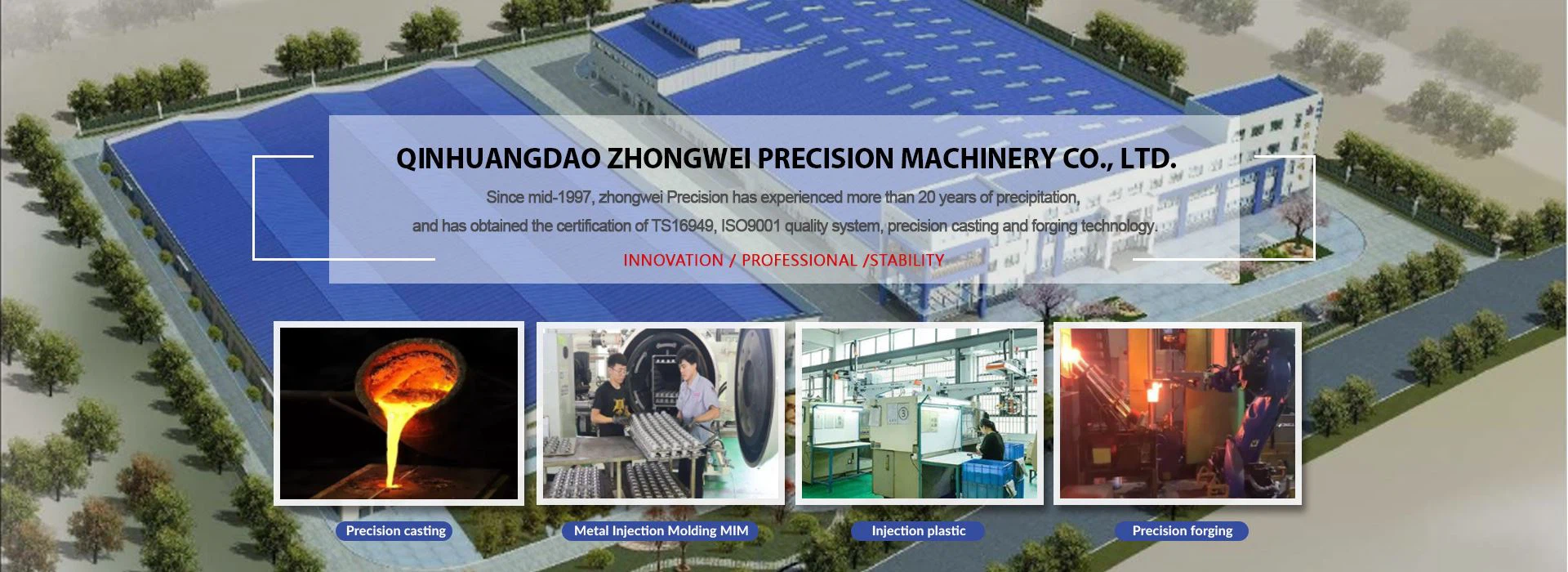
Qinhuangdao Zhongwei Precision Machinery Co., Ltd. currently has more than 10 cold chamber die-casting machines of 200T-1250T models, and a total of 3 hot-chamber die-casting machines of 88T-168T models. The excellent quality has created a gold reputation, making the other shore products. It quickly became famous at home and abroad. More than 70% of the products are exported to the United Kingdom, Germany, Japan, the United States, Taiwan and other countries and regions.
Product Dsecription
1. Implementation standards: the company strictly implements ISO9001, ISO14001, IATF16949 certification
The products have passed the certification of ROHS, FDA EU, etc.
2. Product material standards: ISO, GB, ASTM, SAE, ISO, EN, DIN, JIS, BS
3. Main processes: die casting process, investment casting, shell casting, deburring, sand blasting, machining, heat treatment, leak testing, surface treatment, etc.
4. Casting available materials:
Magnesium alloy, aluminum alloy, zinc alloy, tin bronze, silicon bronze, aluminum bronze, brass, red copper, titanium alloy, high manganese steel, high chromium steel, high nickel steel, carbon steel, alloy steel, stainless steel, gray iron, , cast iron, cast steel, cast aluminum, etc. are customized according to customer requirements.
Available materials for die casting:
Magnesium alloy die castings mainly include Mg-Al-Zn-Mn, Mg-Al-Mn, Mg-Al-Si-Mn alloys.

Material of Magnesium alloy die casting
For zinc die castings, there are two basic series. Traditional MgMAK alloys are often named after their continuous development. They include Alloy 3, Alloy 5 and Alloy 7. Then there are magnesium alloy die castings, in which the aluminum content is higher than the conventional alloy Mg. These include Mg-8, Mg-12 and Mg-27. Mg alloys have higher strength and useful bearing properties.
Alloy 2 provides the highest strength and hardness of conventional magnesium alloy die cast parts. Alloy 2 of magnesium alloy die castings exhibits excellent castability and maintains high strength and hardness levels after long-term aging. This magnesium alloy die casting is a good bearing material and can eliminate bushings and wear inserts in die casting designs.
Alloy 3 is the most widely used magnesium alloy die casting due to its excellent balance of desirable physical and mechanical properties, excellent castability and long-term dimensional stability.
Alloy 5 is the most widely used magnesium alloy die casting with excellent casting properties and improved creep properties compared to No. 3. However, these improvements are accompanied by a reduction in ductility, which affects formability during secondary bending, riveting, swaging or forging. crimping operation.
Alloy 7 is a modification of No 3 with lower magnesium content and tighter impurity specifications, resulting in improved casting flow, ductility and surface finish.
As a good gravity cast alloy, az31d is also hot chamber die castable and can be easily plated and finished using standard procedures for regular magnesium alloy die cast parts.
Product Feature
Magnesium alloy die casting is carried out in automatic machines suitable to withstand high pressures. The molten metal is pushed into a two-piece steel mold containing one or more cavities, each of which accurately replicates one or more parts in reverse. The mechanical properties of magnesium alloy die castings are often superior to other casting processes because of the rapid cooling and rapid solidification that occurs when the molten metal comes into contact with the relatively cold steel side.
In terms of production time, other casting processes cannot compare with magnesium alloy die castings. There are a variety of casting processes that can be used to economically manufacture castings of the required size and quantity. However, magnesium alloy die castings are produced much faster than aluminum or magnesium die castings. Also, magnesium alloy die castings can be cast to tighter tolerances than any other metal or molded plastic. Net shape or zero machining manufacturing is the main advantage of magnesium alloy die castings. Magnesium alloy die casting parts have repeatability less than ±0.001 for smaller parts. Only a few other processes, such as aluminum die casting, can achieve the same net shape performance and eliminate machining.
Another huge advantage of using magnesium alloy die castings is that zinc's excellent casting fluidity, strength and stiffness allow the design of thin-walled profiles, resulting in reduced weight and material cost savings. Magnesium alloy die castings have excellent bearing and wear properties, thus providing greater design flexibility and lower manufacturing costs.
Post Casting Process
1. Heat treatment: annealing, carbonization, tempering, quenching, normalizing, surface tempering
2. Processing equipment: CNC, WEDM, lathe, milling machine, drilling machine, grinder, etc.;
3. Surface treatment: powder spraying, chrome plating, painting, sandblasting, nickel plating, galvanizing, blackening, polishing, bluing, etc.

Moulds and Inspection Fixtures
1. Mold service life: usually semi-permanent. (except for lost foam)
2. Mold delivery time: 10-25 days, (according to product structure and product size).
3. Tooling and mold maintenance: Zhongwei is responsible for precision parts.
Quality Control
1. Quality control: the defective rate is less than 0.1%.
2. Samples and trial run will be 100% inspected during production and before shipment, sample inspection for mass production according to ISDO standards or customer requirements
3. Testing equipment: flaw detection, spectrum analyzer, golden image analyzer, three-coordinate measuring machine, hardness testing equipment, tensile testing machine;
4. Provide after-sales service.
5. The quality can be traced back.
Application
Magnesium alloys are widely used in the field of lightweighting of automobiles and rail transit. Magnesium Magnesium's lightweight transportation products include bus and bus magnesium alloy body frames, logistics vehicle compartments, new energy vehicle battery boxes, instrument panel brackets, rails Traffic seats, bus handrails, etc.
Typical magnesium alloy civilian products: robot parts, LED lamp parts, radiator profiles, shells of electronic equipment parts, outdoor tent folding chairs, trolley case profiles, speaker parts, air purifier shells, etc.
Typical products of magnesium alloy military industry: military RV materials, command cabin profiles, miniature telegraph housing materials, missile tracker housings, satellite components, telescopic sight components, military all-region vehicle frames, firearm parts, individual combat equipment , camp bed, combat table, combat chair, field stretcher, etc.
Certicifation


Send Inquiry
