



Computer Metal Parts Metal Powder Injection Molding Parts
Metal Injection Molding (MIM for short) is a new type of powder metallurgy near-net forming technology derived from the plastic injection molding industry. As we all know, plastic injection molding technology produces various complex shapes at a low price.
Introduction of metal injection molding computer bushing parts
Metal injection molding computer shaft parts | ||||||
Item | Material | Production Process | Sintering Temperature | Mold | Custom | |
Headphone Shell | 304 stainless steel | Metal Injection Molding | 1550℃ | To be customized | Yes | |
Chemical Composition | Chemical Composition:C:≤0.08 ,Si :≤1.0 Mn :≤2.0 , Cr :18.0~20.0 ,Ni :8.0~10.5, S :≤0.03 ,P :≤0.035 N≤0.1。 | |||||
Hardness range | Hardness: The heating temperature of solution treatment is generally high, and the hardness is generally around 135HBS. | |||||
Available Materials | Low carbon stainless steel, titanium alloy (Ti, TC4), copper alloy, tungsten alloy, cemented carbide, high temperature alloy (718, 713) | |||||
Product Feature
Finish | Dimensional Accuracy | Product Density | Appearance Treatment | Appropriate Weight |
Roughness 1~5μm | (±0.1%~±0.5%) | 95~100% | Mirror Reflection | 0.03g~400g) |
Metal Injection Molding (MIM for short) is a new type of powder metallurgy near-net forming technology derived from the plastic injection molding industry. As we all know, plastic injection molding technology produces various complex shapes at a low price. In order to improve its performance, metal or ceramic powder can be added to the plastic to obtain products with high strength and good wear resistance. In recent years, this idea has evolved to maximize the solids content and completely remove the binder and densify the green body during the subsequent sintering process. This new powder metallurgy forming method is called metal injection molding. Turning means that lathe processing is a part of mechanical processing. Lathe machining mainly uses turning tools to turn the rotating workpiece. Lathes are mainly used to process shafts, discs, sleeves and other workpieces with revolving surfaces, and are a more widely used type of machine tool in machinery manufacturing and repair factories.
Product Description
1. Implementation standards: the company strictly implements ISO9001, ISO14001, IATF16949 certification, and the products have passed ROHS, FDA EU certification, etc.
2. Product material standards: ISO, GB, ASTM, SAE, EN, DIN, BS, AMS, JIS, ASME, DMS, TOCT, GB
3. Printer nozzle metal powder injection molding parts main process: metal injection molding MIM, powder metallurgy PM, investment casting, die-casting aluminum,
4. Available materials for powder metallurgy:
Copper alloys, iron bases, titanium alloys, stainless steel bases, aluminum alloys, nickel alloys, cobalt alloys, tungsten alloys, cemented carbides, hydroxy alloys, soft magnetic materials and 3D printing can be customized according to customer requirements.
Laptop Application
Metal injection molding, a technology used to create small, complex metal parts, is a manufacturing process that Apple is using in the new MacBooks to save space inside the device, which is likely to have an ultra-thin design. At the same time, it is reported that Zhaoli Technology Industry has prepared to provide metal injection mold hinge parts for 15-inch Macbook. It is expected that the new Macbook will be shipped in large quantities at the end of 2016 and 2017.


Metal Injection Molding Process Surface Treatment
1.Blackening treatment: It is a common chemical treatment method to produce an oxide film on the metal surface, isolate the air, and achieve the purpose of rust prevention. When the appearance requirements are not high, blackening treatment can be used. The main components of the blackening liquid are sodium hydroxide and sodium nitrite.
2. Phosphating treatment: It is a process of chemical and electrochemical reaction to form a phosphate film. The main purposes of phosphating are: to protect the base metal and prevent metal corrosion to a certain extent; to prime before painting to improve the adhesion and anti-corrosion ability of the coating layer.
3. Spraying treatment: The spray gun or disc atomizer, through pressure or centrifugal force, disperse into uniform and fine droplets, and apply it on the surface of the coating. What is Advanced Metal Injection Molding in Dongtou District? Qinhuangdao Zhongwei Precision Machinery Co., Ltd. is a company specializing in tungsten alloy metal injection molding.
The metal powder and organic binder are uniformly mixed to make various raw materials into a mixture for injection molding. The homogeneity of the mixed material directly affects its fluidity, affects the technical parameters of injection molding, and affects the density and other properties of the final material. The injection molding process in this step is the same in principle as the plastic injection molding process, and its equipment conditions are basically the same. Since the products of this metal powder injection molding technology can be used to make economical structural metals for complex parts, cost-saving savvy manufacturers can often reduce some of their costs. It is also possible later to replace more than two parts and a single powder injection molded part assembly, eliminating the cost of those assembled parts. The larger the number, the better the cost advantage. However, considering the cost of mold and development investment, if the product volume is too small, the cost will be allocated to the product, and the unit price will be unacceptable.
4. Turning is a method of cutting the workpiece on a lathe by using the workpiece to rotate relative to the tool. The cutting energy of turning is mainly provided by the workpiece rather than the tool. Turning is a more basic and common cutting method and plays a very important role in production. Turning is suitable for machining rotary surfaces. Most workpieces with rotary surfaces can be processed by turning methods, such as inner and outer cylindrical surfaces, inner and outer conical surfaces, end faces, grooves, threads, and rotary forming surfaces. The tools used are mainly turning tools. Milling Milling is to fix the blank, and use a high-speed rotating milling cutter to move on the blank to cut out the required shapes and features. Conventional milling is used more for simple shapes/features such as contours and slots. CNC milling machines can process complex shapes and features. The milling and boring machining center can perform three-axis or multi-axis milling and boring processing for machining, molds, inspection tools, tire tools, thin-walled complex surfaces, artificial prostheses, blades, etc. When selecting CNC milling processing content, the advantages and key roles of CNC milling machines should be fully utilized. Planing is a cutting method in which a planer is used to make a horizontal relative linear reciprocating motion on the workpiece, which is mainly used for the shape processing of parts. The precision of planing processing is IT9~IT7, and the surface roughness Ra is. Grinding Grinding refers to the processing method of removing excess material on the workpiece with abrasives and abrasive tools. Grinding is one of the most widely used cutting methods. Selective laser melting is carried out in a tank filled with metal powder, and a high-power carbon dioxide laser is controlled by a computer to selectively sweep over the surface of the metal powder. wherever the laser goes.
5. Application: In industrial products, molded products include electrical equipment (plugs and sockets), pot handles, tableware handles, bottle caps, toilets, non-breaking dinner plates (melaine), carved plastic doors, etc. Lamination molding: a method of combining two or more layers of the same or different materials into a whole under the conditions of heating and pressure, using sheet-like or fibrous materials as fillers. Process flow: The lamination molding process consists of three stages: dipping, pressing and post-processing, and is mostly used to produce reinforced plastic sheets, pipes, bars and model products. Features: dense texture, smooth surface. Thermoforming machine equipment supplier: Toshiba, Japan; Sacmi Group... Six injection molding Injection molding: It is a thermosetting plastic molding method developed on the basis of compression molding, also known as transfer molding. The process is similar to the injection molding process. During injection molding, the plastic is plasticized in the feeding cavity of the mold, and then enters the cavity through the pouring system, while the injection molding is plasticized in the barrel of the injection molding machine. Injection molding schematic process flow: The difference between injection molding and compression molding: The compression molding process is to feed the material first and then close the mold, while the injection molding generally requires the mold to be closed first and then the material. Process features: Advantages: (Compared with compression molding) The plastic has been plasticized before entering the cavity, which can produce plastic parts with complex shapes, thin walls or large changes in wall thickness, and fine inserts. Shorten the molding cycle, improve production efficiency, and improve the density and strength of plastic parts. Because the mold is completely closed before plastic molding, the flash of the parting surface is very thin.
6. Machining: in the production process of parts, cutting the excess metal layer thickness on the blank with a tool directly, so that it can meet the technical requirements of dimensional accuracy, mutual accuracy of shape and position, and surface quality required by the drawing. Common machining methods: Welding Welding: Also known as welding, welding is a manufacturing process and technology for joining metals or other thermoplastic materials such as plastics by heating, high temperature or high pressure. Welding classification: powder metallurgy Powder metallurgy: It is a process technology for preparing metal or using metal powder (or a mixture of metal powder and non-metal powder) as raw material, after forming and sintering, to manufacture metal materials, composite materials and various types of products. Basic process flow: Advantages: Most refractory metals and their compounds, pseudo-alloys, and porous materials can only be manufactured by powder metallurgy. Save metal and reduce product cost. It will not give any contamination to the material, and it is possible to produce high-purity material. Powder metallurgy can ensure the correctness and uniformity of material composition ratio. Powder metallurgy is suitable for producing products with the same shape and a large number of products, which can greatly reduce production costs. Disadvantage: The size of the part is taken into account when there is no batch size. The cost of the mold is relatively higher than that of the casting mold. Scope of production: Powder metallurgy technology can directly make porous, semi-dense or fully dense materials and products, such as oil-impregnated bearings, gears, cams, guide rods, tools, etc. Metal Injection Molding MIM (Metalinjection Molding): is the abbreviation of Metal Injection Molding.
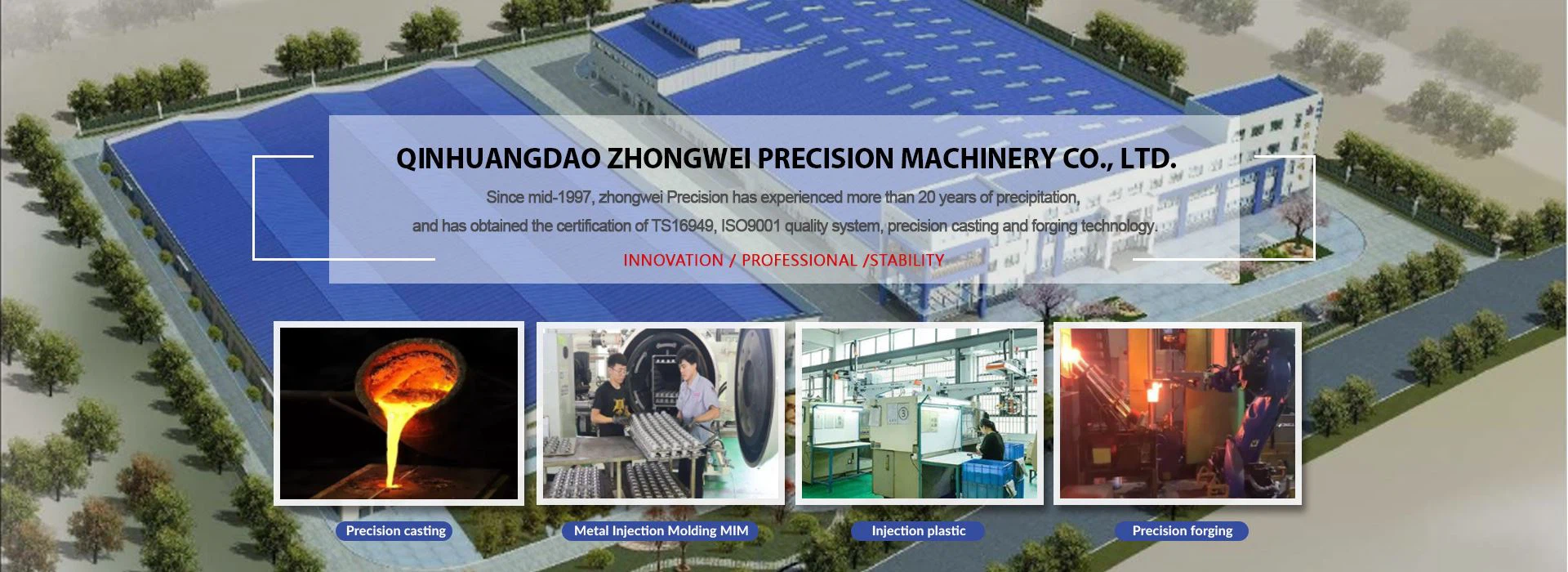
Qinhuangdao Zhongwei Precision Machinery Co., Ltd. focuses on technological innovation and product research and development, and the development scale team continues to grow. A group of professional technical teams is the basis for realizing the strategic goals of the enterprise and the driving force for the sustainable development of the enterprise. Honesty and trustworthiness are the operating requirements of the enterprise and the basic criteria for our life. The company is committed to creating the best metal injection molding, metal powder injection molding, MIM. The company is deeply engaged in metal injection molding, metal powder injection molding, MIM, and is accumulating more energy and expanding to a wider space and a wider field.
Our Service
Pre-sale | Evaluate according to drawings or products, calculate the price, and submit it to the buyer for confirmation |
On sale | All production links of TWS earphone metal powder injection molding are supported by the production system and delivered according to the mutually agreed time. In order to be responsible for the modification, if we fail to meet the customer's requirements during the modification process, a full refund will be given) |
After sales | After handing over the product, we will seal all the buyer's molds for safekeeping. |
Why Choose US?
Our R&D team | Zhongwei Precision Co., Ltd. and Central South University have a R&D team of 10 people. They develop more than 400 products each year, which is more than 68% higher than the same industry, and have obtained more than 20 patent certificates. |
Our technical team | Zhongwei Precision has 5 professional engineers in the field of metal injection molding, and 15 technicians responsible for workshop management. |
Our philosophy on quality management | 1. Focus on the customer |
Device resources | The company has 10 MIM production lines, CNC and intelligent automated production workshops for production lines, which can guarantee the production of millions of MIM parts per day. |
System Certification | ISO9001, ISO14001, IATF16949 certification |
Process After Sintering
1. Heat treatment: annealing, carbonization, tempering, quenching, normalizing, surface tempering
2. Processing equipment: CNC, WEDM, lathe, milling machine, drilling machine, grinder, etc.;
3. Surface treatment: anodizing, powder spraying, chrome plating, painting, sandblasting, nickel plating, galvanizing, blackening, polishing, bluing, etc.
Moulds and Inspection Fixtures
1. Mold service life: usually semi-permanent. (except for lost foam)
2. Mold delivery time: 10-25 days, (according to product structure and product size).
3. Tooling and mold maintenance: Zhongwei is responsible for precision parts.
Quality Control
1. Quality control: the defective rate is less than 0.1%.
2. Samples and trial run will be 100% inspected during production and before shipment, sample inspection for mass production according to ISDO standards or customer requirements.
3. Testing equipment: flaw detection, spectrum analyzer, golden image analyzer, three-coordinate measuring machine, hardness testing equipment, tensile testing machine.


Send Inquiry
