




Metal Injection Molding 5G Base Station Accessories
MIM (Metal Injection Molding) is the abbreviation of Metal Injection Molding. It is a molding method in which a plasticized mixture of metal powder and its binder is injected into a mold. It is firstly mixing the selected powder with a binder, then granulating the mixture and then injection molding the desired shape.
MIM (Metal Injection Molding) is the abbreviation of Metal Injection Molding. It is a molding method in which a plasticized mixture of metal powder and its binder is injected into a mold. It is firstly mixing the selected powder with a binder, then granulating the mixture and then injection molding the desired shape.
Qinhuangdao Zhongwei Precision Machinery Co., Ltd. is a comprehensive company integrating R&D, production and sales of copper alloy, iron base, stainless steel base, aluminum alloy, nickel alloy, cobalt alloy, tungsten alloy, cemented carbide and powder metallurgy structural parts. high-tech enterprises. We are willing to achieve common development with every merchant who needs Metal Injection Molding 5G Base Station Accessories.
Product Description
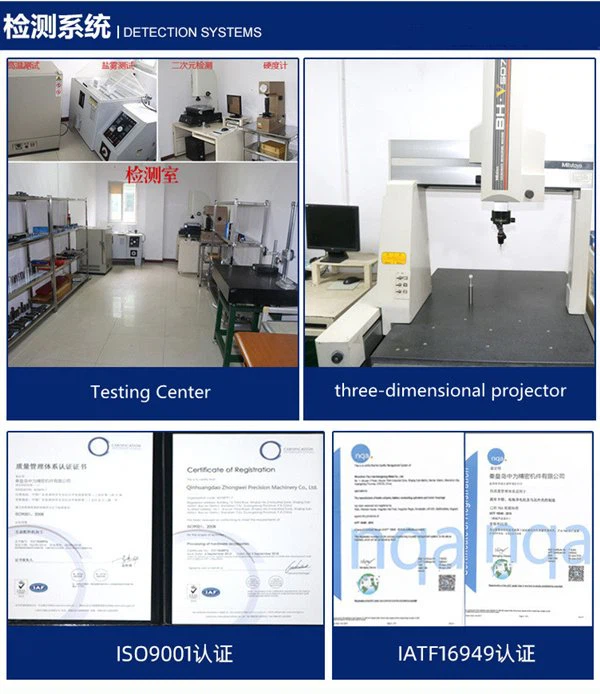
1. Implementation standards: the company strictly implements ISO9001, ISO14001, IATF16949 certification
The products have passed the certification of ROHS, FDA EU, etc.
2. Product material standards: ISO, GB, ASTM, SAE, EN, DIN, BS, AMS, JIS, ASME, DMS, TOCT, GB
3. Main processes: metal injection molding MIM, powder metallurgy PM, investment casting, die-casting aluminum,
4. Available materials for powder metallurgy:
Copper alloy, iron base, titanium alloy, stainless steel base, aluminum alloy, nickel alloy, cobalt alloy, tungsten alloy, cemented carbide, hydroxy alloy, soft magnetic material and 3D printing can be customized according to customer requirements.
Production Process
1. Introduction to Metal Injection Molding (MIM)
Metal Injection Molding (MIM) is an advanced metal manufacturing technology that combines the advantages of two traditional processes, plastic injection molding and powder metallurgy. Many products with high performance requirements use MIM, involving electronics, livelihood, auto parts, medical equipment, military, aerospace and other industries. Such as mobile phones, electronic radiators, sealed packaging, junction boxes, industrial tools, fiber optic connectors, fluid spray systems, sports equipment, hard drives, automotive fuel and ignition systems, dental instruments and dental reinforcement tools, pharmaceutical equipment, pumps, Surgical instruments, aerospace and defense systems, etc.
MIM (Metal Injection Molding) is the abbreviation of Metal Injection Molding. It is a molding method in which a plasticized mixture of metal powder and its binder is injected into a mold. It is firstly mixing the selected powder with a binder, then granulating the mixture and then injection molding the desired shape.

2. Metal Injection Molding (MIM) Process
The MIM process combines the design flexibility of injection molding with the strength and integrity of precision metals to achieve low-cost solutions for extremely complex geometry parts.
The MIM process is divided into four unique processing steps (mixing, molding, debinding and sintering) to achieve the production of parts, with the need for surface treatment depending on the product characteristics.
The MIM manufacturing process generally includes: mixing and granulation, injection molding, degreasing, sintering, and secondary processing.
3. Main technical features of MIM process:
●It is suitable for the forming of various powder materials, and the product is widely used;
●High utilization rate of raw materials, high degree of production automation, suitable for continuous mass production.
●It can directly form small parts with complex geometry (0.03g~200g);
●High dimensional accuracy of parts (±0.1%~±0.5%) and good surface finish (roughness 1~5μm);
●The product has high relative density (95-100%), uniform organization and excellent performance.
4. Several commonly used surface treatment processes for MIM parts
(1) Polishing
Using mechanical, chemical or electrochemical action, the surface roughness of the workpiece is reduced to obtain a bright and flat surface.
(2) Electroplating treatment
The process of attaching a metal film to the surface of a metal or other material by electrolysis. Electroplating can prevent metal oxidation (such as rust), improve wear resistance, electrical conductivity, reflectivity, corrosion resistance (copper sulfate, etc.) and enhance aesthetics.
(3) PVD processing
The use of physical processes to achieve mass transfer, the process of transferring atoms or molecules from the source to the surface of the substrate. Its function is to spray some particles with special properties (high strength, wear resistance, heat dissipation, corrosion resistance, etc.) on the matrix with lower performance, so that the matrix has better performance.
(4) Blackening treatment
It is a common chemical treatment method to produce an oxide film on the metal surface to isolate the air and achieve the purpose of rust prevention. When the appearance requirements are not high, blackening treatment can be used. The main components of the blackening liquid are sodium hydroxide and sodium nitrite.

(5) Phosphating treatment
It is a process of chemical and electrochemical reaction to form a phosphate film. The main purpose of phosphating is to:
1) Provide protection to the base metal and prevent the metal from being corroded to a certain extent;
2) It is used as a primer before painting to improve the adhesion and anti-corrosion ability of the paint film.
(6) Spraying treatment
It is a coating method that is dispersed into uniform and fine droplets by means of pressure or centrifugal force through a spray gun or disc atomizer, and is applied to the surface of the object to be coated.
In summary:
(1) Polishing and phosphating are mainly pretreatments to prepare for other post-treatments;
(2) Electroplating and PVD are two types of processing technologies that are widely used;
(3) Blackening and spraying will greatly change the surface of the product, which is more suitable for large workpieces.
5. The currently applied MIM material systems mainly include:
Stainless steel, iron-based alloys, magnetic materials, tungsten alloys, hard alloys, fine ceramics and other series.
Post Casting Process
1. Heat treatment: annealing, carbonization, tempering, quenching, normalizing, surface tempering
2. Processing equipment: CNC, WEDM, lathe, milling machine, drilling machine, grinder, etc.;
3. Surface treatment: powder spraying, chrome plating, painting, sandblasting, nickel plating, galvanizing, blackening, polishing, bluing, etc.

Moulds and Inspection Fixtures
1. Mold service life: usually semi-permanent. (except for lost foam)
2. Mold delivery time: 10-25 days, (according to product structure and product size).
3. Tooling and mold maintenance: Zhongwei is responsible for precision parts.

Quality Control
1. Quality control: the defective rate is less than 0.1%.
2. Samples and trial run will be 100% inspected during production and before shipment, sample inspection for mass production according to ISDO standards or customer requirements
3. Testing equipment: flaw detection, spectrum analyzer, golden image analyzer, three-coordinate measuring machine, hardness testing equipment, tensile testing machine.
Application
The application of MIM is extremely wide, including daily necessities, such as automobiles, aerospace industry, military industry, mobile phones, watches, medical treatment, household appliances, cameras and power tools equipped with MIM parts. MIM technology can be applied to any material that can be made into powder, including Metal Injection Molding 5G Base Station Accessories.


Send Inquiry
