




Cemented Carbide Powder Metallurgy Sintered Parts
Powder metallurgy is a processing method for preparing metal powder and making metal powder or mixture with non-metal powder into products through forming and sintering processes. Cemented carbide powder metallurgy sintered parts can be used to produce special products that are difficult to be produced by ordinary smelting methods.
Powder metallurgy is a processing method for preparing metal powder and making metal powder or mixture with non-metal powder into products through forming and sintering processes. Cemented carbide powder metallurgy sintered parts can be used to produce special products that are difficult to be produced by ordinary smelting methods. materials, and can manufacture various precision mechanical parts, saving labor and materials. Tungsten alloy powder metallurgy, cemented carbide powder metallurgy, titanium alloy powder metallurgy, but the cost of mold and metal powder is high, and it is not suitable for use when the batch is small or the product size is too large.
Qinhuangdao Zhongwei Precision Machinery Co., Ltd. Powder Metallurgy Division was established in 2007 and is located in Qinhuangdao City, Hebei Province. There are two production lines for metal injection molding MIM process and powder metallurgy PM. The company's existing self-developed products: German Maya warp knitting machine Sensing chain blocks, electric actuator gears, automobile oil pump rotors, washing machine transmission gears and other products, the powder metallurgy products produced cover automobiles, motorcycles, power tools, home appliances, textile machinery parts and other fields. Our company is a comprehensive high-tech enterprise integrating R&D, production and sales of copper alloy, iron base, stainless steel base, aluminum alloy, nickel alloy, cobalt alloy, tungsten alloy, cemented carbide and powder metallurgy structural parts.
Product Description
1. Implementation standards: the company strictly implements ISO9001, ISO14001, IATF16949 certification
The products have passed the certification of ROHS, FDA EU, etc.
2. Product material standards: ISO, GB, ASTM, SAE, EN, DIN, BS, AMS, JIS, ASME, DMS, TOCT, GB
3. Main processes: metal injection molding MIM, powder metallurgy PM, investment casting, die-casting aluminum,
4. Available materials for powder metallurgy:
Copper alloy, iron base, titanium alloy, stainless steel base, aluminum alloy, nickel alloy, cobalt alloy, tungsten alloy, cemented carbide, hydroxy alloy, soft magnetic material and 3D printing can be customized according to customer requirements.
Production Process
1. Production of powder
The production process of powder includes steps such as powder preparation and powder mixing. In order to improve the formability and plasticity of the powder, plasticizers such as gasoline, rubber or paraffin are usually added.
2. Press molding
The powder is pressed into the desired shape under the pressure of 500-600MPa.
3. Sintering
It is carried out in a high temperature furnace or a vacuum furnace in a protective atmosphere. Sintering differs from metal melting in that at least one element remains in the solid state during sintering. During the sintering process, the powder particles become metallurgical products with a certain porosity through a series of physical and chemical processes such as diffusion, recrystallization, fusion welding, compounding, and dissolution.
4. Post-processing
In general, sintered Cemented carbide powder metallurgy sintered parts can be used directly. However, for some parts that require high precision and high hardness and wear resistance, post-sintering treatment is required. Post-processing includes precision pressing, rolling, extrusion, quenching, surface quenching, oil immersion and infiltration.
Manufacturing is the foundation for the sustainable development of the national economy, and the engine and power source for industrialization and modernization. There are more and more high-strength and high-density mechanical parts, hard alloys, electrical contact materials, various permanent magnet and soft magnetic materials, and sintered metal filter materials used in powder metallurgy products in the manufacturing industry, especially in the equipment manufacturing industry. In the national defense industry, such as launch vehicles, missiles, aero-engines, ships, nuclear industries, and the heat-resistant and corrosion-resistant, refractory metals, and superhard materials used in the military electronics industry all belong to the field of powder metallurgy. Can only be manufactured by powder metallurgy technology. In modern science and technology, nanotechnology is also an emerging field of powder metallurgy. Therefore, in the world, powder metallurgy technology has always been a high-tech in the field of material science that has attracted much attention.
Post Casting Process
1. Heat treatment: annealing, carbonization, tempering, quenching, normalizing, surface tempering
2. Processing equipment: CNC, WEDM, lathe, milling machine, drilling machine, grinder, etc.;
3. Surface treatment: powder spraying, chrome plating, painting, sandblasting, nickel plating, galvanizing, blackening, polishing, bluing, etc.

Moulds and Inspection Fixtures
1. Mold service life: usually semi-permanent. (except for lost foam)
2. Mold delivery time: 10-25 days, (according to product structure and product size).
3. Tooling and mold maintenance: Zhongwei is responsible for precision parts.

Quality Control
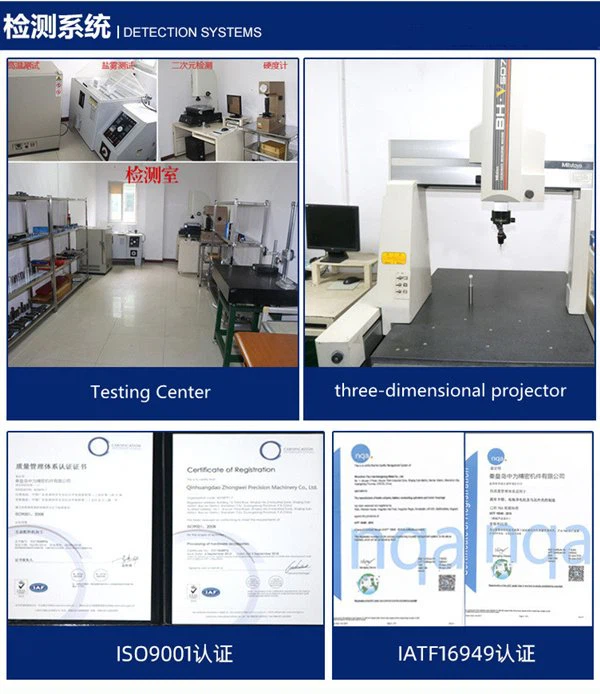
1. Quality control: the defective rate is less than 0.1%.
2. Samples and trial run will be 100% inspected during production and before shipment, sample inspection for mass production according to ISDO standards or customer requirements
3. Testing equipment: flaw detection, spectrum analyzer, golden image analyzer, three-coordinate measuring machine, hardness testing equipment, tensile testing machine.
Application
Cemented carbide powder metallurgy sintered parts are mainly used in the production of spare parts and research related raw materials and accessories in the automotive industry, equipment manufacturing, metal industry, aerospace, military industry, instrumentation, hardware tools, electronic appliances and other fields. Manufacturing of powder preparation equipment and sintering equipment. Products include bearings, gears, carbide tools, molds, friction products and more. In military enterprises, heavy equipment such as armor-piercing projectiles, torpedoes, etc., and brake pairs such as aircraft and tanks need to be produced by powder metallurgy technology. Powder metallurgy auto parts has become the largest market in China's powder metallurgy industry in recent years, and about 50% of auto parts are powder metallurgy parts.
(1) Application: (automobiles, motorcycles, textile machinery, industrial sewing machines, power tools, hardware tools. Electrical appliances. Engineering machinery, etc.) various powder metallurgy (iron copper base) parts.
(2) Classification: powder metallurgy porous materials, powder metallurgy anti-friction materials, powder metallurgy friction materials, powder metallurgy structural parts, powder metallurgy tool and die materials, powder metallurgy electromagnetic materials and powder metallurgy high temperature materials, etc.
Carbide is mainly used for cutting tools, such as turning tools, milling tools, etc. The more carbide content and the less cobalt content in the cemented carbide, the higher the alloy hardness, hot hardness and wear resistance, but the lower the strength and toughness. YG alloys are suitable for processing brittle materials, and YT alloys are suitable for processing plastic materials. Similar alloys with high cobalt content are suitable for rough machining, and those with low cobalt content are suitable for finishing.
Cemented carbide is also used to make cold working dies, such as cold drawing dies, cold punching dies, cold extrusion dies and cold heading dies. Among them, YG type is suitable for drawing dies, YG6 and YG8 are suitable for small drawing dies, and YG15 is suitable for large drawing dies and stamping dies.
Carbide is also used in the manufacture of measuring tools and wear-resistant parts, such as the measuring head of the micrometer, the tip of the top part of the lathe, the guide plate of the finishing roll and the centerless grinder, etc.
In recent years, steel-bonded cemented carbide has been widely used as a new type of tool and die material. After annealing, the steel-bonded cemented carbide can be machined. After quenching and tempering, it has high hardness, wear resistance, certain heat resistance, corrosion resistance and oxidation resistance equivalent to cemented carbide. It can also be welded. And forging, suitable for making tools with complex shapes (such as twist drills, milling cutters, etc.), molds and wear parts.



Send Inquiry
