



Stainless Steel Silica Sol Investment Casting
Stainless steel precision casting or investment investment casting, silica sol process. It is a casting process with little or no cutting, and an excellent process technology in the foundry industry. The surface quality is higher than other casting methods, and even complex, high temperature resistant and difficult to process castings that are difficult to cast by other casting methods can be cast by investment casting.
Stainless steel precision casting or investment investment casting, silica sol process. It is a casting process with little or no cutting, and an excellent process technology in the foundry industry. The surface quality is higher than other casting methods, and even complex, high temperature resistant and difficult to process castings that are difficult to cast by other casting methods can be cast by investment casting.
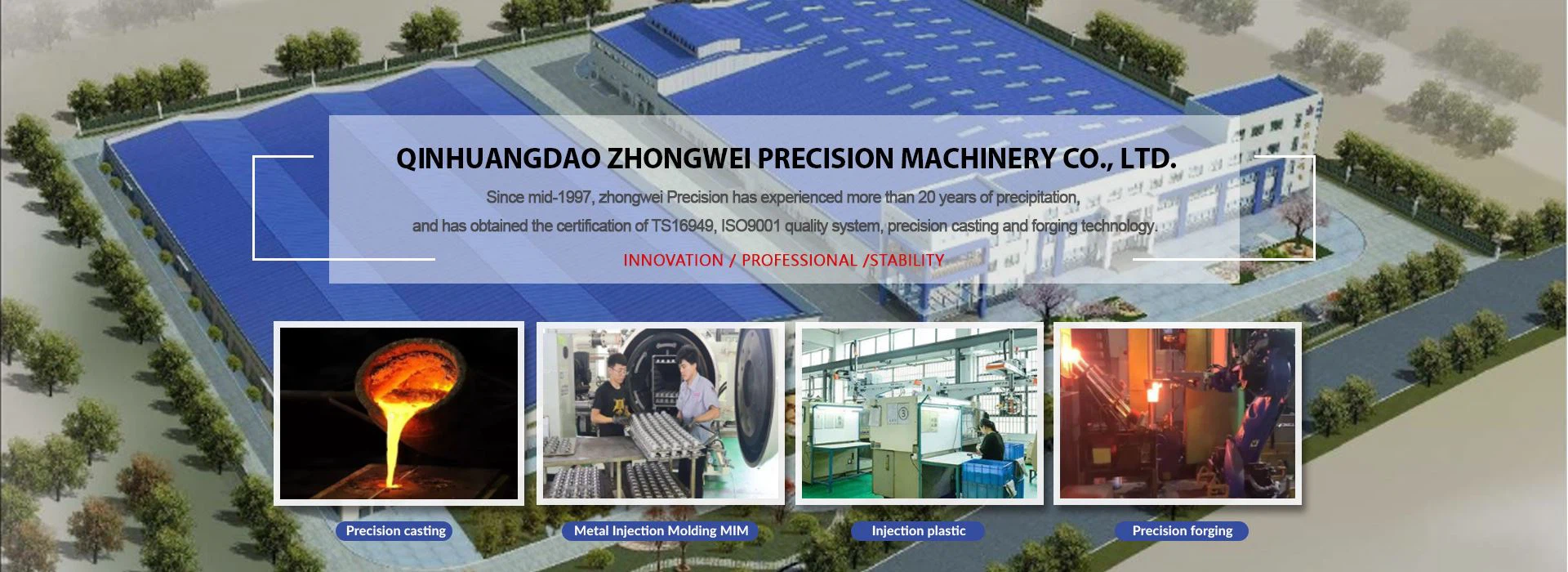
After more than ten years of precipitation, Qinhuangdao Zhongwei Precision Machinery Co., Ltd. has rich production experience in water glass lost wax precision casting, lost foam precision casting technology, silica sol precision casting technology, and shell sand casting technology. We expect manufacturers from all over the world to consult and negotiate business.
Product Description
Stainless Steel Silica Sol Investment Casting Basics
1. Implementation standards: The company strictly implements ISO9001 & TS 16949 certification.
2. Product material standards: ISO, GB, ASTM, SAE, ISO, EN, DIN, JIS, BS
3. Main processes: sand casting, silica sol investment casting, water glass investment casting,shell casting,deburring, sand blasting, machining, heat treatment, leak testing, surface treatment, etc.
4. Available materials:
High manganese steel, high chromium steel, high nickel steel, carbon steel, alloy steel, stainless steel, gray iron, cast iron, cast steel, cast aluminum, cast copper, etc. can be customized according to customer requirements.
Development History Of Stainless Steel Silica Sol Investment Casting
The practical application of modern investment casting methods in industrial production was in the 1940s. The development of aviation jet engines at that time required the manufacture of heat-resistant alloy parts with complex shapes, precise dimensions and smooth surfaces, such as blades, impellers, and nozzles. Since the heat-resistant alloy materials are difficult to machine and the shapes of the parts are so complex that they cannot or are difficult to manufacture by other methods, it is necessary to find a new precise molding process, so the lost wax casting handed down from ancient times is used for reference. With the improvement of modern investment casting methods, important development has been achieved on the basis of ancient craftsmanship. Therefore, the development of the aviation industry has promoted the application of investment casting, and the continuous improvement and perfection of investment casting has also created favorable conditions for the aviation industry to further improve its performance. my country began to apply investment casting to industrial production in the 1950s and 1960s. Since then, this advanced casting process has been greatly developed, and has been widely used in aviation, automobiles, machine tools, ships, internal combustion engines, gas turbines, telecommunication equipment, weapons, medical equipment and cutting tools and other manufacturing industries. Manufacture of works of art.
The so-called investment casting process, simply put, is to use fusible materials (such as wax or plastic) to make a fusible model (referred to as investment mold or model), and apply several layers of special refractory coatings on it, which are dried and hardened. After forming an integral mold shell, the mold is melted from the mold shell with steam or hot water, and then the mold shell is placed in a sand box, filled with dry sand molding around it, and finally the mold is placed in a roasting furnace for high temperature. Roasting (for example, when a high-strength mold is used, the mold shell after demolding can be directly fired without molding), after the mold or mold is fired, molten metal is poured into it to obtain a casting.

The dimensional accuracy of investment castings is relatively high, generally reaching CT4-6 (CT10~13 for sand casting and CT5~7 for die casting). Of course, due to the complex process of investment casting, there are many factors that affect the dimensional accuracy of castings, such as mold The shrinkage of the material, the deformation of the investment mold, the linear change of the shell during the heating and cooling process, the shrinkage rate of the alloy, and the deformation of the casting during the solidification process, etc., so the dimensional accuracy of ordinary investment castings is high, but its Consistency still needs to be improved (castings with medium and high temperature waxes are much more dimensionally consistent).
When pressing the investment mold, a mold with a high surface finish of the cavity is used, so the surface finish of the investment mold is also relatively high. In addition, the shell is made of high temperature-resistant special binder and refractory paint prepared from refractory materials, which is coated and hung on the investment mold, and the inner surface of the cavity that is in direct contact with the molten metal has a high smoothness. Therefore, the surface finish of investment castings is higher than that of general castings, generally reaching Ra.1.6~3.2μm.
The biggest advantage of investment casting is that investment castings have high dimensional accuracy and surface finish, so machining work can be reduced, just leave a little machining allowance on parts with higher requirements, and even some castings only Leave grinding, polishing allowance, can be used without machining. It can be seen that the use of investment casting method can save a lot of machine tool equipment and processing time, and greatly save metal raw materials.
Another advantage of the investment casting method is that it can cast complex castings of various alloys, especially superalloy castings. For example, the blade of a jet engine has a streamlined outline and an inner cavity for cooling, which can hardly be formed by machining. The investment casting process can not only achieve mass production and ensure the consistency of castings, but also avoid the stress concentration of residual knife lines after machining.
Qinhuangdao Zhongwei Precision Machinery Co., Ltd. is a joint-stock enterprise integrating precision casting and processing. It has a casting history of more than ten years. The company adopts silica sol technology and specializes in the production of carbon steel, alloy steel, stainless steel and heat-resistant steel. Precision castings of more than 100 materials. Especially in recent years, it has focused on the development of turbine and impeller projects, production technology and quality control. The company strictly follows ISO90001 certification, and has started TS16949 certification. The high-temperature master alloy adopts Beijing Antai Technology (formerly Beijing Iron and Steel Institute) Beijing Beizhi Functional Materials Co., Ltd. (former Beijing Shougang Metallurgy Research Institute), the K418 (K18C) and K213 (K13) high-temperature master alloys produced by Beihang, have a monthly production capacity of 50,000 sets of turbine impellers.
There are more than 250 employees, including more than 30 professional technicians and more than 10 engineers. The company has very complete investment casting production equipment, machining equipment and advanced physical and chemical analysis and testing equipment, which can meet the product requirements of different levels of customers and the all-round requirements of physical and chemical properties and non-destructive testing. Existing spectrum analyzers, tensile testing machines, X-ray flaw detectors, magnetic particle flaw detectors, portable magnetic particle flaw detectors, metallographic microscopes and other testing equipment, at the same time, the company is constantly introducing the world's advanced technology and professional technical personnel , to expand advanced production and testing equipment, the technical force of the enterprise is becoming stronger and stronger, and the economic strength is also constantly developing and growing.
Post Casting Process
1. Heat treatment: annealing, carbonization, tempering, quenching, normalizing, surface tempering
2. Processing equipment: CNC, WEDM, lathe, milling machine, drilling machine, grinder, etc.;
3. Surface treatment: powder spraying, chrome plating, painting, sandblasting, nickel plating, galvanizing, blackening, polishing, bluing, etc.

Moulds and Inspection Fixtures
1. Mold service life: usually semi-permanent. (except for lost foam).
2. Mold delivery time: 10-25 days, (according to product structure and product size).
3. Tooling and mold maintenance: Zhongwei is responsible for precision parts.
Quality Control
1. Quality control: the defective rate is less than 0.1%.
2. Samples and trial run will be 100% inspected during production and before shipment, sample inspection for mass production according to ISDO standards or customer requirements
3. Testing equipment: flaw detection, spectrum analyzer, golden image analyzer, three-coordinate measuring machine, hardness testing equipment, tensile testing machine;
4. Provide after-sales service.
5. The quality can be traced back.
Application
Stainless Steel Silica Sol Investment Casting is suitable for food and catering, chemicals, medical device manufacturing, building and construction, household appliances, offshore and shipbuilding, automobile manufacturing, energy and industry.
Types Of Stainless Steel
Depending on the environment the metal is expected to withstand, stainless steel is available in a variety of grades and finishes. According to their microstructure, they can be divided into four categories.
1. Austenitic stainless steel
Austenitic stainless steel has austenite as the main microstructure. Austenite is a solid solution of iron and carbon that forms above a critical temperature of 723°C. This stainless steel family exhibits high toughness and impressive high temperature resistance.
70% of all stainless steel is austenite. It contains at least 16% chromium and 6% nickel.
Austenite stabilizers are elements added to promote the formation of the austenite microstructure. This stainless steel grade is a non-magnetic metal and cannot be hardened by heat treatment. Corrosion resistance can be modified according to the usage environment.
2. Ferritic stainless steel
Ferritic steels usually contain only chromium as an alloying element. Chromium content ranges from 10.5 to 18%. They have average corrosion resistance and poor manufacturing characteristics. Heat treatment methods also do nothing to harden the metal.
They generally have better engineering capabilities than austenitic steels. Unlike austenitic stainless steels, they are magnetic. They also have good stress corrosion resistance, which reduces wear on corrosive materials.
3. Duplex stainless steel
Duplex stainless steels are mixtures of austenitic and ferritic stainless steels. Therefore, it has the properties of its two components. It has high chromium and low nickel concentrations. Duplex stainless steels have unique advantages due to their high tensile strength and good weldability.
It shows good stress corrosion resistance, but not as good as ferritic grades. It is tougher than ferritic grades but lower than austenitic grades.
4. Martensitic stainless steel
This type of stainless steel consists of high carbon and low chromium content. Like ferritic grades, it is magnetic. It does show poor weldability compared to other grades, but it has higher hardenability and can be heat treated to improve performance.
Compared to austenitic and ferritic stainless steels with the same chromium and alloy content, martensitic stainless steels have lower corrosion resistance.
5. Precipitation hardening stainless steel
This subgroup provides a combination of austenitic and martensitic properties. Hardening is achieved by adding one or more elements such as aluminium, molybdenum, niobium, titanium and copper.
It is capable of producing high tensile strength by heat treatment. It contains chromium and nickel as alloying elements. These grades are used in high speed applications such as turbine blades.


Send Inquiry
