




A96061 Metal Powder Injection Molded Parts
The 6061 aluminum alloy was welded by vacuum diffusion welding, the tensile strength of the welded joint was tested by a universal testing machine, and the microstructure of the welded joint was analyzed by an optical microscope. Under the conditions of welding temperature of 530 ℃, holding time of 7 h and welding pressure of 3.5 MPa, the tensile strength of the diffusion-welded joint reaches the maximum value of 137.3 MPa.
Product Description
|
A96061 Metal powder injection molded parts |
|||||
|
Item |
Material |
Production Process |
Sintering Temperature |
Mold |
Custom |
|
A96061 |
Aluminum alloy |
Metal Injection Molding |
1500°C |
To be customized |
Yes |
|
Chemical composition |
unit:% Cu:0.15~0.4 Mn :0.15 Mg :0.8~1.2 Zn :0.25 Cr:0.04~0.35 Ti :0.15 Si:0.4~0.8 Fe :≤0.7 Al : Margin |
||||
|
Available Materials |
Low carbon stainless steel, titanium alloy (Ti, TC4), copper alloy, tungsten alloy, hard alloy, high temperature alloy (718, 713) |
||||
Research on A96061 Metal Powder Injection Molded Parts
The 6061 aluminum alloy was welded by vacuum diffusion welding, the tensile strength of the welded joint was tested by a universal testing machine, and the microstructure of the welded joint was analyzed by an optical microscope. Under the conditions of welding temperature of 530 ℃, holding time of 7 h and welding pressure of 3.5 MPa, the tensile strength of the diffusion-welded joint reaches the maximum value of 137.3 MPa; There is no leakage in the water pressure test, and the deformation of the aluminum alloy is not more than 0.5%. The reliable welding of 6061 aluminum alloy water-cooled plate is realized by vacuum diffusion welding process. Liu Xiaochen proposed a new sintering diffusion welding technology, compared and analyzed its differences and connections with traditional powder sintering, diffusion welding and other sealing connection technologies. M. Elsad et al. studied the influence of welding pressure on the microstructure and mechanical properties of aluminum/copper diffusion welding joints. The pulsating pressure can significantly improve the diffusion bonding process by destroying the oxide layer on the metal bonding surface. At the same time, increasing the welding pressure will affect the reaction layer. produce more extrusion deformation (extrusion effect), the purpose of which is to improve the atomic diffusion and mechanical properties of Al-Cu joints by controlling the bonding pressure (welding pressure), temperature (600 °C) and time (60 min) to maintain remains unchanged, while the bonding pressure varies between 5 and 12.5 MPa. The metallurgical and mechanical properties of the joints were studied by M. Elsad. The results showed that an oxide-free bonding interface was formed at the joint in the pressure range of 5–12.5 MPa. The increase of bonding pressure (5-12.5 MPa) increases the bonding strength (78.39-108.47 MPa) and diffusion depth (11.32-20.87 m) between Al/Cu interfaces.
In order to improve the yield of radar antenna components, Li Wendong [25] used brazing and brazing-diffusion welding composite connection methods to conduct welding experiments on 3A21 aluminum alloy multilayer structures. The morphology and composition of the joints were analyzed by scanning electron microscope, energy spectrum and X-ray diffraction. The results show that compared with brazing, the quality of the joint obtained by the brazing diffusion welding composite method is better, and the microstructure of the joint weld mainly includes honeycomb Al matrix, massive Al-Si phase and primary Si, etc. Between Si, Mg, Mn elements have been fully diffused uniformly. Through the analysis of joint shear test and fracture, the results show that within a certain range, the joint shear strength increases with the increase of diffusion time and pressure, and the highest shear strength reaches 81 MPa. The surface morphology of the fracture surface of the joint is brittle fracture, and there are many relatively flat cleavage surfaces in the shape of river patterns and a few dimples on the fracture surface. The deformation of the weldment obtained by the brazing-diffusion welding method is less than 0.02 mm, which meets the deformation requirements. Huang Bensheng discussed that foamed aluminum has both structural and functional properties. In order to give full play to the various properties of foamed aluminum, it is often combined with dense metal to obtain a sandwich structure to improve its comprehensive mechanical properties and reduce costs. There are many connection methods for the sandwich structure, and welding is the most reliable connection method. Firstly, the performance characteristics and welding difficulties of aluminum foam are introduced, and its welding methods are summarized, including conventional arc welding, laser welding, brazing, diffusion welding, friction stir welding, plasma welding and ultrasonic welding, and then the limitations of each process are analyzed. Finally, the development direction of the welding process of foamed aluminum connectors is analyzed.
Metal Injection Molding Process

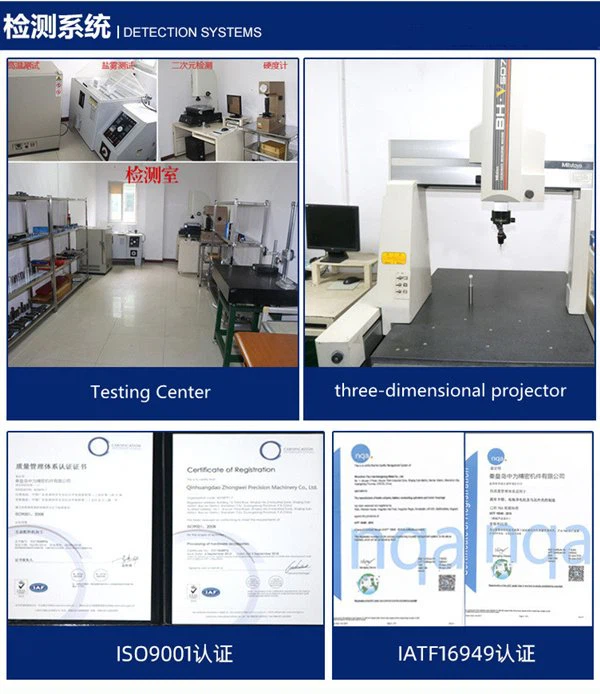
Detection Systems


Send Inquiry
