



S31603 Metal Powder Injection Molded Parts
316L is a stainless steel grade, AISI 316L is the corresponding American designation, and sus 316L is the corresponding Japanese designation. my country's unified digital code is S31603, the standard grade is 022Cr17Ni12Mo2 (new standard), and the old grade is 00Cr17Ni14Mo2, which means that it mainly contains Cr, Ni, and Mo, and the number indicates the approximate percentage contained. The national standard is GB/T 20878-2007 (current version).
Product Description
|
S31603 Metal powder injection molded parts |
|||||
|
Item |
Material |
Production Process |
Sintering Temperature |
Mold |
Custom |
|
S31603 |
Stainless steel |
Metal Injection Molding |
1500°C |
To be customized |
Yes |
|
Available Materials |
Low carbon stainless steel, titanium alloy (Ti, TC4), copper alloy, tungsten alloy, hard alloy, high temperature alloy (718, 713) |
||||
316L is a stainless steel grade, AISI 316L is the corresponding American designation, and sus 316L is the corresponding Japanese designation. my country's unified digital code is S31603, the standard grade is 022Cr17Ni12Mo2 (new standard), and the old grade is 00Cr17Ni14Mo2, which means that it mainly contains Cr, Ni, and Mo, and the number indicates the approximate percentage contained. The national standard is GB/T 20878-2007 (current version).
Chemical composition
C: ≤0.030
Si: ≤1.00
Mn: ≤2.00
S : ≤0.030
P: ≤0.045
Cr: 16.00~18.00
Ni: 10.00~14.00
Mo: 2.00~3.00
Corrosion resistance
316L is widely used in the chemical industry because of its excellent corrosion resistance. 316L is also a derivative of 18-8 austenitic stainless steel, with 2 to 3% Mo added. On the basis of 316L, many steel types are also derived. For example, 316Ti is derived by adding a small amount of Ti, 316N is derived by adding a small amount of N, and 317L is derived by increasing the content of Ni and Mo.
Most of the existing 316L on the market is produced according to the American Standard. For cost considerations, steel mills generally keep the Ni content of S31603 Metal powder injection molded parts products as low as possible. The American standard stipulates that the Ni content of 316L is 10-14%, while the Japanese standard stipulates that the Ni content of 316L is 12-15%. According to the minimum standard, there is a 2% difference in Ni content between the American Standard and the Japanese Standard, which is quite huge when reflected in the price. Therefore, when purchasing 316L products, customers still need to see clearly whether the products refer to ASTM or JIS standards.
The Mo content of 316L makes this steel have excellent corrosion resistance, and can be safely used in environments containing halogen ions such as Cl-. Since the main application of 316L is its chemical properties, steel mills have slightly lower requirements for surface inspection of 316L (compared to 304), and customers with higher surface requirements should strengthen surface inspection.
Mechanical properties
Tensile strength σb (MPa): ≥480
Conditional yield strength σ0.2 (MPa): ≥177
Elongation δ5 (%): ≥40
Reduction of area ψ (%): ≥60
Hardness: ≤187HB; ≤90HRB; ≤200HV
Density: 7.98g/cm3;
Specific heat capacity ratio (20°C): 0.502kJ/(g*K)
|
Thermal conductivity (W/(m*K)) |
||
|
100℃ |
300℃ |
500℃ |
|
15.1 |
18.4 |
20.9 |
Heat treatment:Solid solution 1010 ~ 1150 ℃ rapid cooling.
Microstructure:The organizational characteristics are austenitic stainless steel.
Distinguish
SUS316L stainless steel:
The two most commonly used stainless steels 304 and 316 (or corresponding to German/European standard 1.4308, 1.4408), the main difference in chemical composition between 316 and 304 is that 316 contains Mo, and it is generally recognized that 316 has better corrosion resistance. It is more corrosion resistant than 304 in high temperature environment. Therefore, in high temperature environments, engineers generally choose parts made of 316 materials. But the so-called nothing is absolute, in the concentrated sulfuric acid environment, do not use 316 no matter how high the temperature is. Otherwise, it will cause serious problems. Anyone who studies mechanics has learned threads, and remember that in order to prevent the threads from being seized at high temperatures, a dark solid lubricant needs to be applied: molybdenum disulfide (MoS2), from which two conclusions can be drawn: One: Mo is indeed a high temperature resistant substance (do you know what crucible is used to melt gold? Molybdenum crucible!). Two: Molybdenum can easily react with high-valent sulfur ions to form sulfide. So there is no one kind of stainless steel that is super invincible and corrosion-resistant. In the final analysis, stainless steel is a piece of steel with more impurities (but these impurities are more corrosion-resistant than steel), and steel can react with other substances.
Metal Injection Molding Process

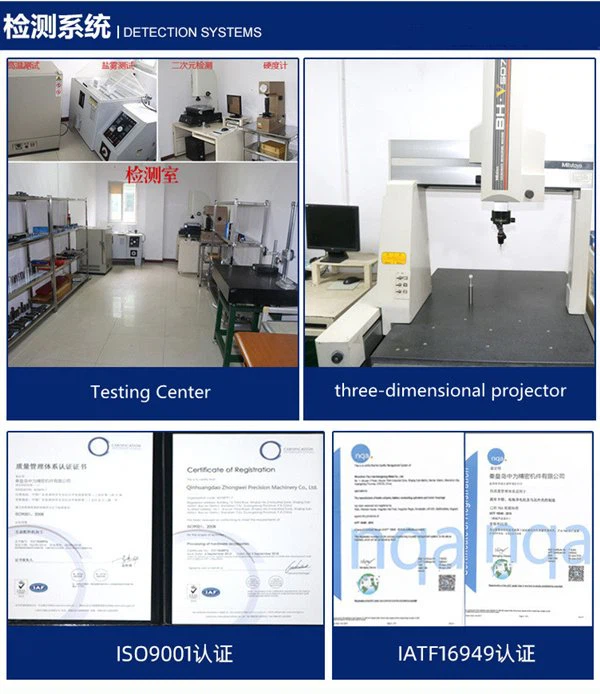
Detection Systems


Send Inquiry
