



FGS600-2 Ductile Iron Castings
Features: Fracture silver-gray, distribution of sesame black spots. A large number of thick sheets of graphite are distributed in the metallographic structure.
Product Introduction
|
FGS600-2 Ductile iron castings |
|||||||
|
Item |
Material |
Production Process |
Sintering Temperature |
Mold |
Custom |
||
|
FGS600-2 Ductile iron castings |
FGS600-2 |
Molten mold casting |
1380℃ |
To be customized |
Yes |
||
|
Available Materials |
Carbon steel, alloy steel, aluminum alloy, low -carbon stainless steel, titanium alloy (TI, TC4), copper alloy, high temperature alloy (718, 713) |
||||||
|
Smoothness |
Dimensional accuracy |
Product density |
Appearance treatment |
Appropriate weight |
|||
|
Roughness 1~5μm |
(±0.1%~±0.5%) |
7.3-7.6/CM³ |
According to customer requirements |
0.03g~40kg |
|||
FGS600-2 lost wax investment casting of ductile iron
Typical defects of ductile iron
1. Poor nodularization and nodularization degradation
Features: Fracture silver-gray, distribution of sesame black spots. A large number of thick sheets of graphite are distributed in the metallographic structure.
Reason: the original iron liquid contains high sulfur, excessive antispheroidizing elements. It is recommended to choose low sulfur coke, desulfurization treatment, increase the amount of rare earth nodulator if necessary, and control the blast intensity and material level of cupola.
2. Shrinkage and porosity
Features: Shrinkage occurs in the first contraction stage. Surface depression and local hot joint depression, dark shrinkage hole with porosity, inner wall rough. Shrinkage occurs in the second contraction stage. The solution pool divided by dendrites becomes a vacuum, the solidified pore wall is rough, and the loose pore filled with dendrites is shrinkage porosity.
Reason: low carbon equivalent, high phosphorus content, increasing the tendency of shrinkage and porosity.
Measures: To improve the rigidity of the mold, such as the use of resin sand, to increase the carbon equivalent of liquid iron.
3. Graphite floating
Features: In the cooling process, the hypereutectic iron liquid first precipitates graphite balls, which float up and gather into graphite floating, distributed in the upper riser of the final part of the casting. The microcosmic observation shows that the series of graphite spheres are in flowering shape.
Reasons: carbon equivalent and rare earth residues are high, the original size of the charge is large, the number is large, may increase the graphite floating.
Measures: It is recommended that C<4%, control the rare earth content, and pay attention to the mix of raw iron and other charges.
4. Anti-white talk
Features: The macro section is a white bright block with clear boundaries, showing a directional white bright needle, appearing in the center of the hot joint. Metallographic observation of supercooled dense fine acicular cementite.
Reasons: the center of the solidification node segregation rich magnesium, rare earth, manganese and other white elements, insufficient inoculation or large cooling speed.
Measures: Reduce the residual rare earth magnesium under the premise of spheroidization, prevent the strong whitened elements in the charge, strengthen inoculation, and improve the temperature of small castings.
5. Slag inclusion
Features: At the upper surface or dead corner of the casting position, the cross section is dark and dull, with different shades of inclusion, and the metallography is visible and blocky inclusion.
Reason: The main reason for the formation of a single slag inclusion is the high sulfur content and serious oxidation of the original iron liquid; The main reason for the secondary slag inclusion is that the residual amount of magnesium is too high, which increases the formation temperature of oxide film.
Measures: Reduce the sulfur and oxygen content of the original iron liquid, ensure that the residual magnesium is reduced during spheroidization, and add an appropriate amount of rare earth to reduce the temperature of the shaped film. The casting system should make the filling stable, and the slag collecting riser should be arranged in the slag inclusion part.
6. Stress deformation and cracks
Characteristics: When the sum of shrinkage stress and phase change stress exceeds the fracture resistance of the fracture section, the metal cracks are formed. The hot crack is dark brown uneven port, and the cold crack is light brown smooth flat fracture.
Reasons: low carbon content, increased carbide forming elements, insufficient inoculation, cooling too fast.
Measures: appropriately increase carbon equivalent, reduce phosphorus content, strengthen inoculation and other measures.
7. Broken graphite
Features: Active elements such as Ce are enriched at the boundary of eutectic clusters, which causes the region to oversaturate out and form wormlike graphite, whose section shape is fragmentary.
Reasons: Slow cooling, eutectic solidification time is too long caused by component segregation and incubation decline.
Measures: Select pure charge and limit the content of Ce and other elements, control low carbon equivalent, and add trace elements such as Sb, Y and Bi.
Zhongwei Precision has the following services
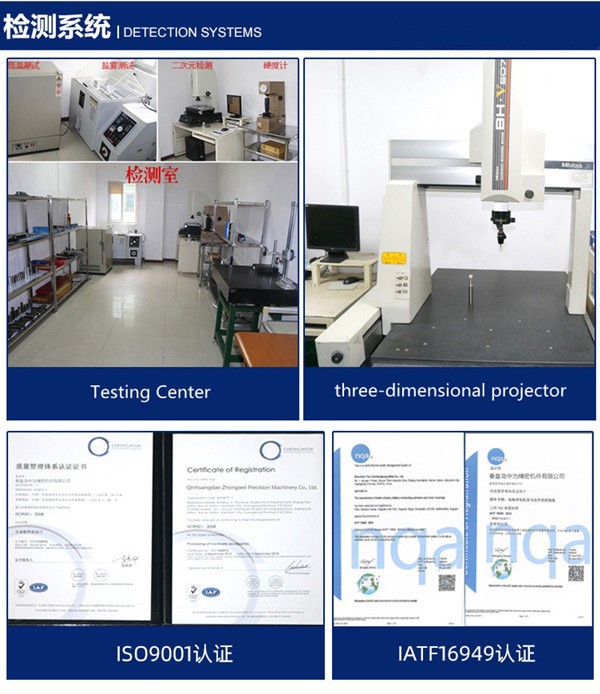
Detection Systems
Copper Silica Sol Investment Casting


We are the manufacturer of "FGS600-2 Ductile iron castings", if you need more information please contact us!


Send Inquiry
