




FGS500-7 Ductile Iron Castings
The mechanical properties of ductile iron are based on two indexes: tensile strength and elongation. Under the condition of stable production process, acceptance can also be carried out according to the hardness value.
Product Introduction
|
FGS500-7 Ductile iron castings |
|||||||
|
Item |
Material |
Production Process |
Sintering Temperature |
Mold |
Custom |
||
|
FGS500-7 Ductile iron castings |
FGS500-7 |
Molten mold casting |
1380℃ |
To be customized |
Yes |
||
|
Available Materials |
Carbon steel, alloy steel, aluminum alloy, low -carbon stainless steel, titanium alloy (TI, TC4), copper alloy, high temperature alloy (718, 713) |
||||||
|
Smoothness |
Dimensional accuracy |
Product density |
Appearance treatment |
Appropriate weight |
|||
|
Roughness 1~5μm |
(±0.1%~±0.5%) |
7.3-7.6/CM³ |
According to customer requirements |
0.03g~40kg |
|||
FGS500-7 lost wax investment casting of ductile iron
Mechanical properties of ductile iron
The mechanical properties of ductile iron are based on two indexes: tensile strength and elongation. Under the condition of stable production process, acceptance can also be carried out according to the hardness value. Because the corresponding relationship between hardness and strength is established on the basis of qualified spheroidization, chemical composition, inoculation stability, and reasonable casting process, in order to ensure the performance, it is stipulated that the metallographic structure must be tested when accepting according to the hardness, and the spheroidization rate shall not be less than 4. Even if the hardness and spheroidization are qualified, the strength and toughness may not meet the requirements due to the presence of cementite, phosphorus eutectic and high silicon solution strengthening in the matrix. Therefore, without the stable conditions of the production process, it can not be accepted according to the hardness value.
GB specified ductile iron grade

1. Net load performance
(1) Hardness
The hardness of ductile iron mainly depends on the matrix structure, and has a corresponding relationship with tensile strength, elongation and other net load properties.
(2) Strength and plasticity
The strength and plasticity of nodular cast iron mainly depend on the matrix structure, lower bainite or tempered martensite strength is the highest, followed by upper bainite, sorbite, pearlite. With the increase of ferrite, the strength decreases and the elongation increases. Austenite or ferrite has lower strength and better plasticity.
2. Dynamic load performance
(1) Impact toughness
The impact toughness of ferritic nodular cast iron varies greatly due to the change of silicon content and bainitic nodular cast iron due to the change of upper, lower bainite and austenite quantity.

(2) Fatigue strength
Some ductile iron has a high fatigue strength, equivalent to 45 normalizing steel, such as pearlitic ductile iron.
Bending fatigue strength of ductile iron with various matrix structures

3. High temperature performance
(1) Hardness
All kinds of ductile iron have good hardness at low temperature, but at 540℃ began to granular, higher than 650℃ began to decompose, the hardness began to decline and gradually close to the hardness of ferritic ductile iron.

(2) High temperature short-term mechanical properties
The figure shows that the tensile strength of ductile iron decreases with increasing temperature. In the elongation, the ferrite first significantly decreased and then sharply increased, and the pearlite slowly decreased and then significantly increased.
(3) High temperature creep and lasting strength

(4) fatigue strength

4. Low temperature performance
With the decrease of temperature, ductile iron gradually changes from toughness to brittleness, especially below the brittleness transition temperature, the impact value drops sharply. At the same time, the yield strength increases, the elongation decreases, and the sensitivity to stress concentration increases obviously, which shows that the deformation is small after the yield. For ferritic nodular cast iron with good plasticity at room temperature, the tensile strength increases at low temperature.
Low temperature tensile properties of ferrite and pearliteSi: 2.1%;P:0.09%

Physical properties of ductile iron
1. Density
① The normal temperature density of ductile iron

② The density of molten magnesium ductile iron

Note:
(1) C:3.44%, Si:2.56%, Mn:0.22%, P:0.11%
(2) C:3.3-3.6%, Si:1.6-2.6%, Mn:0.4-0.5%,
2. Linear expansion coefficient
The coefficient of linear expansion increases slowly with the increase of temperature, and increases significantly after 600℃.

3. Thermal conductivity
The thermal conductivity depends on the composition, structure, graphite form and temperature. The thermal conductivity of graphite is better than that of the matrix structure, and the thermal conductivity of graphite along the base plane is better than that along the C-axis. The higher the carbon content, the better the thermal conductivity; The lower the spheroidization rate, the better the thermal conductivity; The lower the temperature, the better the thermal conductivity. The thermal conductivity of ductile iron is higher than that of steel, but lower than that of gray iron.
Zhongwei Precision has the following services
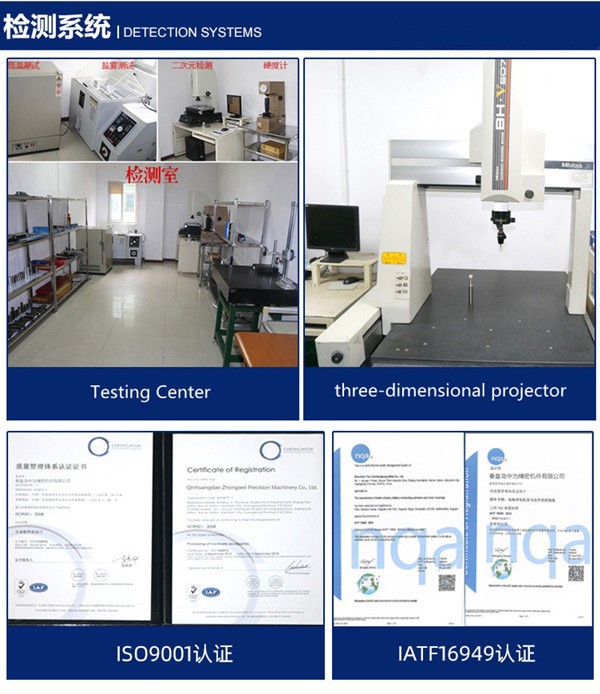
Detection Systems
Copper Silica Sol Investment Casting


We are the manufacturer of "FGS500-7 Ductile iron castings", if you need more information please contact us!


Send Inquiry
