



Tungsten Alloy Metal Injection Molded Parts
The research progress of Tungsten Alloy Metal Injection Molded Parts, emphatically introduces the research and theoretical discussion of tungsten and tungsten alloy powder injection molding process, enumerates the application of tungsten materials in the fields of national defense, aerospace, energy, electronics and other industries, and summarizes the tungsten and tungsten alloys.
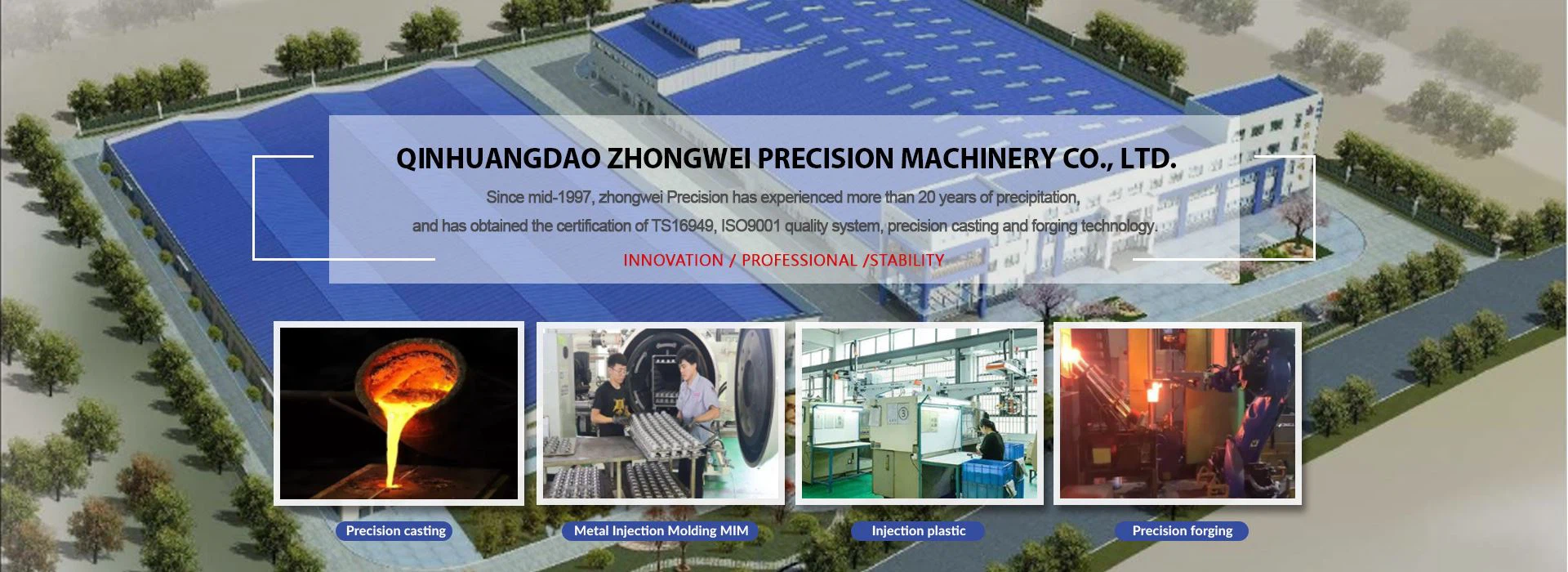
The research progress of Tungsten Alloy Metal Injection Molded Parts, emphatically introduces the research and theoretical discussion of tungsten and tungsten alloy powder injection molding process, enumerates the application of tungsten materials in the fields of national defense, aerospace, energy, electronics and other industries, and summarizes the tungsten and tungsten alloys. material research direction. Through the use of high-quality powder preparation and improvement technology, reasonable structural design of tungsten cathode and comprehensive optimization of the preparation process, the technical subject of tungsten powder injection molding is proposed in the key tungsten parts of new structural design, and the prospect of tungsten science and technology is prospected. A bright future for development. Qinhuangdao Zhongwei Precision Machinery Co., Ltd. is a collection of copper alloy metal injection molding, iron-based metal injection molding, stainless steel-based metal injection molding, aluminum alloy metal injection molding, nickel alloy metal injection molding, cobalt alloy metal injection molding, tungsten alloy metal injection molding A comprehensive high-tech enterprise integrating R&D, production and sales of injection molding, cemented carbide metal injection molding, and powder metallurgy structural parts.
Product Description
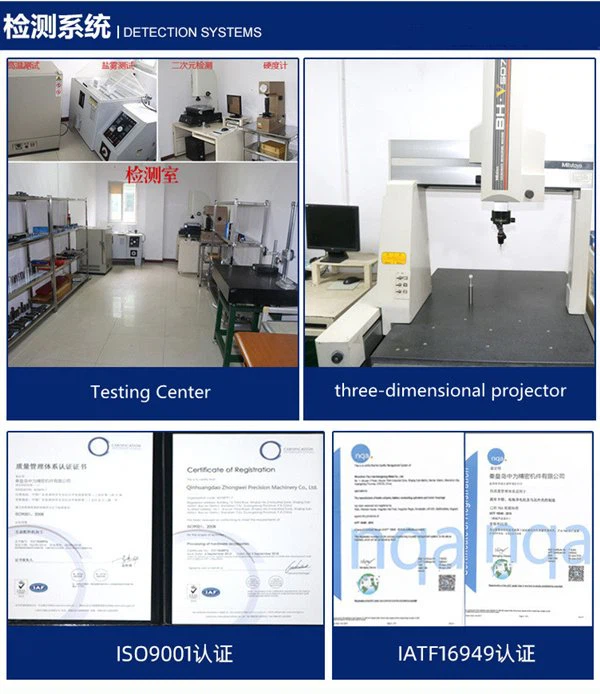
1. Implementation standards: the company strictly implements ISO9001, ISO14001, IATF16949 certification
The products have passed the certification of ROHS, FDA EU, etc.
2. Product material standards: ISO, GB, ASTM, SAE, EN, DIN, BS, AMS, JIS, ASME, DMS, TOCT, GB
3. Main processes: metal injection molding MIM, powder metallurgy PM, investment casting, die-casting aluminum,
4. Available materials for powder metallurgy:
Copper alloys, iron bases, titanium alloys, stainless steel bases, aluminum alloys, nickel alloys, cobalt alloys, tungsten alloys, cemented carbides, hydroxy alloys, soft magnetic materials and 3D printing can be customized according to customer requirements.
Production Process
1. Metal Powder Injection Molding (MIM), as a near-net-shape technology for manufacturing high-quality precision parts, has incomparable advantages over conventional powder metallurgy and machining methods.
1.1. Characteristics of powder injection molding technology
Compared with traditional powder metallurgy and precision casting, powder injection molding technology uses a large amount of binder as powder flow filling
It is the carrier of the mold cavity, so it is possible to prepare powder metallurgy parts of any shape like plastic molding, which is impossible to achieve by traditional powder metallurgy molding process. Since injection molding is a near-net-shape forming process, the products basically do not require subsequent processing. Some products that require dozens of machining processes can be formed at one time using PIM, and the manufacturing cost is relatively low. PIM technology can also realize the integration of components. Due to processing technology or material properties, when some parts are manufactured by traditional technology, they need to be processed into several parts for assembly, and sometimes the materials of several parts are different. With PIM technology, an integral composite part HJ can be directly made. Since the raw material for injection molding fills the mold cavity uniformly in a fluid state, the powder density distribution of the formed blank is uniform, which avoids the problem of uneven density distribution of the formed blank caused by the frictional pressure loss of the mold wall in the powder metallurgy molding process, which can greatly reduce the Sintering deformation. PIM product shape can be very complex and very small (thickness can be less than 0.25mm), can be formed into the final geometry. Compared with precision casting, the dimensional accuracy is high, the surface roughness is low, and no or a little subsequent processing is required. Since the powder used in PIM technology is generally fine, the product can reach a high density after sintering. Therefore, the strength of PIM products, The mechanical properties such as hardness and plasticity are generally better than those of powder metallurgy molding and precision casting products. PIM has a high utilization rate of raw materials, and has greater advantages and potential for parts with complex shapes (such as high-density alloys, cemented carbides, special ceramics, etc.) that are relatively expensive and can only be produced by powder methods.
1.2 The main production steps of metal injection molding technology technology are as follows: mixing metal powder with binder - granulation - injection molding - degreasing - sintering - subsequent processing - final product, the technology is suitable for mass production performance Small size powder metallurgy parts with high height and complex shape.
2. Tungsten Alloy Metal Injection Molded Parts are widely used in aerospace, national defense, medical devices and scientific equipment. The microstructure of the alloy is composed of tungsten particles and a network-like ductile matrix phase, which is generally formed by traditional powder metallurgy. Products with complex shapes cannot be directly obtained by traditional press forming processes, and often require machining, which undoubtedly greatly increases production costs for tungsten-based alloys with relatively high raw material costs. Metal powder injection molding is a high-tech near net shape forming of metal parts produced by the combination of traditional powder metallurgy technology and modern injection molding technology. It can directly prepare metal parts with very complex shapes. The following table is a comparison of MIM process and traditional powder metallurgy process;
2.1 Tungsten-based alloys include tungsten-based high specific gravity alloys (such as w-Ni-Fe, w-Ni-Cu, W-Cu, etc.). Their common characteristics are high melting point, high strength, high hardness and high wear resistance. Refers to W-Ni-Fe high specific gravity (Taijin), small thermal expansion coefficient, good corrosion resistance and oxidation resistance, and good electrical and thermal conductivity, so it has been widely used in the field of cutting-edge science, defense industry and civil industry.
2.2 Properties of tungsten-nickel-iron alloy
Tungsten-nickel-iron alloy is an alloy composed of tungsten as the matrix and a small amount of nickel, iron and other alloying elements. It has: high density (~18.8g/cm3) and adjustable, strong ability to absorb high-energy rays (1/ 3), low thermal expansion coefficient (4~6×10⁻⁶/℃), good plasticity, high strength and elastic modulus, processable and weldable. Widely used in radiation protection and guidance, industrial counterweight components, safety and defense components, etc.
3. Application of metal injection molding technology in tungsten-nickel-iron alloy
3.1 Cluster Arrows Small Arrows
Cluster arrows are an advanced type of ammunition used in melee assault shotguns, and their penetrating and killing functions are mainly completed by small arrows. The small arrow is composed of a tungsten-based high-density alloy upper arrow body and a low-alloy steel tail. It is small in size and complex in shape. MIM technology is used to prepare cluster arrows. First, the w-Ni-Fe upper arrow body is prepared, and then the low-alloy steel tail fin blank is thermally degreased and pre-sintered at a certain temperature, and then the two are assembled for combined sintering And get compound arrows. The small arrow produced by this technology not only has high precision, stable flight and strong penetrating ability, but also its manufacturing cost is less than one third of that of mechanical processing.
3.2 bullet core The high specific gravity alloy bullet core is an important part of the bullet, which plays the role of penetrating helmets, bulletproof vests and other individual protection and killing personnel. The size of the part is small, the structure is complex, and the physical and mechanical properties are high. In the past, the molding process using mechanical processing was not only time-consuming and labor-intensive, but also wasted a lot of raw materials. The part is made of 97W-Ni-Fe alloy and MIM technology, which can be directly formed at one time, and the material utilization rate reaches 100%. The main technical indicators of the prepared elastic core: density P≥18.5g/cm3, tensile strength such as ≥900MPa, elongation a≥11% 3.3 High specific gravity tungsten ball.
3.3 Counterweight
Taijin counterweights with different shapes and high specific gravity are widely used in small electrical appliances. The former are made by pressing/sintering after machining. The follow-up machining process is not only expensive, but also cannot guarantee the uniform weight of each product. It requires a lot of manual inspection, and the yield is low. Using metal injection molding technology, it is not only easy to form products. Various details, and large-scale injection molding ensures that the products are uniform and consistent between parts, which greatly improves the production efficiency and reduces the process cost. The average cost is reduced by 70%.
4. Conclusion:
Tungsten alloy parts can only be produced by powder metallurgy. Due to its high strength and hardness, machining after sintering is extremely difficult. And for products with larger length and diameter. Density inhomogeneity occurs during pressing, resulting in deformation and dimensional deviation after sintering. Using metal injection molding technology, on the one hand, parts with complex shapes can be directly formed at one time. On the other hand, because the feeding material flows uniformly to fill the mold cavity, the density of the formed blank is uniform everywhere, which eliminates the inevitable density gradient phenomenon during the pressing process. Since the emergence and development of MIM technology, many different high specific gravity tungsten alloy parts have been prepared.
Post Casting Process
1. Heat treatment: annealing, carbonization, tempering, quenching, normalizing, surface tempering
2. Processing equipment: CNC, WEDM, lathe, milling machine, drilling machine, grinder, etc.;
3. Surface treatment: powder spraying, chrome plating, painting, sandblasting, nickel plating, galvanizing, blackening, polishing, bluing, etc.

Moulds and Inspection Fixtures
1. Mold service life: usually semi-permanent. (except for lost foam)
2. Mold delivery time: 10-25 days, (according to product structure and product size).
3. Tooling and mold maintenance: Zhongwei is responsible for precision parts.

Quality Control
1. Quality control: the defective rate is less than 0.1%.
2. Samples and trial run will be 100% inspected during production and before shipment, sample inspection for mass production according to ISDO standards or customer requirements
3. Testing equipment: flaw detection, spectrum analyzer, golden image analyzer, three-coordinate measuring machine, hardness testing equipment, tensile testing machine.


Send Inquiry
