




Small Module Gear MIM Parts
A small modulus gear is a gear whose modulus is less than or equal to 1. In aviation machinery, electronic products, precision machinery, instrumentation and timing mechanisms, Small module gear MIM Parts are widely used in small module gears. The processing method of small modulus gears has the same basic principle as that of large and medium modulus gears.
Product Introduction
|
Titanium Injection Molding Small module gear MIM Parts |
|||||||||
|
Item |
Material |
Production Process |
Sintering Temperature |
Mold |
Custom |
|
|||
|
Small module gear |
17-4 |
Metal Injection Molding |
1350°C-1500°C |
To be customized |
Yes |
|
|||
|
Chemical Composition |
C: ≤0.07 Mn:≤1.00 And: ≤1.00 Cr:15.5~17.5 Ni:3.0~5.0 P: ≤0.04 S:≤0.03 Cu:3.0~5.0 Nb+Ta:0.15~0.45 |
||||||||
|
Available Materials |
Low carbon stainless steel, titanium alloy (Ti, TC4), copper alloy, tungsten alloy, hard alloy, high temperature alloy (718, 713) |
||||||||
|
Finish |
Dimensional Accuracy |
Product Density |
Appearance Treatment |
Appropriate Weight |
|||||
|
Roughness 1~5μm |
(±0.1%~±0.5%) |
92~95%
|
Mirror Reflection |
0.03g~400g) |
|||||
|
Mechanical Properties |
Tensile strength σb (MPa): aged at 480°C, ≥1310; aged at 550°C, ≥1060; aged at 580°C, ≥1000; aged at 620°C, ≥930 Conditional yield strength σ0.2 (MPa): aged at 480°C, ≥1180; aged at 550°C, ≥1000; aged at 580°C, ≥865; aged at 620°C, ≥725 Elongation δ5 (%): aging at 480°C, ≥10; aging at 550°C, ≥12; aging at 580°C, ≥13; aging at 620°C, ≥16 Reduction of area ψ (%): aging at 480°C, ≥40; aging at 550°C, ≥45; aging at 580°C, ≥45; aging at 620°C, ≥50 Hardness: solid solution, ≤363HB and ≤38HRC; 480℃ aging, ≥375HB and ≥40HRC; 550℃ aging, ≥331HB and ≥35HRC; 580℃ aging, ≥302HB and ≥31HRC; 620℃ aging, ≥277HB and ≥28HRC |
||||||||
Small modulus gear
Gears with modulus less than or equal to 1
A small modulus gear is a gear whose modulus is less than or equal to 1. In aviation machinery, electronic products, precision machinery, instrumentation and timing mechanisms, Small module gear MIM Parts are widely used in small module gears. The processing method of small modulus gears has the same basic principle as that of large and medium modulus gears.
Small module gear classification

Due to the different uses of Small module gear MIM Parts, the form of rotation and the type of gears are also different.
• Divided according to the relative positions of the two gear shafts in the mechanism:
Two axes are parallel to each other, two axes intersect and two axes are staggered (neither parallel nor intersecting).
• According to the classification of small module gear transmission:
• According to the meshing principle of small modulus gears, it can be divided into:
Involute gear drives, including involute gear drives for timing instruments.
Cycloidal gear transmission, including various modified cycloidal gear transmissions.
• According to the mutual position of the transmission shaft can be divided into:
Parallel shaft gear transmission, including cylindrical spur gear, helical gear transmission, spur rack, helical rack and so on. For parallel shaft transmission with straight teeth, helical cylindrical gears; straight teeth, helical internal gears; straight teeth, helical gears, these gears are generally called "plane gears".
Intersecting shaft gear transmission, including straight bevel gear, helical gear, spiral bevel gear, straight tooth surface gear, arc gear transmission, etc.
Cross-axis gear transmission, including helical gear transmission, worm gear transmission gear, hyperbolic gear and hypoid gear, etc. These gears are often called "space gears".
• According to the use of small modulus gears can be divided into:
The indexing display is driven by gears.
The timing control mechanism is driven by gears.
The servo mechanism is driven by gears.
The adjustment and correction mechanism is driven by gears.
Gear modulus
"Modulus" refers to the ratio of the tooth pitch t between two adjacent tooth profiles on the same side to the circumference ratio π (m=t/π), in millimeters. Modulus is one of the most basic parameters of modulus gear teeth. The larger the modulus, the taller and thicker the teeth. If the number of teeth of the gear is constant, the radial dimension of the wheel is also larger. Modulus series standards are formulated according to the requirements of design, manufacture and inspection. For gears with non-straight teeth, the modulus has the difference of normal modulus mn, end face modulus ms and axial modulus mx, and they are based on their respective pitches (normal pitch, end face pitch and axial modulus Tooth pitch) to the ratio of pi, also in millimeters. For bevel gears, the modulus is divided into big end modulus me, average modulus mm and small end modulus m1. For cutting tools, there are corresponding cutting tool modulus mo and so on. The application of standard modulus is very wide. In metric gear transmission, worm drive, synchronous belt drive and ratchet, gear coupling, spline and other parts, the standard modulus is the most basic parameter. It plays the role of basic parameters for the design, manufacture and maintenance of the above-mentioned parts (see cylindrical gear transmission, worm drive, etc.).
History and Current Situation
It was invented by Parmatech in California in 1973. In the early 1980s, many countries in Europe and Japan also invested a lot of energy to study this technology, and it was rapidly promoted. Especially in the mid-1980s, this technology has developed by leaps and bounds since its industrialization, and it increases at an astonishing rate every year. So far, there are more than 100 companies in more than 10 countries and regions such as the United States, Western Europe and Japan, which are engaged in product development, research and sales of this technology. Japan is very active in competition and has outstanding performance. Many large corporations have participated in the promotion of MIM industry, including Pacific Metals, Mitsubishi Steel, Kawasaki Steel, Kobe Steel, Sumitomo Mining, Seiko-Epson, Datong special steel, etc. At present, there are more than 40 companies specializing in the MIM industry in Japan, and the total sales value of their MIM industrial products has already surpassed that of Europe and is catching up with the United States. So far, more than 100 companies around the world have been engaged in the product development, research and sales of this technology. MIM technology has therefore become the most active frontier technology field in the new manufacturing industry. It is represented by the pioneering technology of the world metallurgical industry. MIM technology is the main direction of powder metallurgy technology development.
Mold and Gage
1. Mold service life: usually semi-permanent. (except lost foam)
2. Mold delivery time: 10-25 days, (according to product structure and product size).
3. Tooling and mold maintenance: Zhongwei is responsible for precision parts.
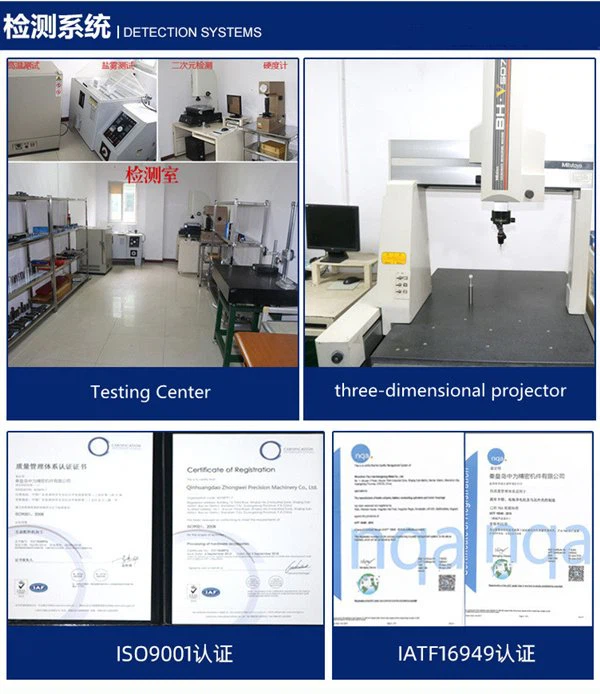
Quality Control
1. Quality control: The defective rate is less than 0.1%.
2. Samples and trial runs will be 100% inspected during production and before shipment, sample inspection for mass production according to ISDO standards or customer requirements.
3. Testing equipment: flaw detection, spectrum analyzer, golden image analyzer, three-coordinate measuring machine, hardness testing equipment, tensile testing machine.


Send Inquiry
