




Scalpel Handle Metal Powder Injection Molding
In recent years, the various medical devices needed by hospitals have led to the rapid development of the medical device industry. The research and development and production of various medical devices have brought convenience to hospitals and patients.
Product Introduction
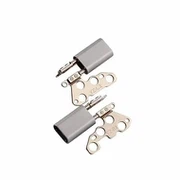
Scalpel handle metal powder injection molding | |||||||||
Item | Material | Production Process | Sintering Temperature | Mold | Custom | ||||
Scalpel handle | 17-4 | Metal Injection Molding | 1550℃ | To be customized | Yes | ||||
Chemical Composition | C:≤0.07 | ||||||||
Available Materials | Low carbon stainless steel, titanium alloy (Ti, TC4), copper alloy, tungsten alloy, hard alloy, high temperature alloy (718, 713) | ||||||||
Finish | Dimensional Accuracy | Product Density | Appearance Treatment | Appropriate Weight | |||||
Roughness 1~5μm | (±0.1%~±0.5%) | 92~95% | Mirror Reflection | 0.03g~400g) | |||||
Mechanical properties | Tensile strength σb (MPa): aged at 480°C, ≥1310; aged at 550°C, ≥1060; aged at 580°C, ≥1000; aged at 620°C, ≥930 | ||||||||
In recent years, the various medical devices needed by hospitals have led to the rapid development of the medical device industry. The research and development and production of various medical devices have brought convenience to hospitals and patients. Surgery is one of them. Scalpel handle metal powder injection molding is a necessary instrument for surgeons to operate. It is mainly used to cut and separate tissues. The emergence of the scalpel has solved many medical problems, saved time for doctors to diagnose and treat patients, and improved the success rate of operations.

Structure of Stainless Steel Scalpel Handle
The products are made of stainless steel materials and are made by stamping, pressing, grinding, polishing and other processes. Handle fits easily with blade
Indications for stainless steel scalpel handles
The product is mainly used for surgical installation of surgical blades
Models of Stainless Steel Scalpel Handles
1. 3# handle is commonly known as small handle, used with 10-15# blade, often with 10# blade (inner knife) for superficial tissue
2. 4# handle is used with 20-25# blade, often with 20# blade (skin knife) for cutting skin
3. The 7# handle is used with the 10-15# blade, and the 15# blade (deep knife) is often used for cutting deep and fine tissues.
4. The 9# handle is used with the 10-15# blade, and the 15# blade (knife) is often used for ophthalmology, ENT, etc.
Y11010 Scalpel handle Commonly used - Recommended

Other common knife handle models are as follows

This product is Scalpel handle metal powder injection molding produced by Zhongwei Precision.
Matching blade
Blades YOB010(10#), YOB020(11#), YOB030(12#), YOB040(15#) are matched with handles Y11010(3#), Y11050(7#)
Blades YOB010(10#), YOB020(11#), YOB030(12#), YOB040(15#) matched with handle Y11010(3#), Y11050(7#)
Among them, blade YOB010(10#) and scalpel handle YOB010(10#) are most commonly used - recommended
The packaging of the following types of blades are: 100 pieces/10 packs/box

More styles and specifications of animal surgical instruments are also available, such as: surgical scissors, tissue scissors, ophthalmic scissors, micro scissors, planing scissors, fine scissors, straight scissors, curved scissors, spring scissors, ophthalmic tweezers, tissue tweezers , accessories tweezers, micro scissors, micro tweezers, micro hemostatic forceps, blood vessel clips/hemostatic clips, skin staplers/wound staplers, etc., suture needles, suture threads, surgical disinfection trays, bone forceps, bone scissors, skull forceps , bone saw, cranial drill, bone drill, skull drill, scalpel, scalpel handle, blade, as well as rat chest opener, tracheal intubation, vascular intubation, animal warming surgical board, surgical lighting, postoperative recovery, Animal anesthesia, animal assisted respiration, animal euthanasia box and other surgical instruments and related equipment.
Suitable for a variety of surgical operations on rats, mice or other animals: basic surgery, planing surgery, organ separation surgery, microsurgery, suture surgery, orthopedic surgery, organ transplantation surgery, implantation surgery, buried electrode surgery, etc. ;
Please make a reasonable choice according to the different types of surgery, different experimental animals, different surgical sites, and different experimental methods.
Sophisticated surgical instruments and equipment can make your surgical operations more effective! the
Imported steel, hand-made, fine workmanship, precision and durability, moderate price, high cost performance.
Detection Systems

Metal Injection Molding Process






Send Inquiry
