



Laptop Hinge MIM Parts
When you buy a laptop, you generally give priority to parameters such as price, hardware configuration, and appearance. Things like laptop hinges are generally ignored by most people, but don’t underestimate Laptop hinge MIM Parts. There is still a lot of knowledge about it. . Today we will introduce the types of hinges commonly used in notebooks and their respective characteristics.
Product Introduction
Titanium Laptop hinge MIM Parts | |||||||||
Item | Material | Production Process | Sintering Temperature | Mold | Custom | ||||
Laptop hinge | 17-4 | Metal Injection Molding | 1350°C-1500°C | To be customized | Yes | ||||
Chemical Composition | C: ≤0.07 | ||||||||
Available Materials | Low carbon stainless steel, titanium alloy (Ti, TC4), copper alloy, tungsten alloy, hard alloy, high temperature alloy (718, 713) | ||||||||
Finish | Dimensional Accuracy | Product Density | Appearance Treatment | Appropriate Weight | |||||
Roughness 1~5μm | (±0.1%~±0.5%) | 92~95% | Mirror Reflection | 0.03g~400g) | |||||
Mechanical properties | Tensile strength σb (MPa): aged at 480°C, ≥1310; aged at 550°C, ≥1060; aged at 580°C, ≥1000; aged at 620°C, ≥930 | ||||||||
Heat treatment | Heat treatment specifications: 1) solid solution 1020-1060 ℃ quick cooling; 2) 480 ℃ aging, after solution treatment, 470-490 ℃ air cooling; 3) 550 ℃ aging, after solution treatment, 540-560 ℃ air cooling; 4) Aging at 580°C, after solution treatment, air cooling at 570-590°C; 5) Aging at 620°C, after solution treatment, air cooling at 610-630°C. | ||||||||
Product Category
When you buy a laptop, you generally give priority to parameters such as price, hardware configuration, and appearance. Things like laptop hinges are generally ignored by most people, but don’t underestimate Laptop hinge MIM Parts. There is still a lot of knowledge about it. . Today we will introduce the types of hinges commonly used in notebooks and their respective characteristics.
What is the purpose of the shaft?
First: As an iconic element of notebook computers, the hinge is an important factor that distinguishes notebook computers and tablet computers today. A machine with a fixed hinge must be a notebook computer, and a computer with a detachable hinge is generally a PC tablet 2-in-1 machine promoted by Intel. And a machine without a hinge must be a tablet.
Second: The hinge affects the opening and closing angle of the screen. The maximum opening and closing angle of the hinge of a general notebook computer is about 130°, which is actually enough for a conventional notebook. However, if a larger opening and closing angle is required, such a hinge design will inevitably affect the user experience, so there are many notebook computers with an opening and closing angle of 180° on the market. In addition, since Lenovo launched the transformable notebook computer with a 360° opening and closing hinge, such a design undoubtedly makes users use it in a variety of ways. For example, the laptop can be stood up in a smaller space for easy viewing, or it can be turned 360° directly into a tablet for easy touch-screen use. Such an innovative design can be said to greatly enhance the playability of the laptop.
Third: The hinge is the hub connecting the notebook screen and the body. Its design not only determines the strength required when the notebook screen is opened, but also determines the port arrangement of the notebook and the way of cooling and airflow. In addition, poor hinge design will not only lead to breakage of the hinge and damage to the casing, but also affect the connection and use of the screen cable.
The function of the hinge is introduced here first, let's take a look at the hinge designs on the market, and what are their maximum opening and closing angles?
Traditional classic sinking laptop hinge
When it comes to the style of the hinge, the most common notebook hinge is the "sinking hinge". This type of hinge uses a relatively simple metal hinge connection inside, and the cost is relatively low, so the sinking hinge mostly appears on consumer-grade notebooks. It is also because of the relatively low cost that the damping of the hinges is basically relatively fixed, so most laptops equipped with such hinges cannot open and close the screen with one hand, and their maximum opening and closing angles are also relatively fixed. Generally, it is about 130°.
Sunken hinges are also common in relatively high-end business notebooks, but they are more high-end than consumer-grade notebooks. It can be said to be an upgraded version of ordinary sunken hinges. Most of their maximum opening and closing angles can reach 180°, the screen can be completely "lay flat", and they will also optimize the damping of the rotating shaft, making the opening and closing of the screen smoother, enabling one-handed opening and closing.
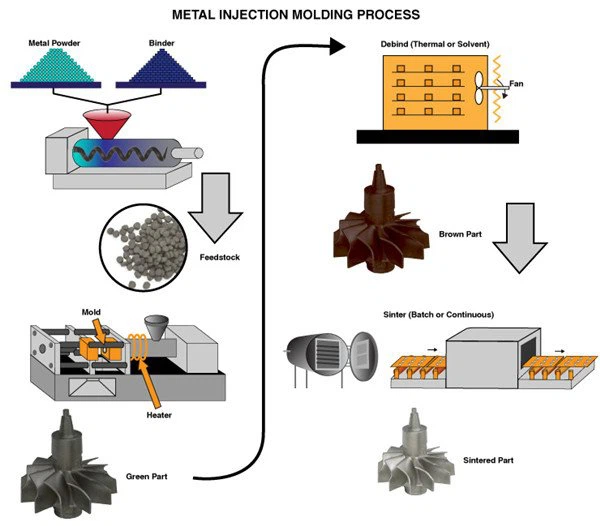
Metal Injection Molding Process
Detection Systems


Send Inquiry
