



MHZ2 Cylinder Piston Rod MIM Parts
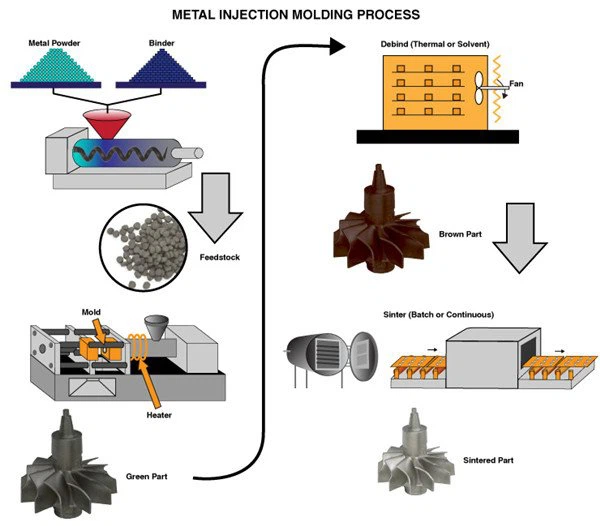
The basic process is: firstly, the solid powder and organic binder are evenly mixed, and after granulation, they are injected into the mold cavity with an injection molding machine to solidify and form in a heated and plasticized state (~150°C), and then chemically or thermally.
Product Introduction
Titanium MHZ2 cylinder piston rod MIM Parts | |||||||||
Item | Material | Production Process | Sintering Temperature | Mold | Custom |
| |||
MHZ2-16D piston rod | 440c | Metal Injection Molding | 1550℃ | To be customized | Yes |
| |||
Chemical Composition | C: 0.95~1.20 | ||||||||
Available Materials | Low carbon stainless steel, titanium alloy (Ti, TC4), copper alloy, tungsten alloy, hard alloy, high temperature alloy (718, 713) | ||||||||
Finish | Dimensional Accuracy | Product Density | Appearance Treatment | Appropriate Weight | |||||
Roughness 1~5μm | (±0.1%~±0.5%) | 92~95% | Mirror Reflection | 0.03g~400g) | |||||
Mechanical properties | Hardness: annealed, ≤269HB; | ||||||||
Heat treatment | 1) Annealing, slow cooling at 800~920℃; | ||||||||
Introduction to Metal Injection Molding Technology
The basic process is: firstly, the solid powder and organic binder are evenly mixed, and after granulation, they are injected into the mold cavity with an injection molding machine to solidify and form in a heated and plasticized state (~150°C), and then chemically or thermally.The method of decomposition removes the binder in the shaped blank, and finally obtains the final product through sintering and densification. Compared with traditional technology, it has the characteristics of high precision, uniform structure, excellent performance and low production cost. Its products are widely used in electronic information engineering, biomedical equipment, office equipment, automobiles, machinery, hardware, sports equipment, clocks and watches, Industrial fields such as weapons and aerospace. Therefore, it is generally believed in the world that the development of this technology will lead to a revolution in parts forming and processing technology, and it is known as "the most popular parts forming technology today" and "the forming technology of the 21st century".
Metal injection molding process characteristics
Metal powder injection molding technology is a product of multidisciplinary penetration and interdisciplinary integration of plastic molding technology, polymer chemistry, powder metallurgy technology and metal material science. It can use molds to injection mold blanks and quickly manufacture high-density, high-precision products through sintering. , Structural parts with three-dimensional complex shapes can quickly and accurately materialize design ideas into products with certain structural and functional characteristics, and can directly mass-produce parts, which is a new revolution in the manufacturing technology industry. This process technology not only has the advantages of fewer conventional powder metallurgy processes, no cutting or less cutting, and high economic benefits, but also overcomes the shortcomings of traditional powder metallurgy products, uneven material, low mechanical properties, difficult to form thin walls, and complex structures. It is especially suitable for mass production of small, complex and special metal parts. Process flow Binder → mixing → injection molding → degreasing → sintering → post-processing. the
●Powder metal powder
The particle size of the metal powder used in the MIM process is generally 0.5-20 μm; in theory, the finer the particles, the larger the specific surface area, which is easy to form and sinter. The traditional powder metallurgy process uses coarser powders larger than 40 μm.
●Organic adhesives
The role of the organic adhesive is to bond the metal powder particles, so that the mixture has rheology and lubricity when heated in the barrel of the injection machine, that is to say, the carrier that drives the powder flow. Therefore, the choice of binder is the carrier of the whole powder. Therefore, the sticky pull selection is the key to the whole powder injection molding. Requirements for organic adhesives:
1. The dosage is small, and the mixture can produce better rheology with less adhesive;
2. No reaction, no chemical reaction with metal powder in the process of removing the adhesive;
3. Easy to remove, no carbon remains in the product.
●Blending
Mix metal powder and organic binder evenly together to make various raw materials into injection molding mixture. The uniformity of the mixture directly affects its fluidity, thus affecting the injection molding process parameters, as well as the density and other properties of the final material. Injection molding This step process is consistent with the plastic injection molding process in principle, and its equipment conditions are basically the same. In the injection molding process, the mixture is heated in the barrel of the injection machine into a rheological plastic material, and injected into the mold under appropriate injection pressure to form a blank. The microcosm of the injection molded blank should be uniform, so that the product shrinks evenly during the sintering process.
●Extraction
The organic binder contained in the blank must be removed before sintering. This process is called extraction. The extraction process must ensure that the binder is gradually discharged from different parts of the blank along the tiny channels between the particles without reducing the strength of the blank. Binder removal rates generally follow a diffusion equation. Sintering can make the porous degreased blank shrink to densification and become a product with certain organization and performance. Although the performance of the product is related to many process factors before sintering, in many cases, the sintering process has a great or even decisive influence on the metallographic structure and properties of the final product.
●Post-processing
For parts with relatively precise size requirements, necessary post-processing is required. This process is the same as the heat treatment process of conventional metal products.
Features of MIM process
Comparison of MIM technology and other processing technology
The particle size of the raw material powder used by MIM is 2-15 μm, while the particle size of the raw powder powder of traditional powder metallurgy is mostly 50-100 μm. The finished product density of the MIM process is high because of the use of fine powder. The MIM process has the advantages of the traditional powder metallurgy process, and the high degree of freedom in shape is beyond the reach of traditional powder metallurgy. Traditional powder metallurgy is limited to the strength and filling density of the mold, and the shape is mostly two-dimensional cylindrical.
The traditional precision casting de-drying process is a very effective technology for making products with complex shapes. In recent years, ceramic cores can be used to assist in the completion of finished products with slits and deep holes. However, due to the strength of the ceramic core and the limitation of the fluidity of the casting solution , the process still has some technical difficulties. Generally speaking, this process is more suitable for manufacturing large and medium-sized parts, and the MIM process is more suitable for small and complex-shaped parts. Comparison Items Manufacturing Process MIM Process Traditional Powder Metallurgy Process Powder Particle Size (μm) 2-1550-100 Relative Density (%) 95-9880-85 Product Weight (g) Less than or equal to 400 grams 10-hundreds Product Shape Three-dimensional complex shape The mechanical properties of two-dimensional simple shapes.
Comparison of MIM process and traditional powder metallurgy method Die casting process is used in materials with low melting point and good fluidity of casting liquid such as aluminum and zinc alloy. Due to the limitations of materials, the products of this process have limited strength, wear resistance and corrosion resistance. The MIM process can process more raw materials.
Although the precision and complexity of the precision casting process has increased in recent years, it is still not as good as the dewaxing process and the MIM process. Powder forging is an important development and has been applied to the mass production of connecting rods. But in general, the cost of heat treatment and the life of the die in the forging project are still problematic, which still needs to be further resolved.
The traditional mechanical processing method, which has recently improved its processing capacity by automation, has made great progress in effect and precision, but the basic procedures are still inseparable from step-by-step processing (turning, planing, milling, grinding, drilling, polishing, etc.) ) to complete the shape of the part. The machining accuracy of machining methods is far superior to other machining methods, but because the effective utilization rate of materials is low, and the completion of its shape is limited by equipment and tools, some parts cannot be completed by machining. On the contrary, MIM can effectively use materials without limitation. For the manufacture of small and difficult-shaped precision parts, the MIM process has lower cost and higher efficiency than mechanical processing, and has strong competitiveness.
MIM technology does not compete with traditional processing methods, but makes up for the technical deficiencies or defects that cannot be produced by traditional processing methods. MIM technology can play its specialties in the field of parts made by traditional processing methods. The technical advantages of the MIM process in the manufacture of parts can form structural parts with highly complex structures.
Injection molding technology utilizes the injection molding machine to inject the product blank to ensure that the material is fully filled in the mold cavity, which also ensures the realization of the highly complex structure of the part. In the past, in the traditional processing technology, individual components were made first and then combined into components. When using MIM technology, it can be considered to integrate into a complete single part, which greatly reduces steps and simplifies the processing procedure. Comparison of MIM and other metal processing methods The dimensional accuracy of the product is high, and there is no need for secondary processing or only a small amount of finishing.
The injection molding process can directly form thin-walled and complex structural parts. The shape of the product is close to the requirements of the final product, and the dimensional tolerance of the parts is generally maintained at about ±0.1-±0.3. It is especially important to reduce the processing cost of hard alloys that are difficult to machine, and to reduce the processing loss of precious metals. The product has uniform microstructure, high density and good performance.
During the pressing process, due to the friction between the mold wall and the powder and between the powder and the powder, the pressing pressure distribution is very uneven, which also leads to the uneven microstructure of the pressed blank, which will cause the pressed powder metallurgy parts to be in The shrinkage is uneven during the sintering process, so the sintering temperature has to be reduced to reduce this effect, resulting in large porosity, poor material compactness, and low density, which seriously affect the mechanical properties of the product. Conversely, the injection molding process is a fluid forming process. The existence of the binder ensures the uniform distribution of the powder, thereby eliminating the uneven microstructure of the blank, and then making the density of the sintered product reach the theoretical density of its material. In general, the density of pressed products can only reach 85% of the theoretical density. The high compactness of the product can increase the strength, strengthen the toughness, improve the ductility, electrical and thermal conductivity, and improve the magnetic properties. High efficiency, easy to realize large-scale and large-scale production.
The metal mold used in MIM technology has a lifespan comparable to that of engineering plastic injection molds. Due to the use of metal molds, MIM is suitable for mass production of parts. Since the product blank is molded by the injection machine, the production efficiency is greatly improved, the production cost is reduced, and the consistency and repeatability of the injection molded product are good, thus providing a guarantee for large-scale and large-scale industrial production. Wide range of applicable materials and broad application fields (iron base, low alloy, high speed steel, stainless steel, gram valve alloy, hard alloy).
The materials that can be used for injection molding are very wide. In principle, any powder material that can be poured at high temperature can be made into parts by MIM process, including difficult-to-process materials and high-melting point materials in traditional manufacturing processes. In addition, MIM can also conduct material formulation research according to user requirements, manufacture any combination of alloy materials, and form composite materials into parts. The application fields of injection molded products have spread to all fields of the national economy and have broad market prospects.
Metal Injection Molding Process
Detection Systems



Send Inquiry
