



Laptop MIM Parts
Metal injection molding, a technique used to create small, complex metal parts, is a manufacturing process that Apple uses in the new MacBooks to save space inside the devices, as the next-generation MacBook Pro is likely to have an ultra-thin design.
Product Introduction
Laptop MIM Parts | |||||||||
Item | Material | Production Process | Sintering Temperature | Mold | Custom | ||||
Laptop | 17-4 | Metal Injection Molding | 1350°C-1500°C | To be customized | Yes | ||||
Chemical Composition | C: ≤0.07 | ||||||||
Available Materials | Low carbon stainless steel, titanium alloy (Ti, TC4), copper alloy, tungsten alloy, hard alloy, high temperature alloy (718, 713) | ||||||||
Finish | Dimensional Accuracy | Product Density | Appearance Treatment | Appropriate Weight | |||||
Roughness 1~5μm | (±0.1%~±0.5%) | 92~95% | Mirror Reflection | 0.03g~400g) | |||||
Mechanical properties | Tensile strength σb (MPa): aged at 480°C, ≥1310; aged at 550°C, ≥1060; aged at 580°C, ≥1000; aged at 620°C, ≥930 | ||||||||
Heat treatment | Heat treatment specifications: 1) solid solution 1020-1060 ℃ quick cooling; 2) 480 ℃ aging, after solution treatment, 470-490 ℃ air cooling; 3) 550 ℃ aging, after solution treatment, 540-560 ℃ air cooling; 4) Aging at 580°C, after solution treatment, air cooling at 570-590°C; 5) Aging at 620°C, after solution treatment, air cooling at 610-630°C. | ||||||||
Laptop development background
Metal injection molding, a technique used to create small, complex metal parts, is a manufacturing process that Apple uses in the new MacBooks to save space inside the devices, as the next-generation MacBook Pro is likely to have an ultra-thin design. At the same time, it is reported that Zhaoli Technology Industry is ready to provide metal injection mold hinge parts for 15-inch Macbook. It is expected that the new Macbook will be shipped in large quantities at the end of 2016 and 2017.

Application of MIM technology (SKD11) on Hinge (process flow introduction)

According to the different performances required by customers, the selected materials are also different. Generally, MIM iron-based materials and tool steel materials such as SKD11 are used.
1. Iron-based materials

Generally, we use iron-based materials for general-purpose parts. After sintering, heat treatment and electroplating meet the performance of customers. For products with complex shapes and structures, of course, mold structure design and precision processing have high requirements. We generally use plastic-based feeding materials. This can reduce sintering deformation and improve the yield of subsequent processes.
2. SKD11 material
Gear products require high hardness, high wear resistance, and have special requirements for materials. We choose SKD11 material, which has a narrow sintering temperature range and is very sensitive to temperature. Improper control can easily lead to melting, which will lead to product scrapping. Sintering settings Reasonable temperature curve.
The shape of the fixing part is complex, and it also requires high hardness, high wear resistance and certain toughness. It is made of SKD11 and has high hardness after sintering. It needs to be placed with a special sintering fixture.

Fixture
With the development of MIM technology, the new generation of MacBook Pro will provide an ultra-thin design, making people more portable and more flexible in office. We look forward to her arrival!
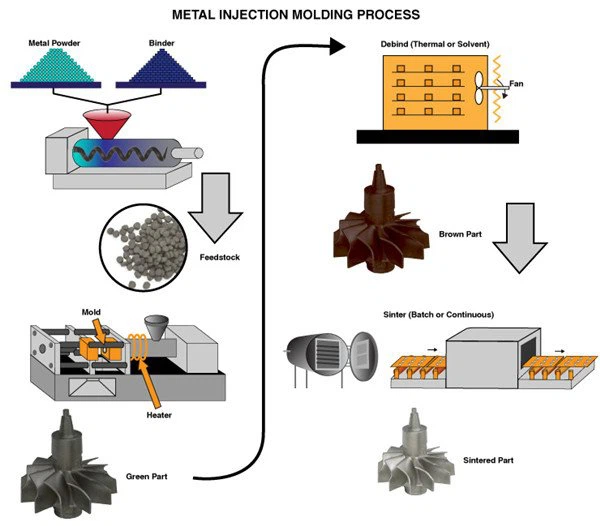
Metal Injection Molding Process
Detection Systems


Send Inquiry
