




Cobalt Alloy Powder Injection Molding
Tungsten-cobalt alloy is also called tungsten carbide-cobalt carbide. According to the cobalt content, it can be divided into three categories: high cobalt (20% to 30%), medium cobalt (10% to 15%) and low cobalt (3% to 8%). This type of cermet can be manufactured according to the usual special ceramic batching, molding and other processes.
Tungsten-cobalt alloy is also called tungsten carbide-cobalt carbide. According to the cobalt content, it can be divided into three categories: high cobalt (20% to 30%), medium cobalt (10% to 15%) and low cobalt (3% to 8%). This type of cermet can be manufactured according to the usual special ceramic batching, molding and other processes. Only the sintering atmosphere should be controlled to be vacuum or reducing atmosphere according to the properties of the billet and the quality of the finished product. in a vacuum furnace. The grades of this kind of cemented carbide produced in China are YG2, YG3, YG3X, YG4C. The letters "YG" indicate "WC-Co", the numbers after "G" indicate the content of Co, "X" indicates fine grains, and "C" indicates coarse grains. Such cermets generally increase their flexural strength and fracture toughness with increasing cobalt content, while their hardness decreases. Cobalt alloy powder injection molding has high elastic modulus and small thermal expansion coefficient, and is the most widely used type of cemented carbide.
Qinhuangdao Zhongwei Precision Machinery Co., Ltd. is a collection of copper alloy metal injection molding, iron-based metal injection molding, stainless steel-based metal injection molding, aluminum alloy metal injection molding, nickel alloy metal injection molding, cobalt alloy metal injection molding, tungsten alloy metal injection molding A comprehensive high-tech enterprise integrating R&D, production and sales of injection molding, cemented carbide metal injection molding, and powder metallurgy structural parts.
Product Description
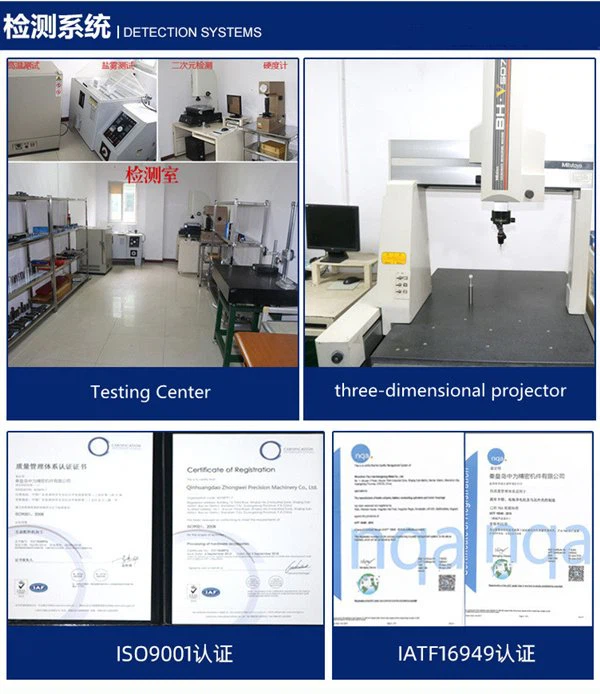
1. Implementation standards: the company strictly implements ISO9001, ISO14001, IATF16949 certification
The products have passed the certification of ROHS, FDA EU, etc.
2. Product material standards: ISO, GB, ASTM, SAE, EN, DIN, BS, AMS, JIS, ASME, DMS, TOCT, GB
3. Main processes: metal injection molding MIM, powder metallurgy PM, investment casting, die-casting aluminum,
4. Available materials for powder metallurgy:
Copper alloys, iron bases, titanium alloys, stainless steel bases, aluminum alloys, nickel alloys, cobalt alloys, tungsten alloys, cemented carbides, hydroxy alloys, soft magnetic materials and 3D printing can be customized according to customer requirements.
Product Hardness
1. Hardness testing method
Cobalt alloy powder injection molding hardness testing mainly uses Rockwell hardness tester to test HRA hardness value. PHR series portable Rockwell hardness testers are very suitable for testing the hardness of tungsten-cobalt alloys. The weight accuracy of the instrument is the same as that of the desktop Rockwell hardness tester, and it is very convenient to use and carry.
Tungsten-cobalt alloy is a kind of metal. The hardness test can reflect the difference in mechanical properties of tungsten-cobalt alloy materials under different chemical composition, structure and heat treatment conditions. Therefore, the hardness test is widely used in the inspection of tungsten-cobalt alloy properties and supervising heat treatment. The correctness of the process and the research of new materials.
The properties of tungsten-cobalt alloys are related to alloy composition, microstructure and manufacturing process. The most important factor is: the composition and content of the bond metal. Tungsten-cobalt alloy is a high-hardness, refractory metal compound powder, which is compacted and sintered with metals such as cobalt or nickel as a binder. The carbides in it are harder and more resistant to high temperature and temperature. In industry, cutting high-hardness materials, such as hardened steel or materials with higher hardness, high-speed steel tools are incompetent. High-speed steel tools cut general ferrous metals. Due to the limitation of heat resistance, their cutting speed and production efficiency are still at a low level. Therefore, the advent of tungsten-cobalt alloy tool materials has made a leap in cutting production efficiency.
Tungsten-cobalt alloy is the most productive and widely used type of cemented carbide because of its high flexural strength, compressive strength, impact toughness, elastic modulus and small thermal expansion coefficient. Generally, the flexural strength and fracture toughness of tungsten-cobalt alloys increase with the increase of cobalt content, while the hardness decreases. The appearance of the tungsten-cobalt alloy coating is close to that of the chromium coating, and the plating solution has good dispersion and coverage. Through the test, the influence of sodium tungstate, cobalt sulfate, additives, current density and pH value on the tungsten content and properties of the coating, it is found that tungsten-cobalt alloy has good corrosion resistance, heat resistance and wear resistance, and can be used as a cutting tool. It can process cast iron, non-ferrous metals, non-metals, heat-resistant alloys, titanium alloys and stainless steel, etc. It can also be used as extension dies, wear-resistant parts, stamping dies and drills.
2. Purpose
Tungsten-cobalt alloys can be used as tools to process cast iron, non-ferrous metals, non-metals, heat-resistant alloys, titanium alloys and stainless steel, etc., and can also be used as extension dies, wear-resistant parts, stamping dies and drill bits. An alloy with tungsten and cobalt as the main components, which is mostly used in the production of drill bits for mining.
Post Casting Process
1. Heat treatment: annealing, carbonization, tempering, quenching, normalizing, surface tempering
2. Processing equipment: CNC, WEDM, lathe, milling machine, drilling machine, grinder, etc.;
3. Surface treatment: powder spraying, chrome plating, painting, sandblasting, nickel plating, galvanizing, blackening, polishing, bluing, etc.

Moulds and Inspection Fixtures
1. Mold service life: usually semi-permanent. (except for lost foam)
2. Mold delivery time: 10-25 days, (according to product structure and product size).
3. Tooling and mold maintenance: Zhongwei is responsible for precision parts.

Quality Control
1. Quality control: the defective rate is less than 0.1%.
2. Samples and trial run will be 100% inspected during production and before shipment, sample inspection for mass production according to ISDO standards or customer requirements
3. Testing equipment: flaw detection, spectrum analyzer, golden image analyzer, three-coordinate measuring machine, hardness testing equipment, tensile testing machine.


Send Inquiry
