




Metal Injection Molding Pneumatic Components
Metal Injection Molding (MIM) is a near-net-shape process suitable for producing small, three-dimensional complex shapes and products with special performance requirements. In Qinhuangdao, we can customize metal injection molding pneumatic MHZ2-16D fork, metal injection molding pneumatic MHZ2-20D fork, metal injection molding pneumatic slider guide, metal injection molding MHZ2 sliding table, metal injection molding pneumatic MHZ2 piston rod , Metal Injection Molding Pneumatic Components such as Pneumatic MHZ2 Finger.
Metal Injection Molding (MIM) is a near-net-shape process suitable for producing small, three-dimensional complex shapes and products with special performance requirements. In Qinhuangdao, we can customize metal injection molding pneumatic MHZ2-16D fork, metal injection molding pneumatic MHZ2-20D fork, metal injection molding pneumatic slider guide, metal injection molding MHZ2 sliding table, metal injection molding pneumatic MHZ2 piston rod , Metal Injection Molding Pneumatic Components such as Pneumatic MHZ2 Finger. Qinhuangdao Zhongwei Precision Machinery Co., Ltd. is a comprehensive company integrating R&D, production and sales of copper alloy, iron base, stainless steel base, aluminum alloy, nickel alloy, cobalt alloy, tungsten alloy, cemented carbide and powder metallurgy structural parts. high-tech enterprises. We are willing to achieve common development with every businessman.
Product Description
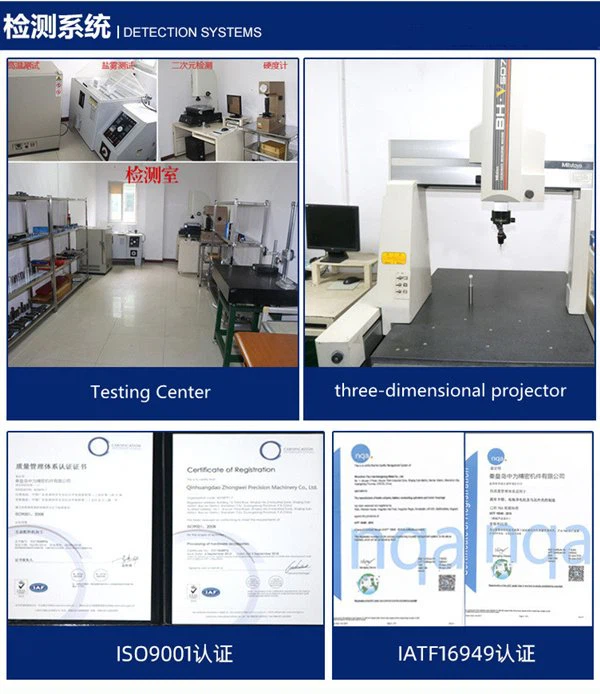
1. Implementation standards: the company strictly implements ISO9001, ISO14001, IATF16949 certification
The products have passed the certification of ROHS, FDA EU, etc.
2. Product material standards: ISO, GB, ASTM, SAE, EN, DIN, BS, AMS, JIS, ASME, DMS, TOCT, GB
3. Main processes: metal injection molding MIM, powder metallurgy PM, investment casting, die-casting aluminum,
4. Available materials for powder metallurgy:
Copper alloy, iron base, titanium alloy, stainless steel base, aluminum alloy, nickel alloy, cobalt alloy, tungsten alloy, cemented carbide, hydroxy alloy, soft magnetic material and 3D printing can be customized according to customer requirements.
Production Process
Pneumatic components are involved in a wide range of powder metallurgy products. Due to the high development of powder metallurgy, some parts that were previously processed as materials and hardware have been replaced by powder metallurgy, because the processing speed of materials and hardware is slow, labor costs are high, and it is not suitable for large quantities. Therefore, the intervention of powder metallurgy greatly improves the production cycle and cost. The following focuses on the application of MIM process (metal injection molding) in pneumatic components:
1\Finger cylinder accessories: MHZ2 series fork, guide rail, gripper
(1) Raw materials: metal powder (iron, stainless steel 5%-8%) + binder (plastic powder 92%-95%)----mixing---kneading---crushing---granulation Iron powder granulation: air spray powder (the particles are round), water spray powder (irregular shape) Powder preparation: atomization powder, reduction method, mechanical alloying, vapor deposition, sol-gel, spontaneous combustion reaction synthesis , Electrolytic binder: ①Improve the fluidity of powder particles, have both lubrication and wetting, prevent the agglomeration of fine powder, and may cause the friction of the mold wall and the phase separation of the powder particle binder in the injection molding stage. ② Avoid the generation of heterogeneous embryos and shrinkage and deformation in different sizes and directions. ③The binder can be used as the backbone of the product after degreasing. There is a little residual binder to improve the strength and shape retention of the embryo body, and form a porous channel, which is convenient for rapid decomposition in the next stage. (paraffin/polymer)
(2) Injection molding: ①Pour the raw material into the inverted funnel, inject it into the square mold with high temperature and high pressure through the injection gun (first, pour the granular feed into the inverted funnel into the injection gun and heat it to a certain temperature to make it) It has fluidity. It is injected into the square mold through the feeding port, and then flows into the required mold cavity through the nozzle for pressure cooling and molding, and is ejected by the ejector pin to obtain the MIM forming blank) ② The obtained blank does not have any metal properties, Not easy to break and not easy to break. ③The tonnage of the equipment is 80T and 120T (14 sets in total), and the maximum product weight that can be made is 500g. ④Product density is 7.8 ⑤Hardness: iron HRC50-60, stainless steel HRC35-40.
(3) Degreasing: The brown embryo is obtained by removing the binder component from the inside of the blank. Temperature: 90-110°C Time: 4-6h The obtained brown embryo is fragile and fragile (98% of the binder is removed).
(4) Sintering: Vacuum sintering furnace Temperature: 800-1200℃ Time: 24h Remove 2% of the binder inside, and have all the metal properties.
(5) Post-processing treatment: ①Shaping treatment ②Polishing and grinding ③Flat grinding and grinding ④Deburring ⑤Surface treatment ⑥Anti-rust treatment
Note: The particles are small, the gap is also small, the surface finish is high, and it can be directly electroplated.
Advantages of MIM Process
Qinhuangdao Zhongwei Precision Machinery Co., Ltd., formerly based on precision casting, has developed into a comprehensive high-tech enterprise in the fields of casting, powder metallurgy, metal injection molding, injection molding, etc. It can professionally develop and produce Metal Injection Molding Pneumatic Components products, with rich With a strong scientific research team and extremely high new material research capabilities, it has 3 supporting mold factories with a monthly production capacity of 50 sets, several pure imported Arburg and Nissei injection machines, catalytic degreasing furnaces, vacuum sintering furnaces, and integrated degreasing and sintering furnaces. , with an annual production capacity of 70 million to 80 million pieces, can customize high-end MIM parts, and provide solutions for MIM solutions according to customer needs.
The following are the advantages of the MIM process:
1. High degree of design freedom: Compared with other metal forming methods, MIM can manufacture parts with more complex shapes. Basically, all structures that can be realized by injection molds can be applied to MIM.
2. More material choices: MIM can use almost most metal materials. Considering the economy, the main application materials include iron-based, nickel-based, copper-based, titanium-based metals or alloys.
3. Excellent physical and chemical properties: Because the sintered density of MIM is very close to the theoretical density, its physical and chemical properties are also very good, such as mechanical strength, which greatly surpasses traditional powder metallurgy.
4. Exquisite appearance performance: The surface roughness (Ra) of MIM sintered billet can reach 1μm, and a dazzling appearance effect can be obtained through various surface treatment methods.
5. Excellent dimensional accuracy: MIM can generally achieve a tolerance accuracy of ± 0.5%, and with other processing methods, higher dimensional accuracy can be obtained.
6. Powerful and flexible mass production capacity: MIM can flexibly adjust and rapidly increase production, and can respond quickly from hundreds of pieces per day to more than hundreds of thousands per day.
Post Casting Process
1. Heat treatment: annealing, carbonization, tempering, quenching, normalizing, surface tempering
2. Processing equipment: CNC, WEDM, lathe, milling machine, drilling machine, grinder, etc.;
3. Surface treatment: powder spraying, chrome plating, painting, sandblasting, nickel plating, galvanizing, blackening, polishing, bluing, etc.

Moulds and Inspection Fixtures
1. Mold service life: usually semi-permanent. (except for lost foam)
2. Mold delivery time: 10-25 days, (according to product structure and product size).
3. Tooling and mold maintenance: Zhongwei is responsible for precision parts.

Quality Control
1. Quality control: the defective rate is less than 0.1%.
2. Samples and trial run will be 100% inspected during production and before shipment, sample inspection for mass production according to ISDO standards or customer requirements
3. Testing equipment: flaw detection, spectrum analyzer, golden image analyzer, three-coordinate measuring machine, hardness testing equipment, tensile testing machine.


Send Inquiry
