




Fiber Tee MIM Parts
The main raw materials of MIM are metal powder and thermoplastic binder. Binders are an intermediate processing aid and are removed from injection molded products. The properties of the powder determine the final properties of the MIM product.
Product Introduction
Fiber Tee MIM Parts | |||||||||
Item | Material | Production Process | Sintering Temperature | Mold | Custom | ||||
Fiber base | 316 | Metal Injection Molding | 1350°C-1500°C | To be customized | Yes | ||||
Chemical Composition | C: ≤0.08 | ||||||||
Available Materials | Low carbon stainless steel, titanium alloy (Ti, TC4), copper alloy, tungsten alloy, hard alloy, high temperature alloy (718, 713) | ||||||||
Finish | Dimensional Accuracy | Product Density | Appearance Treatment | Appropriate Weight | |||||
Roughness 1~5μm | (±0.1%~±0.5%) | 92~95% | Mirror Reflection | 0.03g~400g) | |||||
Physical Properties | • 316 Annealed • 316L annealed • 316/316L spring tempered | ||||||||
Product Name:Fiber Tee MIM Parts
Product material: SUS316L, SUS304
Manufacturing process: high-precision metal powder injection molding MIM
Surface effect: the surface is smooth, flat, without obvious scratches, lack of material, burrs, etc.
Product performance: high density (greater than 7.5), good welding performance.
Dimensional accuracy: The sintering accuracy of the product can reach within ±0.5% of the dimensional value, so as to meet the assembly requirements.
Qinhuangdao Zhongwei Precision Machine Parts Co., Ltd., a professional metal injection molding factory, has been committed to the research, development and application of powder injection molding (MIM and CIM) since its establishment in 1997. And in 2009, with the development of the industry, it rose to a new level.
The company adopts the advanced process route of BASF in Germany to shorten the sample production and mass production time of customers to meet the requirements of rapid industrialization. Through cooperation with Peking University, Tsinghua University and Taiwan MIM industry experts, the company continuously optimizes the process and provides degreasing and sintering technology. At present, the sintering process of iron-based materials and stainless steel materials has been stabilized.
So far, the company has achieved a production scale of 2 million pieces of MIM products per month, with an annual consumption of 20 tons of metal powder, and it is growing steadily.
Due to the in-depth research on the German BASF catalytic degreasing process and the long-term experience accumulated in practice, the company has successfully developed a very cost-effective catalytic degreasing furnace, and after the actual use of several companies, the effect is good.
Our goal is not only to make products according to the requirements of customers, but also to provide customers with value-added services. We will help them think of what customers think of, and we will do better for them when they think of it!
The Metal Injection Molding communication accessories process is a simple concept and a complex process. Plasticizing powdered raw materials with the help of thermoplastic additives and subsequent use of metal injection molding to form complex parts was first developed as ceramic components.
The main technical problems to be solved before the industrialized MIM process can include:
1. Produce uniform powder mixed with binder with high metal powder loading and sufficient viscosity for injection molding;
2. Conformity provided during the development of economical binder removal;
3. Sintered to high density and dimensional accuracy.
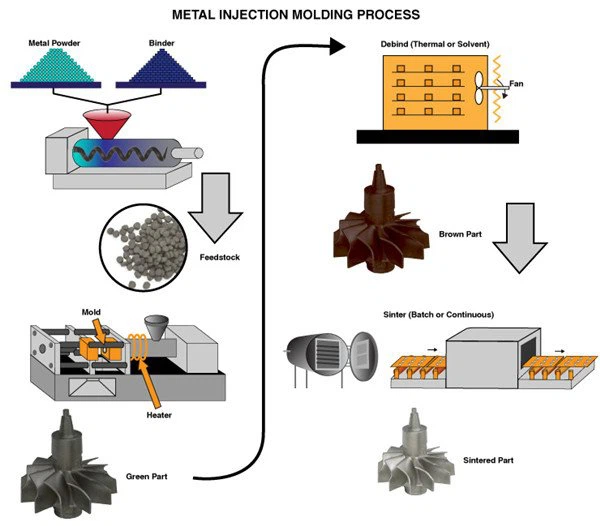
Key steps of metal injection molding communication accessories
1. Prepare raw materials
The main raw materials of MIM are metal powder and thermoplastic binder. Binders are an intermediate processing aid and are removed from injection molded products. The properties of the powder determine the final properties of the MIM product.
The blended powder mixture is processed at elevated temperature into a plasticized binder using a kneader or shear roll extruder. This intermediate product is the so-called raw material. It is usually granulated to a particle size of a few millimeters, as is common in the plastic injection molding industry.
Raw materials can be purchased "ready to mold" from a number of international suppliers, or a MIM production can be fabricated in-house if the necessary skills and knowledge are provided.
2. Injection molding
"Green" MIM parts are formed in an injection molding process equivalent to the molding of plastic parts. The variety of part geometries that can be manufactured by this method is similar to that of a wide variety of plastic components.
3. Remove the adhesive
A subsequent debinding process is used to obtain the part and an interconnected pore network without disrupting the shape of the part. The type of adhesive removal process applied is explained further following this introduction. At the end of the binder removal process there is often some binder still present in the part that holds the metal powder particles together, but the pore network allows rapid evaporation of the residual binder during the initial stages of sintering, while the metal particles begin to act as sintering necks grow between.
4. Sintering
The sintering process results in the elimination of most of the pore volume previously occupied by the binder. Therefore, MIM parts exhibit significant shrinkage during sintering. Linear shrinkage is usually as high as 15% to 20%. If desired, sintered MIM parts can be further processed by conventional metalworking methods like heat treatment or surface treatment of cast or forged parts in the same way
For some applications, such as automotive, medical and aerospace, hot isostatic pressing (HIP) can be used to completely remove any residual porosity. As MIM parts are usually small, this can be relatively cost-effective for key components.
Metal Injection Molding Process
Detection Systems


Send Inquiry
