What is powder metallurgy?
Nov 09, 2022
What is powder metallurgy?
Powder metallurgy is a process technology for manufacturing metal materials, composites and various types of products by making metal powders or using metal powders (or mixtures of metal powders and non-metallic powders) as raw materials, forming and sintering. The powder metallurgy method is similar to the production of ceramics, which belongs to the powder sintering technology. Therefore, a series of new powder metallurgy technologies can also be used for the preparation of ceramic materials. Due to the advantages of powder metallurgy technology, it has become the key to solve the problem of new materials and plays a decisive role in the development of new materials.

Powder metallurgy includes powder making and products. Among them, pulverizing is mainly a metallurgical process, which is consistent with the word. Powder metallurgy products are often far beyond the scope of materials and metallurgy, and are often interdisciplinary (materials and metallurgy, machinery and mechanics, etc.) technologies. In particular, modern metal powder 3D printing integrates mechanical engineering, CAD, reverse engineering technology, layered manufacturing technology, numerical control technology, material science and laser technology, making powder metallurgy product technology a modern comprehensive technology across more disciplines.

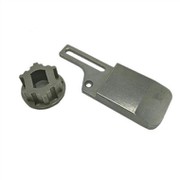
Zhongwei Precision Production of Powder Metallurgy Injection Molding Parts
Define Announcements
Powder metallurgy is an industrial technology to produce metal materials, composite materials and various types of products by making metal powders or using metal powders (or mixtures of metal powders and non-metallic powders) as raw materials, forming and sintering. Powder metallurgy technology has been widely used in transportation, machinery, electronics, aerospace, weapons, biology, new energy, information and nuclear industry, and has become one of the most dynamic branches of new materials science. Powder metallurgy technology has a series of advantages, such as significant energy saving, material saving, excellent performance, high product accuracy and good stability, and is very suitable for mass production. In addition, some materials and complex parts that cannot be prepared by traditional casting methods and machining methods can also be manufactured by powder metallurgy technology, which has attracted much attention in the industry.
The broad powder metallurgy products industry includes iron stone tools, hard alloys, magnetic materials and powder metallurgy products. The narrow sense of powder metallurgy products industry only refers to powder metallurgy products, including powder metallurgy parts (accounting for the vast majority), oil bearing and metal injection molding products.
Feature broadcast
Powder metallurgy has unique chemical composition and mechanical and physical properties, which can not be obtained by traditional melting and casting methods. Powder metallurgy technology can be used to directly produce porous, semi dense or fully dense materials and products, such as oil-bearing bearings, gears, cams, guide rods, tools, etc. It is a kind of less or no cutting technology.
(1) Powder metallurgy technology can minimize alloy composition segregation and eliminate coarse and uneven casting structure. It plays an important role in preparing high-performance rare earth permanent magnetic materials, rare earth hydrogen storage materials, rare earth luminescent materials, rare earth catalysts, high temperature superconducting materials, new metal materials (such as Al Li alloys, heat-resistant Al alloys, superalloys, powder corrosion resistant stainless steels, powder high-speed steels, intermetallic compound high-temperature structural materials, etc.).

(2) A series of high-performance non-equilibrium materials, such as amorphous, microcrystalline, quasicrystalline, nanocrystalline and supersaturated solid solution, can be prepared. These materials have excellent electrical, magnetic, optical and mechanical properties.
(3) It can easily realize multiple types of composites and give full play to the respective characteristics of each component material. It is a low-cost technology to produce high-performance metal matrix and ceramic composites.
(4) It can produce materials and products with special structures and properties that cannot be produced by ordinary smelting methods, such as new porous biological materials, porous separation membrane materials, high-performance structural ceramic abrasives and functional ceramic materials.
(5) It can realize near net formation and automatic batch production, thus effectively reducing the resource and energy consumption of production.
(6) It can make full use of ore, tailings, steelmaking sludge, steel rolling scale, and recycling waste metal as raw materials. It is a new technology that can effectively regenerate and comprehensively utilize materials.
Many of our common machining tools and hardware abrasives are made by powder metallurgy technology.
Preparation method broadcast
(1) Produce powder. The production process of powder includes the steps of powder preparation, powder mixing, etc. In order to improve the formability and plasticity of the powder, plasticizers such as engine oil, rubber or paraffin are usually added.
(2) Press forming. The powder is pressed to the required shape under the pressure of 15-600MPa.
(3) Sintering. It shall be conducted in a high-temperature furnace or vacuum furnace with protective atmosphere. Sintering is different from metal melting. At least one element is still in solid state during sintering. During sintering, the powder particles become metallurgical products with certain porosity through a series of physical and chemical processes such as diffusion, recrystallization, fusion welding, combination, dissolution, etc.
(4) Post processing. Generally, sintered parts can be used directly. But for some parts with high dimensional accuracy, high hardness and wear resistance, post sintering treatment is also required. Post treatment includes fine pressing, rolling, extrusion, quenching, surface quenching, oil immersion, and infiltration.
Preparation method of powder
Powder preparation is the first step of powder metallurgy. With the continuous increase of powder metallurgy materials and products and the continuous improvement of their quality, more and more types of powders are required to be provided. For example, from the material range, not only metal powder, but also alloy powder and metal compound powder are used; From the perspective of powder shape, it is required to use powders of various shapes. For example, when a filter is generated, it is required to form a powder; From the perspective of powder particle size, it is required that the powder with various particle sizes should have a coarse particle size of 500~1000 microns and an ultra-fine particle size of less than 0.5 microns.
In order to meet the various requirements for powder, there are also various methods for producing powder. These methods are nothing more than transforming metal, alloy or metal compound into powder state in solid, liquid or gaseous state. Various methods for preparing powders and powders prepared by various methods.
Methods for converting metals and alloys or metal compounds into powders in solid state include:
(1) Mechanical crushing method and electrochemical corrosion method are used to prepare metal and alloy powder from solid metal and alloy:
(2) Reduction method for preparing metal and alloy powders from solid metal oxides and salts Reduction chemical method for preparing metal compound powders from metal and alloy powders, metal oxides and non-metallic powders
The method for converting metal and alloy or metal compound into powder in liquid state includes:
(1) Preparation of alloy powder from liquid metal and alloy by atomization
(2) There are displacement methods and solution hydrogen reduction methods to prepare metal alloy and coated powder from metal salt solution replacement and reduction; The method of preparing metal powder by precipitation from molten metal salt includes molten salt aging method; Metal bath method is used to separate metal compound powder from auxiliary metal bath.
(3) An aqueous solution electrolysis method for preparing metal and alloy powder by electrolysis from metal salt solution; The molten salt electrolysis method is used to prepare metal and metal compound powder from molten metal salt electrolysis.
Method for converting metal or metal compound into powder in gaseous state:
(1) Steam condensation method is used to produce metal powder from metal steam condensation;
(2) Thermal dissociation of carbon based materials from gaseous metal carbon based materials to produce metals, alloys and coated powders
(3) The method of gaseous hydrogen reduction for preparing metal, alloy powder and metal, alloy coating from gaseous metal halide; The chemical vapor deposition method is used to prepare metal compound powder and coating from gaseous metal halide deposition.
However, from the essence of the process, the existing pulverizing methods can be generally summarized into two categories, namely mechanical method and physical chemical method. Mechanical method is a technological process of mechanical crushing of raw materials, while the chemical composition is basically unchanged; Physicochemical method is a process to obtain powder by changing the chemical composition or aggregation state of raw materials with the help of chemical or physical effects. Many production methods of powder are industrial scale, and some of the most widely used methods, such as Hans reduction method, atomization method and electrolysis method, such as vapor deposition method and liquid deposition method, are also important in special applications. [1]
The basic processes of powder metallurgy process are:
1. Preparation of raw material powder. The existing pulverizing methods can be broadly divided into two categories: mechanical method and physical chemical method. The mechanical method can be divided into: mechanical pulverization and atomization; Physicochemical method can be divided into electrochemical corrosion method, reduction method, chemical method, reduction chemical method, vapor deposition method, liquid deposition method and electrolysis method. Among them, reduction method, atomization method and electrolysis method are most widely used.
2. The powder is formed into a billet of the desired shape. The purpose of forming is to make a certain shape and size of the compact, and make it have a certain density and strength. The forming methods are basically divided into pressure forming and non pressure forming. Compression molding is the most widely used in pressure molding. In addition, 3D printing technology can be used to make the embryo block.
3. Sintering of billets. Sintering is a key process in powder metallurgy. The formed compacts can obtain the required final physical and mechanical properties through sintering. Sintering can be divided into unit system sintering and multi-element system sintering. For the solid state sintering of single system and multicomponent system, the sintering temperature is lower than the melting point of the metals and alloys used; For the liquid phase sintering of multicomponent systems, the sintering temperature is generally lower than the melting point of the refractory components, but higher than the melting point of the fusible components. In addition to ordinary sintering, there are also special sintering processes such as loose sintering, melt leaching, hot pressing, etc.
4. Post processing of products. The treatment after sintering can adopt various methods according to different product requirements. Such as finishing, oil immersion, machining, heat treatment and electroplating. In addition, in recent years, some new processes, such as rolling and forging, have also been applied to the processing of sintered P/M materials and achieved satisfactory results.
Property of powder
A general term for all properties of a powder. It includes: geometrical properties of powder (particle size, specific surface area, pore size and shape, etc.); Chemical properties of the powder (chemical composition, purity, oxygen content, acid insoluble substances, etc.); Mechanical properties of powder (loose density, fluidity, formability, compressibility, stacking angle, shear angle, etc.); Physical properties and surface characteristics of the powder (true density, luster, wave absorption, surface activity, ze% 26mdash; ta (% 26ccedil;) Potential, magnetism, etc.). Powder properties often determine the properties of powder metallurgy products to a large extent.
The most basic geometric properties are the particle size and shape of the powder.
(1) Grain size. It affects the processing and forming of the powder, the shrinkage during sintering and the final performance of the product. The performance of some powder metallurgy products is almost directly related to the particle size. For example, the filtering accuracy of filter materials can be obtained empirically by dividing the average particle size of the original powder particles by 10; The properties of cemented carbide products are closely related to the grain size of wc phase. The particle size of the powder used in production practice ranges from hundreds of nanometers to hundreds of microns. The smaller the particle size is, the greater the activity is, and the easier the surface is to oxidize and absorb water. When it is as small as hundreds of nanometers, the storage and transportation of the powder is not easy. And when it is small to a certain extent, the quantum effect starts to work, and its physical properties will change greatly. For example, ferromagnetic powder will become superparamagnetic powder, and the melting point will also decrease with the decrease of particle size.
(2) The particle shape of the powder. It depends on the pulverizing method, such as the powder obtained by electrolysis, and the particles are dendritic; The iron powder particles obtained by the reduction method are sponge flakes; Spherical powder is basically obtained by gas atomization. In addition, some powders are egg shaped, disc shaped, needle shaped, onion shaped, etc. The shape of powder particles will affect the fluidity and loose density of the powder. Due to the mechanical engagement between particles, the compacts of irregular powder are also strong, especially the dendritic powder, which has the highest compacts strength. But for porous materials, spherical powder is the best.
Mechanical properties The mechanical properties of powders are the technological properties of powders, which are important technological parameters in powder metallurgy forming process. The loose packing density of powder is the basis for weighing by volume method during compaction; The fluidity of the powder determines the filling speed of the powder to the die and the production capacity of the press; The compressibility of the powder determines the difficulty of the pressing process and the pressure applied; The formability of the powder determines the strength of the billet.
The chemical properties mainly depend on the chemical purity of raw materials and the pulverizing method. Higher oxygen content will reduce the compactability, compact strength and mechanical properties of sintered products. Therefore, most technical conditions of powder metallurgy have certain provisions on this. For example, the allowable oxygen content of the powder is 0.2%~1.5%, which is equivalent to the oxide content of 1%~10%.