




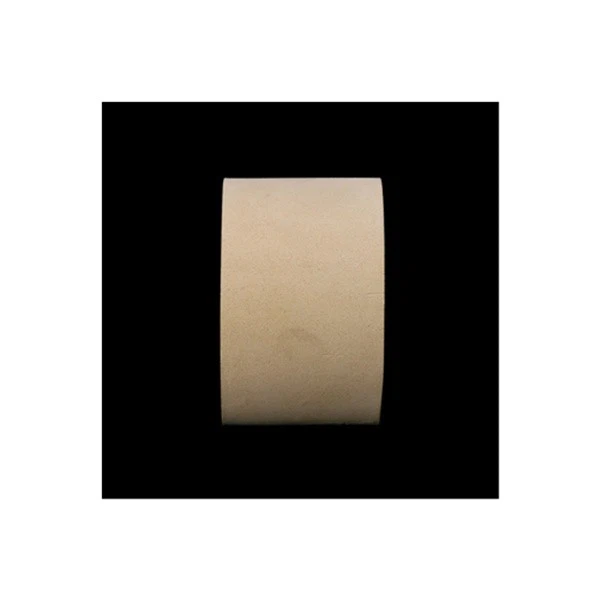

Cordierite Ceramic Pieces
The compressive strength is 280~500MPa. Tensile strength 25 ~ 40MPa. Bending strength 50 ~ 60MPa. The impact strength is 1.8~2.2cm·kg/cm2. Linear expansion coefficient (1.1~1.8)×10-6(20~100℃). The average thermal conductivity is 3.35~5.02kJ/(m2·h·℃)(0~100℃). Cold and heat resistant temperature 300 ~ 500 ℃. Insulation resistance 2.3~5.6MΩ·cm (400~600℃). The dielectric loss tangent value is 200×10-4 (50Hz); 40×10-4 (500Hz). The refractoriness is about 1400℃.
Cordierite ceramics, the main raw materials for making ceramics are talc, clay, alumina, feldspar, etc.
Cordierite (2MgO·2Al2O3·5SiO2) is a ceramic with the main crystal phase.
The compressive strength is 280~500MPa. Tensile strength 25 ~ 40MPa. Bending strength 50 ~ 60MPa. The impact strength is 1.8~2.2cm·kg/cm2. Linear expansion coefficient (1.1~1.8)×10-6(20~100℃). The average thermal conductivity is 3.35~5.02kJ/(m2·h·℃)(0~100℃). Cold and heat resistant temperature 300 ~ 500 ℃. Insulation resistance 2.3~5.6MΩ·cm (400~600℃). The dielectric loss tangent value is 200×10-4 (50Hz); 40×10-4 (500Hz). The refractoriness is about 1400℃.
Zhongwei Precision is committed to providing domestic and foreign customers with advanced Cordierite Ceramic Pieces with high strength, high toughness, wear resistance, corrosion resistance and high temperature resistance. It is a high-tech company integrating R&D, production and sales of industrial precision advanced ceramic products in the field of precision ceramics enterprise. With a variety of modern high-precision equipment, it has independently realized the completion of the entire production process of ceramic parts from ceramic powder preparation, green body molding, high temperature sintering to ceramic material finishing.
Product Description
1. Implementation standards: the company strictly implements ISO9001 certification, and the products have passed ROHS, FDA EU certification, etc.
2. Product material standards: ISO, GB, ASTM, SAE, EN, DIN, BS, AMS, JIS, ASME, DMS, TOCT, GB
3. Main processes: grouting, injection molding, tape casting, isostatic pressing, 3D printing
4. Available materials for ceramics:
It mainly produces finished ceramic rods, ceramic tubes, ceramic rings, ceramic plates, ceramic suction cups, ceramic blades and other special-shaped ceramic structures. The main ceramic materials are alumina, zirconia, silicon carbide, silicon nitride, and aluminum nitride ceramics. High temperature resistance, wear resistance, corrosion resistance, acid and alkali resistance, anti-magnetic, pressure resistance. And 3D printing, etc. are customized according to customer requirements.
Combined tube, its high wear resistance effectively resists material wear and impact.
Product Manufacturing Process
1. Production Process
Manufactured into Cordierite Ceramic Pieces by general ceramic technology. The sintering range is narrow, the sintering temperature is only a few degrees away from the decomposition temperature of cordierite, and it is difficult to obtain a dense body. Chlorite, magnesium carbonate, barium carbonate, zirconium silicate, zirconium dioxide, boron trioxide, spodumene, etc. are often used as additives, which can reduce the sintering temperature, expand the sintering temperature range, and improve its dielectric properties. It can be used as coil bobbin, arc-resistant electrical insulating material, base material for composite materials, and material for burner nozzles of electrical and thermal insulating devices. The English name of cordierite is Cordierite, which is named in honor of the French geologist P. L. A. Coedier, while the gem-quality cordierite is named Iolite or Dichroite in English. Iolite is derived from Greek and means "violet", which symbolizes the color characteristics of gem-quality iolite. Cordierite has obvious pleochroism, and its color can be found to have obvious changes when observed from different angles with the naked eye. The chemical composition is a silicate rich in iron, magnesium and aluminum. The magnesium in the composition can be replaced by iron or manganese, and part of the aluminum can also be replaced by iron. The crystals are mostly short columnar, and occasionally contain inclusions such as sillimanite, spinel, zircon, apatite, and mica. The color is generally light blue, dark blue or gray-blue, some are colorless, white, gray, light yellow, light purple or light brown, and after weathering, it is slightly green. If the degree of weathering increases, cordierite can turn into mica, chlorite, or talc.
Cordierite is formed by moderate to high thermal metamorphism of rocks with high aluminum content, mainly in gneiss or schist with high aluminum content. The gem-quality cordierite with better quality is mostly produced in Sri Lanka and India, in addition to Germany, Myanmar, Tanzania, Finland, Madagascar, the United States and other countries.
2. Physical Properties
Color: The color of gem-quality varieties is blue and blue-purple, and iolite can also be colorless, yellowish white, green, brown and gray.
Gloss and Transparency: Vitreous gloss, transparent to translucent.
Optical properties: biaxial crystal, negative optical properties.
Refractive index and birefringence: RI: 1.54-1.55, DR: 0.01±0.002 is related to the ratio of Mg and Fe in its composition. When Mg is rich, the refractive index is low, and when iron is rich, the refractive index is high.
Pleochroism: Strong, the trichromaticity is yellow-purple, yellow and blue. Visible to the naked eye, different colors can be seen if viewed from different directions.
Luminosity: none
Absorption spectrum: It is shown as iron absorption spectrum.
Cleavage: cordierite can have three groups of cleavage, among which {010} is moderate cleavage, {100} and {001} are incomplete cleavage, and the fracture is uneven.
Protrusion: Negative or Positive Low Protrusion
Scratch hardness: Mohs hardness is 7~7.5
Relative density: 2.60, which gradually increases with the increase of Fe content.
Crystal system: Orthorhombic system
Crystal: short column
Aggregate type: granular, massive
Others (1) are brittle; (2) the refractive index is 1.542 ~ 1.551; (3) transparent to translucent; (4) the crystal even has repeated double crystals and is pseudo hexagonal; (5) when the crystal is wrapped with sillimanite , zircon and other small minerals, you can often see the multi-color halo of lemon yellow.
3. Chemical Properties
Chemical composition (Mg, Fe2+) 2Al3 [AlSi5O18]. H2O
Chemical Class: Silicates
Chemical properties:
(1) Magnesium in the composition can be replaced by a small amount of manganese
(2) The aluminum in the composition can be replaced by some high-valent iron
4. Microscopic Features
Common mineral inclusions include hematite or goethite, apatite, zircon and gas-liquid inclusions. Among them, a cordierite package produced in Sri Lanka is mainly hematite and goethite, and the color is red. Most of the particles are plate-like and needle-like, and are arranged in a direction. Red, this cordierite is also known as "Bloodshot".
5. Cordierite Ceramics

Cordierite Ceramic Pieces have high compressive strength and tensile strength of 25 to 40 MPa. They are ceramics of the main crystal phase.
The compressive strength is 280~500MPa. Tensile strength 25 ~ 40MPa. Bending strength 50 ~ 60MPa. The impact strength is 1.8~2.2cm·kg/cm2. Linear expansion coefficient (1.1~1.8)×10-6(20~100℃). The average thermal conductivity is 3.35~5.02kJ/(m2·h·℃)(0~100℃). Cold and heat resistant temperature 300 ~ 500 ℃. Insulation resistance 2.3~5.6MΩ·cm (400~600℃). The dielectric loss tangent value is 200×10-4 (50Hz); 40×10-4 (500Hz). The refractoriness is about 1400℃.
The main raw materials are talc, clay, alumina, feldspar, etc. Manufactured with general ceramic technology. The sintering range is narrow, the sintering temperature is only a few degrees away from the decomposition temperature of cordierite, and it is difficult to obtain a dense body. Chlorite, magnesium carbonate, barium carbonate, zirconium silicate, zirconium dioxide, boron trioxide, spodumene, etc. are often used as additives, which can reduce the sintering temperature, expand the sintering temperature range, and improve its dielectric properties. It can be used as coil bobbin, arc-resistant electrical insulating material, base material for composite materials, and material for burner nozzles of electrical and thermal insulating devices.
6. Cordierite Honeycomb Ceramics
Cordierite honeycomb ceramics are made from synthetic cordierite raw materials, adding binders and loss-on-ignition agents, mixing, sloughing, extruding, drying, and firing at 1280-1320°C. It is characterized in that the raw material used in molding is a fully synthetic cordierite raw material, the molding process is an extrusion process, and the drying adopts a combination of tunnel-type setting drying and box-type drying furnace. The preparation method includes the following steps: wet-grinding clay, talc, alumina and light-burned magnesium powder in a ball mill to a particle size of less than 320 meshes, and the ball-milled powder is subjected to pressure filtration and vacuum refining to become a mud block, and a green body is formed. The cordierite material is synthesized in the down-flame kiln; then the synthesized cordierite is finely ground to the required particle size again; the finely ground cordierite powder is then added to the binder with MC or PVA as the main component, Honeycomb ceramics can be produced through the extrusion molding process. Mainly used in automobile exhaust catalytic purification, industrial furnace dust removal and heat storage, petroleum catalytic cracking and other industries.
Process After Sintering
Processing equipment: equipped with CNC engraving machine, centerless grinding, internal and external cylindrical grinding, surface grinding, CNC lathe machining center, wire cutting, turning, milling, grinding and other high-precision production and testing equipment.
Moulds and Inspection Fixtures
1. Mold service life: usually semi-permanent. (except for lost foam).
2. Mold delivery time: 10-25 days, (according to product structure and product size).
3. Tooling and mold maintenance: Zhongwei is responsible for precision parts.
Quality Control
1. Quality control: the defective rate is less than 0.1%.
2. Samples and trial run will be 100% inspected during production and before shipment, sample inspection for mass production according to ISDO standards or customer requirements.
3. Test equipment: roundness measuring instrument, three-coordinate measuring instrument, image coordinate measuring instrument, Hexagon three-coordinate measuring instrument, image measuring instrument, density measuring instrument, smoothness measuring instrument, micro Vickers hardness tester.


Send Inquiry
