



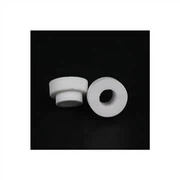
Boron Nitride Ceramic Parts
Boron Nitride Ceramic Parts have good heat resistance, thermal stability, thermal conductivity, high temperature dielectric strength, and are ideal heat dissipation materials and high temperature insulation materials. Boron nitride is chemically stable and resistant to corrosion by most molten metals. It also has good self-lubricating properties. Boron nitride products have low hardness and can be machined with an accuracy of 1/100mm.
Boron nitride crystal belongs to the hexagonal crystal system, its structure is similar to graphite, and its properties have many similarities, so it is also called "white graphite".
Boron Nitride Ceramic Parts have good heat resistance, thermal stability, thermal conductivity, high temperature dielectric strength, and are ideal heat dissipation materials and high temperature insulation materials. Boron nitride is chemically stable and resistant to corrosion by most molten metals. It also has good self-lubricating properties. Boron nitride products have low hardness and can be machined with an accuracy of 1/100mm.
Zhongwei Precision is committed to providing domestic and foreign customers with advanced ceramics with high strength, high toughness, wear resistance, corrosion resistance and high temperature resistance. It is a high-tech enterprise integrating R&D, production and sales of industrial precision advanced ceramic products in the field of precision ceramics. With a variety of modern high-precision equipment, it has independently realized the completion of the entire production process of ceramic parts from ceramic powder preparation, green body molding, high temperature sintering to ceramic material finishing.
Product Description
1. Implementation standards: the company strictly implements ISO9001 certification, and the products have passed ROHS, FDA EU certification, etc.
2. Product material standards: ISO, GB, ASTM, SAE, EN, DIN, BS, AMS, JIS, ASME, DMS, TOCT, GB
3. Main processes: grouting, injection molding, tape casting, isostatic pressing, 3D printing
4. Available materials for ceramics:
It mainly produces finished ceramic rods, ceramic tubes, ceramic rings, ceramic plates, ceramic suction cups, ceramic blades and other special-shaped ceramic structures. The main ceramic materials are alumina, zirconia, silicon carbide, silicon nitride, and aluminum nitride ceramics. High temperature resistance, wear resistance, corrosion resistance, acid and alkali resistance, anti-magnetic, pressure resistance. And 3D printing, etc. are customized according to customer requirements.
Combined tube, its high wear resistance effectively resists material wear and impact.
Product Performance and Production Method
1. Material properties
CBN is usually black, brown or dark red crystals with a sphalerite structure and good thermal conductivity. The hardness is second only to diamond, and it is a superhard material that is often used as tool material and abrasive. Boron nitride is chemically resistant and not attacked by inorganic acids and water. The boron-nitrogen bond is broken in hot concentrated alkali. Above 1200℃, it begins to oxidize in air. The melting point is 3000°C, and sublimation begins when it is slightly lower than 3000°C. Decomposition begins at about 2700°C under vacuum. Slightly soluble in hot acid, insoluble in cold water, relative density 2.25. The compressive strength is 170MPa. The maximum operating temperature is 900 °C in an oxidizing atmosphere, and can reach 2800 °C in an inactive reducing atmosphere, but the lubricating performance is poor at room temperature. Most of the properties of boron carbide are better than carbon materials. For hexagonal boron nitride: low coefficient of friction, good high temperature stability, good thermal shock resistance, high strength, high thermal conductivity, low coefficient of expansion, high electrical resistivity, corrosion resistance, microwave or Infrared transparent.
2. Material structure
Boron nitride is a hexagonal crystal, most commonly a graphite lattice, and there are also amorphous variants. In addition to the hexagonal crystal form, boron carbide has other crystal forms, including: rhombohedral boron nitride (abbreviation: r-BN, or Said: trigonal boron nitride, its structure is similar to h-BN, which will be produced in the process of h-BN conversion to c-BN), cubic boron nitride [abbreviation: c-BN, or |3-BN, or z -BN (that is, sphalerite-type boron nitride), the texture is very hard], wurtzite-type boron nitride (abbreviation: w-BN, h-BN is a hard state under high pressure). Graphene-like 2D boron nitride crystals have even been found (similar to MoS: 2D crystals).
3. Production method
(1) High temperature and high pressure synthesis method
In 1957, Wentorf artificially synthesized cubic BN for the first time. When the temperature is close to or higher than 1700°C and the minimum pressure is 11-12GPa, the pure hexagonal boron nitride (HBN) is directly transformed into cubic boron nitride (CBN). It was subsequently found that the use of catalysts can greatly reduce the transition temperature and pressure. Commonly used catalysts are: alkali and alkaline earth metals, alkali and alkaline earth nitrides, alkaline earth fluorinated nitrides, ammonium borate salts and inorganic fluorides. Among them, the temperature and pressure required by ammonium borate as the catalyst are the lowest, the required pressure is 5GPa at 1500°C, and the temperature range is 600-700°C when the pressure is 6GPa. It can be seen that although the addition of catalyst can greatly reduce the transition temperature and pressure, the required temperature and pressure are still higher. Therefore, the equipment prepared by Boron Nitride Ceramic Parts is complicated and expensive, and its industrial application is limited.
(2) Chemical vapor synthesis method
In 1979, Sokolowski successfully used pulsed plasma technology to prepare cubic boron nitride (CBN) films at low temperature and low pressure. The equipment used is simple and the process is easy to realize, so it has developed rapidly. Various vapor deposition methods have emerged. Traditionally, it mainly refers to thermal chemical vapor deposition. The experimental device is generally composed of a heat-resistant quartz tube and a heating device. The substrate can be heated by a furnace (hot-wall CVD) or by high-frequency induction heating (cold-wall CVD). The reaction gas decomposes on the surface of the high-temperature substrate, and at the same time, a chemical reaction occurs to deposit a film. The reaction gas is a mixed gas of BCl3 or B2H4 and NH3.
(3) Hydrothermal synthesis method
In this method, in the high temperature and high pressure reaction environment in the autoclave, water is used as the reaction medium, so that generally insoluble or insoluble substances are dissolved, and the reaction can also be recrystallized. Hydrothermal technology has two characteristics, one is its relatively low temperature, and the other is that it is carried out in a closed container, which avoids volatilization of components. As a low temperature and low pressure synthesis method, it is used to synthesize cubic boron nitride at low temperature.
(4) Benzene thermal synthesis method
As a low-temperature nanomaterial synthesis method emerging in recent years, benzene thermal synthesis has received extensive attention. Benzene is an excellent solvent for solvothermal synthesis due to its stable conjugated structure, which has recently been successfully developed into a benzene thermal synthesis technique, such as the reaction formula:
BCl3+Li3N→BN+3LiCl or BBr3+Li3N→BN+3LiBr
The reaction temperature is only 450 °C, and the benzene thermal synthesis technology can prepare the metastable phase that can usually be prepared under extreme conditions and can only exist under ultra-high pressure at relatively low temperature and pressure. This method realizes the preparation of cubic boron nitride at low temperature and low pressure. However, this method is still in the experimental research stage, and it is a synthetic method with great application potential.
(5) Self-propagating technology
The necessary external energy is used to induce a highly exothermic chemical reaction, and the system reacts locally to form a chemical reaction front (burning wave). Although this method is a traditional inorganic synthesis method, it has only been reported for the synthesis of boron nitride in recent years.
(6) Carbothermal synthesis technology
The method uses boric acid as a raw material on the surface of silicon carbide, carbon as a reducing agent, and ammonia gas nitridation to obtain boron nitride. The obtained product has high purity and has great application value for the preparation of composite materials.
(7) Ion beam sputtering technology
A mixed product of cubic boron nitride and hexagonal boron nitride is obtained by particle beam sputtering deposition technology. Although this method has fewer impurities, the form of the product is difficult to control because the reaction conditions are difficult to control, and the research on this method still has great potential for development.
(8) Laser-induced reduction method
The laser is used as an external energy source to induce a redox reaction between the reaction precursors, and the B and N are combined to form boron nitride, but this method also obtains a mixed phase.
Process After Sintering
Processing equipment: equipped with CNC engraving machine, centerless grinding, internal and external cylindrical grinding, surface grinding, CNC lathe machining center, wire cutting, turning, milling, grinding and other high-precision production and testing equipment.
Moulds and Inspection Fixtures
1. Mold service life: usually semi-permanent. (except for lost foam).
2. Mold delivery time: 10-25 days, (according to product structure and product size).
3. Tooling and mold maintenance: Zhongwei is responsible for precision parts.
Quality Control
1. Quality control: the defective rate is less than 0.1%.
2. Samples and trial run will be 100% inspected during production and before shipment, sample inspection for mass production according to ISDO standards or customer requirements.
3. Test equipment: roundness measuring instrument, three-coordinate measuring instrument, image coordinate measuring instrument, Hexagon three-coordinate measuring instrument, image measuring instrument, density measuring instrument, smoothness measuring instrument, micro Vickers hardness tester.

Application
Boron Nitride Ceramic Parts is a ceramic product made of boron nitride as a raw material. It not only has high temperature resistance, corrosion resistance, but also has very good heat dissipation and thermal conductivity. It is an emerging material that is becoming more and more important in an era when technology increasingly requires materials with unique properties. Then let's take a look at the specific areas where boron nitride ceramics can be used.
First, as we all know, boron nitride ceramics are not wettable with aluminum water, so it can provide very comprehensive protection for the surfaces of materials that are in direct contact with aluminum, magnesium, zinc alloys and their slag. Therefore, boron nitride ceramics can be used to make some cutting tools and drill bits for geological exploration and oil drilling. It can be said that the drill bit made of boron nitride ceramics is definitely better than the drill bit of other materials.
Second, because boron nitride ceramics have various shapes, they can be made into various suitable parts, or as packaging materials for preventing neutron radiation. Of course, it is also a special resistance material made of boron nitride ceramics at high temperature.
Third, the melting point of boron nitride ceramics is very high, and its resistivity is also very large at high temperatures, so it is very good to use it to make high-temperature insulating materials. As long as there is a need to use high-temperature insulating materials, boron nitride ceramics can be used for production, which can be said to be the most ideal production material.
Fourth, if cubic boron nitride is made of boron nitride ceramics, it can become a very good semiconductor material, which can play a very important role in microelectronics or optoelectronics. In addition, since boron nitride ceramics do not soften or deform at high temperatures, they can also be used as high-temperature furnace materials.




Send Inquiry
