




Magnesium Oxide Ceramic Parts
Magnesium oxide ceramics is a magnesium oxide-based material used in thick-film integrated circuits. Magnesium oxide ceramics have good conductivity, mechanical strength and high temperature resistance.
Magnesium oxide ceramics is a magnesium oxide-based material used in thick-film integrated circuits. Magnesium oxide ceramics have good conductivity, mechanical strength and high temperature resistance.
Zhongwei Precision is committed to providing domestic and foreign customers with advanced Magnesium oxide ceramic parts with high strength, high toughness, wear resistance, corrosion resistance and high temperature resistance. technology companies. With a variety of modern high-precision equipment, it has independently realized the completion of the entire production process of ceramic parts from ceramic powder preparation, green body molding, high temperature sintering to ceramic material finishing.
Product Description
1. Implementation standards: the company strictly implements ISO9001 certification, and the products have passed ROHS, FDA EU certification, etc.
2. Product material standards: ISO, GB, ASTM, SAE, EN, DIN, BS, AMS, JIS, ASME, DMS, TOCT, GB
3. Main processes: grouting, injection molding, tape casting, isostatic pressing, 3D printing
4. Available materials for ceramics:
It mainly produces finished ceramic rods, ceramic tubes, ceramic rings, ceramic plates, ceramic suction cups, ceramic blades and other special-shaped ceramic structures. The main ceramic materials are alumina, zirconia, silicon carbide, silicon nitride, and aluminum nitride ceramics. High temperature resistance, wear resistance, corrosion resistance, acid and alkali resistance, anti-magnetic, pressure resistance. And 3D printing, etc. are customized according to customer requirements.
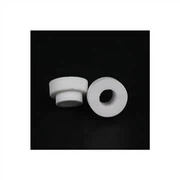
Combined tube, its high wear resistance effectively resists material wear and impact.
Product Feature
Ceramics mainly composed of magnesium oxide. It belongs to cubic crystal system, NaCl type structure. The melting point of pure magnesium oxide is 2800℃±13℃. Its Mohs hardness is 6, its tensile strength, compressive strength and flexural strength are much lower than those of sintered Al2O3, and its high temperature strength is also lower. MgO is a good insulator with a resistivity >1014Ω·cm at room temperature, and the resistivity decreases sharply with the increase of temperature. Magnesium oxide ceramic parts are typical basic refractory materials, which can work stably up to 2400°C in an oxidizing atmosphere or nitrogen protection; MgO will decompose in a reducing atmosphere and volatilize in the form of metallic magnesium, and start to volatilize in a vacuum at 1600°C ; Fe, Zn, Pb, Cu, M and other metals have no reducing effect on it. MgO ceramics can be used as crucibles for metal smelting, and are also suitable for smelting high-purity uranium and thorium in the atomic energy industry; they can also be used as thermocouple protection sleeves. It can be used as a radome and a transmission window material for infrared radiation, etc.
Nowadays, my country's ceramic technology and production technology are at the leading level in the world, and it has the title of "Porcelain Capital". With the further development of modern technology, the important use of magnesium oxide in ceramic production has gradually been recognized. Today, I will introduce the special purpose of electronic ceramics. The role of magnesium oxide.
Oxide ceramics are generally used for electronic ceramics. Magnesium oxide is the main raw material in oxide ceramics because of its large surface activity and high temperature characteristics. In the research and development of high-purity and high-density magnesium oxide ceramic materials, magnesium oxide uses magnesium oxide with a purity of more than 99% as raw material to ensure the purity of magnesium oxide ceramics with its own characteristics.
As an important inorganic chemical product, magnesium oxide has a wide range of uses, mainly used in refractory materials and refining magnesium metal, followed by pulp, uranium extraction, building materials, fertilizers, rubber, plastics and adhesives. Japan, the United States, Germany and other countries have carried out research on magnesium oxide powder, among which Japan is in a leading position. Japanese companies use metal magnesium as raw materials and use gas phase oxidation technology to develop high purity magnesium oxide powder with a purity of more than 99.95% and an average particle size of 10nm. Pure magnesium oxide. In terms of application, Japan has successfully developed a transparent thin-plate ceramic made of magnesium oxide. The product has good toughness and a heat-resistant temperature of up to 2800 °C. The company has provided samples to industries such as aviation, electronics, and optical components.
In addition, magnesium oxide can also be used to prepare magnesium oxide ceramic cores in ceramics. The made magnesium oxide ceramic cores have a smooth surface of the casting, which makes up for the large number of pores and sticking in the inner holes of the casting when such materials are cast with silicon-based cores. Defects such as sand; excellent solubility and loss, can be well dissolved in weak acid, short core removal time, simple core removal equipment, non-polluting, safe and reliable core removal process, reducing the cost of precision casting; casting hollow thin-walled castings does not occur Hot cracking; high dimensional accuracy of the core; sufficient strength, not deformed or broken during modeling, handling and furnace loading. Together with alumina, fused ceramic particles can be prepared, and Magnesium oxide ceramic parts can be widely used in the field of abrasives. Together with rare earth oxides as sintering aids to prepare silicon nitride ceramics, it can efficiently and economically manufacture products of various complex shapes, such as cutting tools, sealing rings, bearings, nozzles and various high temperature, wear, and Corrosive products, etc. Preparation of high toughness ceramic materials.
Magnesium oxide ceramics are generally sintered by hot pressing and hot isostatic pressing, but there are still some defects in normal pressure sintering. Hot pressing sintering helps powder particles to fully contact and conduct diffusion, thereby reducing the sintering temperature of magnesia ceramics and shortening the sintering time. The hot isostatic pressing sintering temperature can complete the sintering and densification of ceramics at a much lower temperature than other sintering methods, and effectively inhibit the adverse reactions of magnesia ceramics at high temperatures.
Process After Sintering
Processing equipment: equipped with CNC engraving machine, centerless grinding, internal and external cylindrical grinding, surface grinding, CNC lathe machining center, wire cutting, turning, milling, grinding and other high-precision production and testing equipment.
Moulds and Inspection Fixtures
1. Mold service life: usually semi-permanent. (except for lost foam).
2. Mold delivery time: 10-25 days, (according to product structure and product size).
3. Tooling and mold maintenance: Zhongwei is responsible for precision parts.
Quality Control
1. Quality control: the defective rate is less than 0.1%.
2. Samples and trial run will be 100% inspected during production and before shipment, sample inspection for mass production according to ISDO standards or customer requirements.
3. Test equipment: roundness measuring instrument, three-coordinate measuring instrument, image coordinate measuring instrument, Hexagon three-coordinate measuring instrument, image measuring instrument, density measuring instrument, smoothness measuring instrument, micro Vickers hardness tester.



Send Inquiry
