


Prediction and analysis of the problems and development prospects of China's medical device industry in 2021
Jan 03, 2023
Prediction and analysis of the problems and development prospects of China's medical device industry in 2021
With the continuous development, the increase of per capita disposable income, the continuous improvement of public health awareness, the intensification of the aging trend of society, and the upgrading and policy support of the medical device industry, China's medical device industry will maintain rapid expansion. Data shows that the market size of China's medical devices in 2018 was about 530.4 billion yuan, with a year-on-year growth of 19.86%, nearly four times the global growth rate of medical devices. China Commercial Industry Research Institute predicts that the market size of China's medical devices will reach 776.5 billion yuan in 2020.
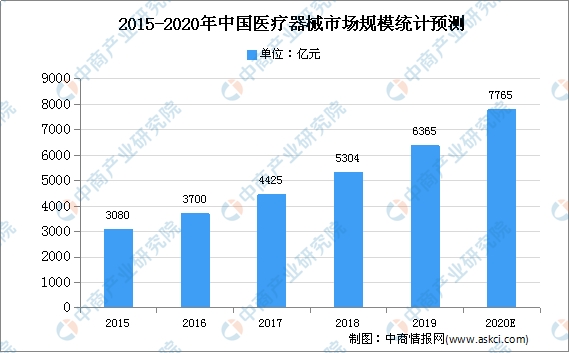
Data source: China Medical Device Blue Book, compiled by China Commercial Industry Research Institute
Difficulties in the development of medical device industry:
1。 The hospital procurement management process is complex

According to such laws and regulations as the Administrative Measures for the Configuration and Use of Large Medical Equipment (Trial), the national competent authority mainly adopts the product catalog management for the configuration license of large medical equipment. If the orthopaedic surgical navigation positioning robot or the newly developed products are clearly listed in the category A or B of the catalog management due to the product type, it is necessary to apply to the provincial health administrative department or even the National Health Commission for configuration license.
2。 Acceptance of doctors and patients
Although robot assisted navigation and positioning surgery has not significantly changed doctors' surgical procedures, it has been a short time for orthopedic surgical robots in China to enter clinical surgery applications. Robot assisted surgery is still in its infancy. Doctors have a process of learning and accepting the use of new technologies, and patients also need a process to build their confidence in the results of robot assisted surgery, which leads to some doctors The patient is unwilling to try robot assisted surgery, which has caused certain difficulties for the product promotion of the issuer.
3。 High product price and high operation cost
Surgical robot is a large medical equipment with high terminal price, which is one of the reasons that affect the popularity of orthopaedic surgical navigation positioning robot. The charge for an operation usually includes a series of charges such as operation fee, anesthesia fee, hospitalization fee, blood transfusion fee, medicine fee, examination fee, consumables fee, etc. At present, the charge of orthopedic surgery navigation positioning robot is separately charged as a new item in the patient's surgery settlement sheet, and the robot use fee is approved by the local health authority. The charging item of orthopedic surgical robot is a new medical service price item. At present, it is only included in the medical insurance scope in Jiangmen City, Guangdong Province, and the disposable sterile positioning tool kit has not been separately included in the medical insurance scope. Therefore, if patients choose to use orthopedic surgical navigation positioning robot and disposable sterile positioning tool kit, it will increase the economic burden.
Development prospect of medical device industry
1。 The proportion of medical device expenditure in medical and health expenditure and the per capita medical device expenditure have a large room for improvement
Due to the late start of China's medical device industry and the long-term "medicine for medicine" industry model, enterprises pay more attention to investment and development in the drug market, resulting in the current situation that China's medical device market is far behind the drug market. With the rapid development of medical devices in China, the domestic medical market is changing from "focusing on drugs rather than devices" to "balanced development of drugs and devices". At the same time, medical device enterprises are also experiencing the transformation from quantity to quality, from imitation to brand building. The gap between the medical device market and the drug market is gradually narrowing. In the future, China's medical device market has huge development potential, and the per capita medical device cost is expected to grow steadily.
2。 The increase of per capita disposable income drives the growth of urban and rural health care expenditure
With the rapid growth of China's GDP, China's per capita disposable income has also increased significantly. In 2019, the per capita disposable income of residents nationwide was 30733 yuan, with a year-on-year growth of 8.44%. The household health care expenditure of urban and rural residents is on the rise as a whole, and its proportion in the per capita consumption expenditure is also increasing year by year, driving the development of the medical device market.


