




AП33 Metal Powder Injection Molding
The state code behind our common AП33 metal powder injection molding heat treatment strengthened aluminum alloy is generally the letter T plus one or more Arabic numerals to indicate the subdivision state of T. Add 0-10 Arabic numerals after T to indicate subdivision state (called TX state). The number after T indicates the heat treatment procedure for the product.
Product Description
|
AП33 metal powder injection molding |
|||||
|
Item |
Material |
Production Process |
Sintering Temperature |
Mold |
Custom |
|
AП33 |
Aluminum alloy |
Metal Injection Molding |
1500°C |
To be customized |
Yes |
|
Chemical composition |
unit:% Cu:0.15~0.4 Mn :0.15 Mg :0.8~1.2 Zn :0.25 Cr:0.04~0.35 Ti :0.15 Si:0.4~0.8 Fe :≤0.7 Al : Margin |
||||
|
Available Materials |
Low carbon stainless steel, titanium alloy (Ti, TC4), copper alloy, tungsten alloy, hard alloy, high temperature alloy (718, 713) |
||||
Heat Treatment Process
The state code behind our common AП33 metal powder injection molding heat treatment strengthened aluminum alloy is generally the letter T plus one or more Arabic numerals to indicate the subdivision state of T. Add 0-10 Arabic numerals after T to indicate subdivision state (called TX state). The number after T indicates the heat treatment procedure for the product.
T0 After solution heat treatment, natural aging and then cold working. Suitable for products that have been cold-worked to increase strength.
T1 Cooled by high temperature forming process, then naturally aged to a basically stable state. It is suitable for products that are no longer cold-worked (straightening, leveling, but not affecting the limit of mechanical properties) after being cooled by the high-temperature forming process.
T2 is cooled by the high temperature forming process, and naturally aged to a basically stable state after cold working. It is suitable for products that are cooled by high temperature forming process, and then cold processed, or straightened and flattened to improve the strength.
T3 Cold working after solution heat treatment, and then natural aging to a basically stable state. It is suitable for products that undergo cold working, or straightening and leveling to improve strength after solution heat treatment.
T4 Naturally aged to a basically stable state after solution heat treatment. It is suitable for products that do not undergo cold working after solution heat treatment (straightening and leveling can be performed, but do not affect the limit of mechanical properties), and then natural aging products.
T5 The state in which it is cooled by a high-temperature forming process and then artificially aged. It is suitable for products that are cooled by the high-temperature forming process without cold processing (straightening and leveling can be performed, but the limit of mechanical properties is not affected), and then artificially aged.
T6 is the state of artificial aging after solution heat treatment. It is suitable for products that are not subjected to cold working after solution heat treatment (straightening and leveling can be performed, but does not affect the limit of mechanical properties), and then artificially aged.
T7 is the state of artificial aging after solution heat treatment. It is suitable for products whose strength exceeds the highest peak point on the aging curve during artificial aging in order to obtain some important properties after solution heat treatment.
T8 The state of cold working after solution heat treatment and artificial aging. It is suitable for products that have been cold processed, or straightened or leveled to improve product strength.
T9 is the state of artificial aging after solution heat treatment and then cold working. It is suitable for products that have been cold-processed to increase product strength.
T10 After cooling from the high temperature forming process, it is cold worked and then artificially aged. It is suitable for products that have been cold processed, or straightened or leveled to improve product strength. T state and TXXX state (except the stress relief state) After the TX state code, add an Arabic numeral (called TXX state), or add two Arabic numerals (called TXXX state), indicating that the product characteristics have been significantly changed ( Such as mechanical properties, corrosion resistance, etc.), the state of specific process treatment.
T42 is suitable for products whose natural aging has reached a fully stable state after solution heat treatment in the O or F state, and is also applicable to products whose mechanical properties have reached the T42 state after heat treatment of processed products in any state by the purchaser.
T62 is applicable to products that enter artificial aging after solution heat treatment in O or F state, and also applies to products whose mechanical properties have reached T62 state after heat treatment of processed products in any state by the purchaser.
T73 is suitable for products that have been aged to achieve the specified mechanical properties and stress corrosion resistance after solution heat treatment.
T74 Same as T73 state definition. The tensile strength of this state is greater than that of T73 state, but less than that of T76 state.
T76 Same as T73 state definition. The tensile strength of this state is higher than that of T73 and T74 states, and the stress corrosion cracking resistance is lower than that of T73 and T74 states, but its exfoliation corrosion resistance is still good.
T7X2 is suitable for products that have been subjected to artificial aging treatment after solution heat treatment in the O or F state, and whose mechanical properties and corrosion resistance have reached the T7X state.
T81 is suitable for products that are subjected to about 1% cold deformation to increase strength after solution heat treatment, and then undergo artificial aging.
T87 is suitable for products that undergo a 7% cold working deformation to increase strength after solution heat treatment, and then perform artificial aging. Stress-relieving state Add "51", or "510", or "511" or "52" or "54" after the above TX or TXX or TXXX state code to indicate the state code of the product that has undergone stress-relieving treatment.
TX51 TXX51 TXXX51 Applicable to thick plates, rolled or cold-finished bars and die forgings, forged rings or rolled rings that are stretched according to the specified amount after solution heat treatment or cooling from high-temperature forming processes. These products are stretched Thereafter no straightening is performed. The permanent deformation of thick plate is 1.5%~3%; the permanent deformation of rolled or cold finished bar is 1%~3%; the permanent deformation of die forging ring or rolling ring is 1%~5% . The permanent deformation of extruded rods, shapes and pipes is 1%~3%; the permanent deformation of drawn pipes is 1.5%~3%.
TX511 TXX511 TXXX511 It is suitable for extruded rods, shapes and pipes stretched according to the specified amount after solution heat treatment or cooling from high temperature forming process, and drawn pipes. These products can be slightly straightened after stretching to meet the standard tolerance.
TX52 TXX52 TXXX52 Suitable for solution heat treatment or after cooling from high temperature forming process, the stress is relieved by compression to produce products with a permanent deformation of 1%~5%.
TX54 TXX54 TXXX54 Suitable for die forgings that relieve stress by cold shaping in the final forging die. the
T6, solution treatment (quenching), artificial aging.
T62, by annealing or F state solution treatment, artificial aging.
T61 is a special heat treatment state, requiring its strength to be lower than T6.
Metal Injection Molding Process

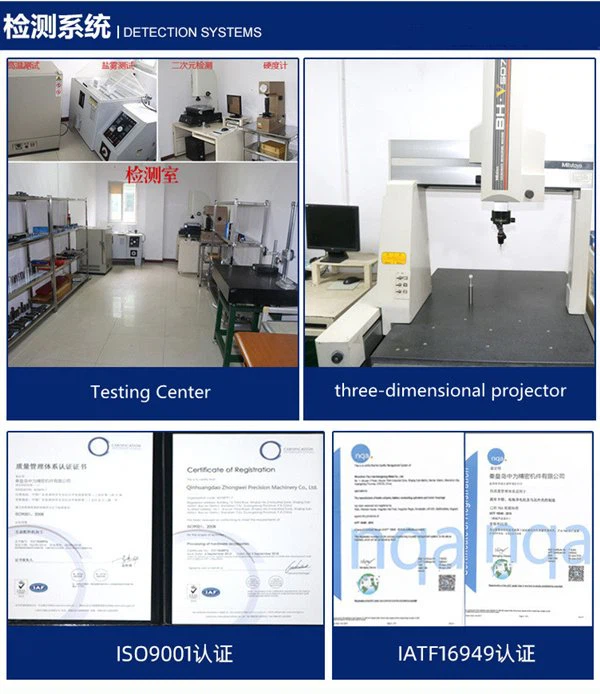
Detection Systems


Send Inquiry
