




Tungsten-rhenium Alloy Heat Sink
A solid solution strengthened alloy composed of tungsten element and rhenium element.Tungsten-rhenium alloy is a solid-solution strengthened alloy composed of tungsten element and rhenium element. Commonly used rhenium content (mass fraction, %) in the alloy is 3, 5, 10, 25 and 26. Divided into low content W-Re alloy (Re≤5%) and high content W-Re alloy (Re≥15%).
Product Description
|
Tungsten-rhenium alloy heat sink |
|||||
|
Item |
Material |
Production Process |
Sintering Temperature |
Mold |
Custom |
|
Heat sink |
Tungsten Rhenium Alloy |
Metal Injection Molding |
1650°C |
To be customized |
Yes |
|
Available Materials |
Low carbon stainless steel, titanium alloy (Ti, TC4), copper alloy, tungsten alloy, hard alloy, high temperature alloy (718, 713) |
||||
Tungsten Rhenium Alloy
A solid solution strengthened alloy composed of tungsten element and rhenium element.
Tungsten-rhenium alloy is a solid-solution strengthened alloy composed of tungsten element and rhenium element. Commonly used rhenium content (mass fraction, %) in the alloy is 3, 5, 10, 25 and 26. Divided into low content W-Re alloy (Re≤5%) and high content W-Re alloy (Re≥15%).

Figure 1
Tungsten-rhenium alloy is a solid-solution strengthened alloy composed of tungsten element and rhenium element. Commonly used rhenium content (mass fraction, %) in the alloy is 3, 5, 10, 25 and 26. Divided into low content W-Re alloy (Re≤5%) and high content W-Re alloy (Re≥15%). When the Re content in the alloy exceeds 26%, the W-Re alloy will precipitate brittle σ phase.
According to the preparation method, strengthening method and selected tungsten-based raw materials, the classification of tungsten-rhenium alloys is shown in Figure 1.
The main processing materials of tungsten-rhenium alloy are wire and sheet. Silk accounts for the vast majority. Mainly used as high temperature structural materials.
Tungsten-rhenium alloy has better mechanical properties and ductility than pure tungsten, and has high resistivity, so it has better processability and weldability. Tungsten-rhenium alloy containing 3% rhenium can be used as the core metal of electron tube filament, grid wire and direct heating cathode. Tungsten-rhenium alloy containing thorium, that is, thoriated tungsten-rhenium alloy, is used as a direct-heating cathode of a large launch tube, and its performance is better than that of a thoriated tungsten cathode, and it is not easy to deform at high temperature. the
Tungsten-rhenium alloy scrap is mainly tungsten-rhenium alloy, and also includes molybdenum-rhenium alloy. The methods for recovering rhenium from waste tungsten-rhenium alloy include oxidative biogenesis method and saltpeter melting decomposition-ion exchange method.
Production Process

Figure 2
There are two methods of producing tungsten-rhenium alloy: powder metallurgy and smelting. The production process is shown in Figure 2. In actual production, the powder metallurgy method dominates. Isostatic pressing and medium frequency induction heating sintering can obtain high-quality alloy blanks with the best uniformity and consistency.
Preparation of Tungsten Rhenium Powder
|
Comparison of Various Prealloying Methods |
|||
|
Mixing method |
Raw material |
Main features |
Application range |
|
Solid-liquid mixing method |
Tungsten powder (doped tungsten powder) + rhenium powder into tungsten trioxide powder + ammonium perrhenate powder |
The process is simple, the composition is the most accurate, it is easy to manufacture, and the cost is low; but the composition uniformity is poor, and composition segregation is easy to occur; the deformation performance is poor |
Used to prepare tungsten-rhenium alloys that do not require strict composition uniformity, or alloys that do not undergo plastic cross-shaping |
|
Solid-liquid mixing method |
Tungsten powder (doped tungsten powder) + ammonium perrhenate solution or tungsten trioxide powder + gaolaisuanan |
With tungsten or trioxide powder as the core, the periphery is covered with ammonium perrhenate crystals, and the composition uniformity is good. After grinding, the powder is empty into flakes, and its compressibility is poor. |
Preparation of tungsten-rhenium thermoelectric tungsten wire and tungsten wire for electron tube and picture tube. Especially suitable for preparing tungsten-rhenium alloy |
|
Liquid-liquid feed method |
Ammonium tungstate solution + ammonium perrhenate solution |
The core composition of the particles is uncertain, either tungsten or rhenium, which is the most ideal package summer powder, with the best composition distribution and uniformity; the composition accuracy is not easy to control. Fine powder with high activity, easy to oxidize, and poor cross-shape performance |
It is most suitable for the production of tungsten-rhenium thermoelectric materials, especially the positive wire |
|
High energy ball mill mixing method |
Rhenium powder or tungsten powder (doped tungsten powder)+ammonium perrhenate solution or tungsten trioxide powder |
The process is simple, the composition is easy to control, the powder is highly active, easy to oxidize, and the material is easy to be mixed with impurities, which will deteriorate the deformation performance |
Used in the manufacture of tungsten-rhenium alloys for various purposes and compositions |
Figure 3
The method of preparing tungsten-rhenium pre-alloyed powder is the key to the uniformity of alloy composition. The comparison of various pre-alloyed methods is shown in Figure 3.
Billet Preparation
The alloy compact can be made by steel mold forming or cold isostatic pressing, and the compact is sintered into a dense ingot with a relative density of 85% to 95% in a hydrogen-passing vertical melting furnace, a hydrogen-passing intermediate frequency furnace or a hydrogen-passing resistance furnace. There are also ingots made by hot isostatic pressing.
Processing
|
Classification of tungsten-rhenium wire grades according to different properties (CB/T 4148-2002) |
||
|
Serial number |
Type |
Performance |
|
W-IHc,W-3Re |
L |
Spiral |
|
W |
Bent shape |
|
|
Chemical composition of tungsten rhenium wire (GB/T4184 -2002) |
|||||
|
Grade |
Tungsten |
Rhenium (mass fraction)/% |
Potassium (mass fraction)/% |
Su content of each impurity element (mass fraction)/% |
Total amount of impurity elements (mass fraction)/% |
|
W-1Re |
Margin |
1.00±0.10 |
0.004-0.009 |
≤0.01 |
≤0.05 |
|
W-3Re |
3.00±0.15 |
||||
Figure 4
Sintered ingots are made into different types of processed materials, such as rods, wires, plates, foils and strips, through different processing methods (swivel forging, rolling, drawing, etc.). The composition of tungsten-rhenium alloy with good processing performance is W-(18~26)Re. The recommended optimum forging temperature for alloy processing is 1500°C and annealing temperature is 1600~1800°C. For alloys with Re content > 26%, the allowable sigma phase content is limited. Although the precipitation of this second phase leads to material strengthening, its processability is still very good. Alloys with Re content <18% can be processed smoothly, but require a higher initial processing temperature.
Wire is the main processing material of w-Re alloy. The grades of tungsten-rhenium wire in my country are classified according to different properties, and the chemical composition is shown in Figure 4.

Figure 5
Composite strengthening method is an effective method to further improve the high temperature mechanical properties of W-Re alloys. Adding Hfc particles or adding ThO2 particles to the alloy is the most common composite method, and the prepared alloy systems include W-He-Hf-C system and W-He-ThO2 system. The particle distribution in the alloy changes continuously with the processing process. Figure 6 atlas (a) shows the microstructure of the Hfc particle distribution change in the W-24.5Re-2Hfc alloy rod. After hot isostatic pressing (rod ∅ 41mm), the relative density of the alloy reaches 99%, and the particles in the compact structure are distributed in grain boundaries and grains (as shown in Figure 6 (a)), and in the subsequent hot swaging process In Hfc, when the deformation rate reaches 62%, the σ phase appears in the structure, and the Hfc particles concentrate to the grain boundary (Figure 6, atlas (b)). The improvement of the high-temperature mechanical properties of the alloy is shown in Figure 6 (c). Figure 6 Atlas (d) and (e) are the comparison of the microstructure of W-Re alloy, W-Re-ThO2 alloy and W-Re-Hfc alloy after 2500K annealing. It can be seen that different The morphology presented by adding particles is not the same.


Performance
Tungsten-rhenium alloy has a series of excellent properties, such as high melting point, high strength, high hardness, high plasticity, high recrystallization temperature, high resistivity, high thermoelectric potential value, low vapor pressure, low electron work function and low extension Brittle transition temperature. The properties of typical tungsten-rhenium alloys are shown in Figure 7 (a) on the right. It can be seen from the right figure of Figure 7 that the recrystallization temperature of doped rhenium is much higher than that of pure tungsten rhenium.

Figure 7
The high-temperature tensile properties of several tungsten-rhenium alloys are shown in Figure 7 (b) on the right. It can be seen from Figure 7 that the tensile properties of these alloys are much higher than those of pure tungsten at around 1500 °C. The example of adding Hfc to improve the high-temperature mechanical properties of tungsten-rhenium alloy is shown in Figure 7 (c) of the microstructure section above.
Application
Both tungsten and rhenium are refractory metals that are widely used in high temperature applications. But they also have disadvantages, pure tungsten is brittle, and the recrystallization temperature is very low; pure rhenium has poor processing performance and is expensive. So that their range of application is greatly limited. Tungsten and rhenium are made into tungsten-rhenium alloys with various components. These alloys overcome the shortcomings of pure tungsten and pure rhenium, and have many excellent properties, such as high melting point, high strength, high hardness, high plasticity, high resistivity, and high recrystallization Temperature, high thermoelectric potential value, low vapor pressure, low electron work function and low plastic-brittle transition temperature, etc. At the same time, they also have excellent resistance to "water cycle" reaction performance, and the price is 75~ lower than pure rhenium 95%.
Therefore, tungsten-rhenium alloys have been widely used in electronic technology, thermal control, modern nuclear technology and aerospace technology, temperature measurement, instrumentation, electrical appliances and other cutting-edge science and technology departments. In particular, tungsten-rhenium alloy wire is matched into a thermocouple, which has high thermoelectric potential and sensitivity, and has a wide range of temperature measurement, fast response speed, and good corrosion resistance. It is a good thermal sensing material in the field of temperature measurement. Since tungsten-rhenium thermocouples replace platinum-rhodium thermocouples is the general trend.
• Application in electric vacuum technology
The main performance requirements for electron tubes, kinescopes and bulb filaments are:
① Good ductility at low temperature (that is, good formability of one-time wire winding). The processed filament is wound, folded or twisted into filaments of various shapes and sizes, which must have good insulation between each other, low plastic-brittle transition temperature, good uniformity and consistency;
② Low-temperature annealing has good ductility (that is, good secondary winding formability). The filament parts after primary winding must be annealed to fix the shape and size of the parts. Generally, annealing is carried out within the temperature range of the primary recrystallization of the wire. Only wires with good low-temperature annealing ductility can meet the requirements of secondary winding (double helix filament) or multiple winding and folding;
⑧ Good high temperature ductility (that is, ductility after secondary recrystallization). During the process of removing the core wire, transporting, and installing the tube, it must be subjected to vibration and impact, and the filament with poor ductility will be destroyed. The finished filament should be used at high temperature, and the filament should be kept in the required shape during use;
④High temperature anti-sagging performance is good. Since most of the filament exists in a spiral shape, the filament is longer and has a certain quality. To keep the pitch unchanged during use, high temperature sag resistance is the key.
• Used as electrical contact material
Many contact materials are commonly used in electrical switches, such as car horn contacts and ignition contacts, voltage regulator contacts, telephone contacts, various electrical switch contacts, etc. When working, each pair of contacts has the characteristics of mutual friction, spark corrosion and high-frequency contact. Therefore, the contact material should meet the following requirements: ①The contact resistance of the material is small, ②The volt-ampere characteristic of the arc is small, ⑧The dip Erosion rate is small.
The metals that can be used as contact materials are: copper, silver, platinum, rhodium, iridium, tungsten, molybdenum, rhenium, tungsten-copper alloy, tungsten-silver alloy, tungsten-chin alloy and high specific gravity alloy. Tungsten, molybdenum, rhenium and their alloys have been widely used in automotive horn contacts and ignition contacts. The use of tungsten-rhenium alloy as a contact material is still a product developed in recent years. It can be compared with platinum, iridium, rhodium and other precious metal contacts.
• Used as thermocouple material
Tungsten-rhenium alloy wires of various compositions can be paired into tungsten-rhenium thermocouples. Tungsten-rhenium thermocouples widely used in industrial practice include: W/W-26Re doped, W-3Re/W-25Re, W-5Re/W-20Re and W-5Re/W-26Re and other tungsten-rhenium thermocouples . They have high thermoelectric potential value and high sensitivity, thermoelectric potential - temperature correspondence relationship is good linearity, high measurement temperature (up to 2800 ℃), high precision (the allowable deviation is ±0.25%t, ±0.5%t and ±0.5%t and ± 1%t and other three).
Tungsten-rhenium thermocouples are mainly used for temperature measurement in vacuum, reducing atmosphere and inert atmosphere for temperature measurement and high temperature field. Taking some special anti-oxidation measures in an oxidizing atmosphere can replace the platinum-rhodium thermocouple for temperature measurement. The price of tungsten-rhenium thermocouple is 12 to 18 times lower than that of single platinum-germanium thermocouple. The temperature measurement of tungsten-rhenium thermocouple instead of platinum-rhodium thermocouple has obvious economic benefits, and it has been paid more and more attention by people.
• Other applications
(1) High temperature structural materials
Tungsten-rhenium alloys used in aerospace vehicles include: heat shields, peripheral parts of rocket nozzles, cone parts, coatings for engines or engine parts. Tungsten-rhenium alloy containers and crucible materials heated to 2000°C without reaction for refining uranium. Tungsten-rhenium alloys are used for heating elements and heat shields of high-temperature furnaces, crucibles for evaporating high-purity metals, and springs, screws, nuts, support rods and connecting rods in high-temperature fields, which have good plasticity.
(2) Wear-resistant materials
Because tungsten-rhenium alloy has high hardness, high strength, good wear resistance and corrosion resistance, it can be used to make printing needles of printers, and its life span can reach 100 million times. In addition, it can also make nibs, center of gravity hammers and wear-resistant parts of surveying and mapping instruments.
(3) Electrode material
Tungsten-rhenium alloy rods containing thorium oxide, zirconia and cerium oxide dispersed particles are used for electrodes of argon arc welding machines and non-consumable electric arc furnace melting electrodes. It is resistant to high temperature and ablation, and has a long service life.
Metal Injection Molding Process

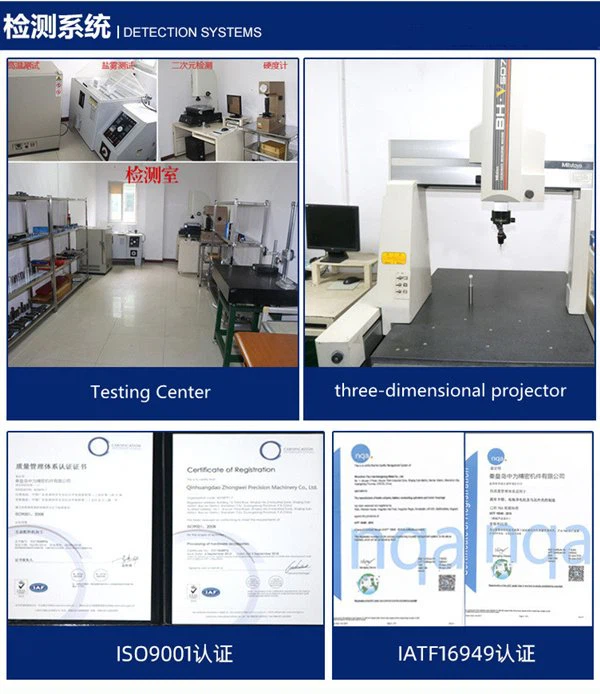
Detection Systems



Send Inquiry
