



ZS4505 Ductile Iron Castings
Ductile iron is a kind of high strength cast iron material developed in the 1950s, its comprehensive performance is close to steel, it is based on its excellent performance, has been successfully used to cast some complex forces, strength, toughness, wear resistance requirements of high parts.
Product Introduction
|
ZS4505 Ductile Iron Castings |
|||||||
|
Item |
Material |
Production Process |
Sintering Temperature |
Mold |
Custom |
||
|
ZS4505 Ductile Iron Castings |
ZS4505 |
Molten mold casting |
1380℃ |
To be customized |
Yes |
||
|
Available Materials |
Carbon steel, alloy steel, aluminum alloy, low -carbon stainless steel, titanium alloy (TI, TC4), copper alloy, high temperature alloy (718, 713) |
||||||
|
Smoothness |
Dimensional accuracy |
Product density |
Appearance treatment |
Appropriate weight |
|||
|
Roughness 1~5μm |
(±0.1%~±0.5%) |
7.3-7.6/CM³ |
According to customer requirements |
0.03g~40kg |
|||
ZS4505 ductile iron lost wax investment casting
Ductile iron is a kind of high strength cast iron material developed in the 1950s, its comprehensive performance is close to steel, it is based on its excellent performance, has been successfully used to cast some complex forces, strength, toughness, wear resistance requirements of high parts. Ductile iron has rapidly developed into a cast iron material second only to gray iron and widely used. The so-called "iron instead of steel" mainly refers to ductile iron. Nodular cast iron is obtained by spheroidization and inoculation treatment, which effectively improves the mechanical properties of cast iron, especially the ductility and toughness, so as to obtain higher strength than carbon steel. Chinese name nodular cast iron Foreign name Nodular cast iron (DI) role to improve the mechanical properties of cast iron development time in the 1950s alloying elements C, Si, Mn, S, P and other five elements catalog 1 Introduction to the development history of components main properties 2 Construction technology Chinese technology Major issues 3 Related data Variety grade Application field Representative Product Future Direction Introduction Broadcast Edit Development history According to modern archaeological research, a large number of iron cast-related relics and relics have been found in the Back end Bay cast iron site of the Old City of Xinzheng Zheng Han, which is located in the southwest of the Dongcheng district of the old city of Zheng Han in Xinzheng City, covering an area of nearly 100,000 square meters. The site was a government-run handicraft workshop for casting tools and farm implements in the capital of Korea in the middle and late Warring States period. The decarbonization kiln was discovered for the first time at the Houduanwan cast iron site in Henan Province, which advanced the history of ductile iron in China by at least 200 years. At least 2,000 years earlier than the West. [5] Reaumur of France made white heart malleable cast iron in 1722. Later, Seth Boyden (Seth Boyden) in the United States invented the black heart malleable cast iron in 1826. By the 1920s. Due to the progress of the research on the main components of cast iron such as carbon and silicon and the influence of adding other alloying elements, melting methods and inoculation effects, the so-called high-grade cast iron has appeared. As a result, the material has been considerably improved, and the scope of application has been expanded to a certain extent. However, due to the fundamental shortcomings of low toughness, it has not been able to rapidly expand its application range. In 1947, the British Morrogh [6](Morrogh) discovered the presence of spherical graphite in cast iron. In 1948, by adding Ce to high carbon, low sulfur and low phosphorus gray cast iron, and keeping its residue above 0.02%, ductile cast iron was produced. Almost at the same time, the United States International Nickel Corporation (INCO) Gagnebin (Gagnebin) and other by adding Mg to the cast iron, and keeping its residue above 0.04%, to obtain the same ductile iron. During the Second World War, due to the lack of chromium element resources necessary for the production of wear-resistant martensitic white cast iron, the study of Cr substitute elements became an urgent matter. Therefore, various metals and transition metals chemically combined with carbon have been systematically investigated as to whether they can form carbides, including magnesium. In order to slow down the intense splashing when adding magnesium, Cu80-MG20 alloys and Ni80-M920 alloys have been used. The results show that magnesium not only has a good effect as a substitute element for chromium, but also has a significant desulphurization effect when there is a certain degree of residual magnesium in hot metal. On the basis of these new findings, the effect of adding magnesium to gray cast iron has also been studied. Adding 0.5% Mg to gray cast iron containing 3.5% C, 2.25% Siand 2% Ni, the tensile strength far exceeds the original expectation (common gray cast iron is about 13kgf/mm2), up to 78kgf/mm2. Cast iron is an iron-carbon alloy with carbon content greater than 2.11%. It is obtained by industrial pig iron, scrap steel and other steel and alloy materials through high-temperature melting and casting. In addition to Fe, it also contains carbon in other cast iron in the form of graphite precipitation. If the cast iron is called gray cast iron or gray cast iron when the precipitated graphite is sheet-like, the cast iron is called vermicular cast iron, the cast iron is malleable cast iron or code iron when it is flocculated, and the cast iron is called ductile cast iron when it is spherical. In addition to iron, the chemical composition of ductile iron is usually: carbon content 3.0 ~ 4.0%, silicon content 1.8 ~ 3.2%, the total amount of manganese, phosphorus, sulfur does not exceed 3.0% and an appropriate amount of rare earth, magnesium and other nodular elements.
Zhongwei Precision has the following services
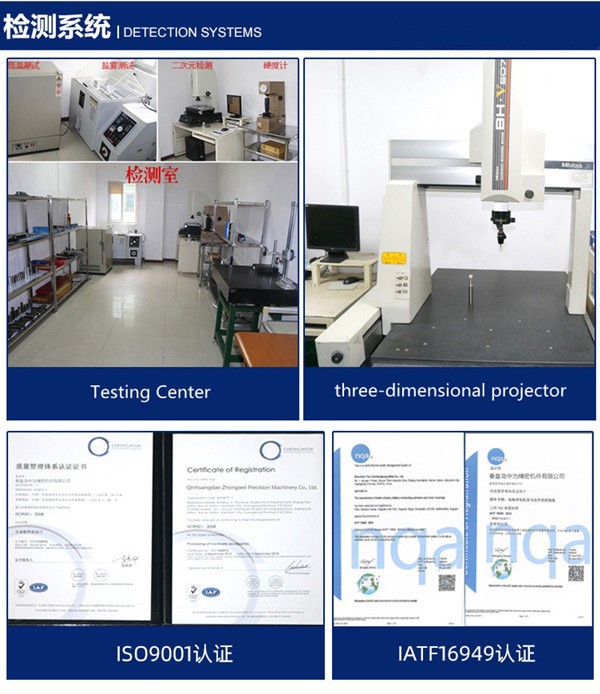
Detection Systems
Copper Silica Sol Investment Casting


We are the manufacturer of "ZS4505 Ductile Iron Castings", if you need more information please contact us!


Send Inquiry
