



Silica Sol Precision Casting
The difference between the three casting methods of precision casting is that the wax and shell materials are different. Take silica sol as an example. Sand, Moying sand, wrong powder and silica sol are used to make shells.
Precision casting is a casting process we often hear about, and it is even more familiar to precision casting manufacturers. There are three types of precision casting:
1. Silica sol precision casting;
2. Water glass casting;
3. Compound casting;
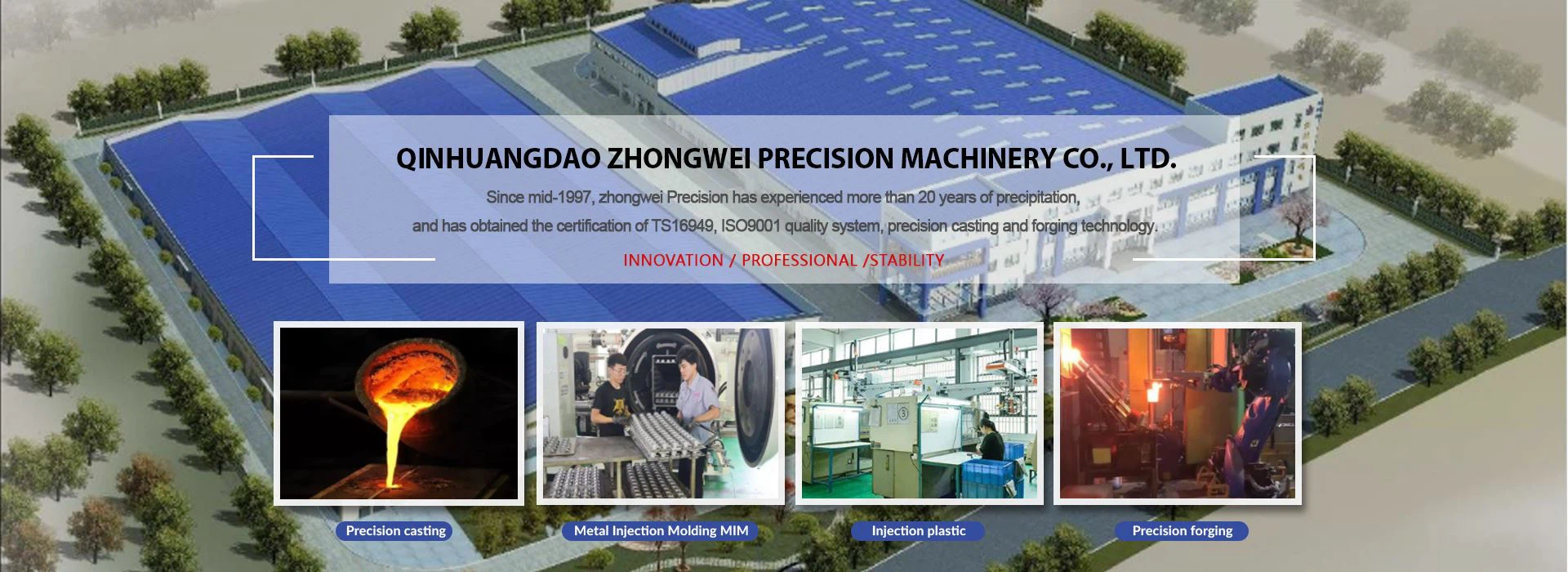
After more than ten years of precipitation, Qinhuangdao Zhongwei Precision Machinery Co., Ltd. has rich production experience in water glass lost wax precision casting, lost foam precision casting technology, silica sol precision casting technology, and shell sand casting technology. We expect manufacturers from all over the world to consult silica sol precision casting.
Product Description
Basic situation of Silica sol precision casting
1. Implementation standards: The company strictly implements ISO9001 & TS 16949 certification.
2. Product material standards: ISO, GB, ASTM, SAE, ISO, EN, DIN, JIS, BS
3. Main processes: sand casting, silica sol investment casting, water glass investment casting,shell casting,deburring, sand blasting, machining, heat treatment, leak testing, surface treatment, etc.
4. Available materials:
Titanium alloy, carbon steel, alloy steel, stainless steel, gray iron, cast iron, cast steel, cast aluminum, cast copper, etc. can be customized according to customer requirements.

Silica Sol Precision Casting Process Classification
The difference between the three casting methods of precision casting is that the wax and shell materials are different. Take silica sol as an example. Sand, Moying sand, wrong powder and silica sol are used to make shells. According to the needs of each product, 4-8 layers of shells can be made; the process of water glass is to use low-temperature wax to make wax molds, and then Use foamed alkali, quartz sand, etc. to make shells; the composite process is that the first two processes are staggered together, the first two or three layers are made of silica sol process, and the latter layers are made of water glass.
If the three processes are compared in terms of size, silica sol is very suitable for small parts, the surface will be finer, the roughness value can reach RA3.2-6.4, the tolerance size will be better controlled, and the use of In the case of the silica sol process, in some places, no processing is required, and one-time molding can be used, which can also save a lot of costs. The composite type is not as good as the silica sol process in terms of surface or tolerance size, but the composite type process can make larger castings, which are better than water glass in terms of size and outer surface, and sometimes can When it reaches about Ra6.4-12.5, the water glass is one grade worse than the composite process.
So for precision casting manufacturers, what are the aspects of the application of silica sol in precision casting?
Silica sol is mainly used in the adhesive of precision casting coatings, and can be used to make reinforcement coatings and surface coatings of shells. Precision casting manufacturers will use small particle silica sol in precision casting to replace ethyl silicate, which can not only reduce the cost of casting, but also improve the labor environment and conditions. When silica sol is used for precision casting of thin shells, the strength of the shell shape will be increased, the finish of the castings will be better, and the dimensional accuracy will be higher. Low in ethyl silicate. For large castings, castings that require high surface finish and castings that require no margin or a small margin, it is also more suitable to use silica sol for casting. Precision casting manufacturers use silica sol as a high temperature resistant coating for casting molds, which can make the coating have very good wear resistance and heat resistance, and can also reduce the loss of molten metal liquid at high temperature to the mold, and also help castings to be removed mold.
1. Because the back layer retains the water glass adhesive, the overall high temperature strength and creep resistance of its shell are lower than those of the silica sol shell, and the dimensional accuracy and shape and position tolerance of the cast castings are not comparable to those of silicon the shell of the sol;
2. Because the composite shell is made of zircon powder with a relatively high price, the cost of its shell is 4.5 times that of water glass. If the large steel casting foundry uses mullite sand powder for the back layer If it is, then its shell cost is almost the same as that of silica sol, and its low cost advantage is not very obvious;
3. The quality stability of composite shell castings is better than that of water glass, but it is worse than that of silica sol shells;
4. The compound shell cannot use medium temperature wax material, nor can medium temperature wax material be dewaxed with hot water;
5. The air permeability of the composite shell is not as good as that of the water glass and the silica sol shell, and the high temperature strength of the shell is not as strong as that of the silica sol shell, which is more likely to cause waste.
Although the dimensional accuracy of ordinary investment castings is relatively high, it needs to be improved in order to achieve consistency. For large-scale steel casting manufacturers, the casting size and surface quality of stainless steel precision casting are higher than other casting methods, and the castings that are more complicated than other casting methods and are not easy to process can be directly used for investment casting. process for casting.
Post Casting Process
1. Heat treatment: annealing, carbonization, tempering, quenching, normalizing, surface tempering
2. Processing equipment: CNC, WEDM, lathe, milling machine, drilling machine, grinder, etc.;
3. Surface treatment: powder spraying, chrome plating, painting, sandblasting, nickel plating, galvanizing, blackening, polishing, bluing, etc.

Moulds and Inspection Fixtures
1. Mold service life: usually semi-permanent. (except for lost foam).
2. Mold delivery time: 10-25 days, (according to product structure and product size).
3. Tooling and mold maintenance: Zhongwei is responsible for precision parts.
Quality Control
1. Quality control: the defective rate is less than 0.1%.
2. Samples and trial run will be 100% inspected during production and before shipment, sample inspection for mass production according to ISDO standards or customer requirements
3. Testing equipment: flaw detection, spectrum analyzer, golden image analyzer, three-coordinate measuring machine, hardness testing equipment, tensile testing machine;
4. Provide after-sales service.
5. The quality can be traced back.
Application
Silica sol precision casting is used in almost all industrial sectors, especially electronics, petroleum, chemical, energy, transportation, light industry, textiles, pharmaceuticals, medical devices, pumps and valves.


Send Inquiry
