




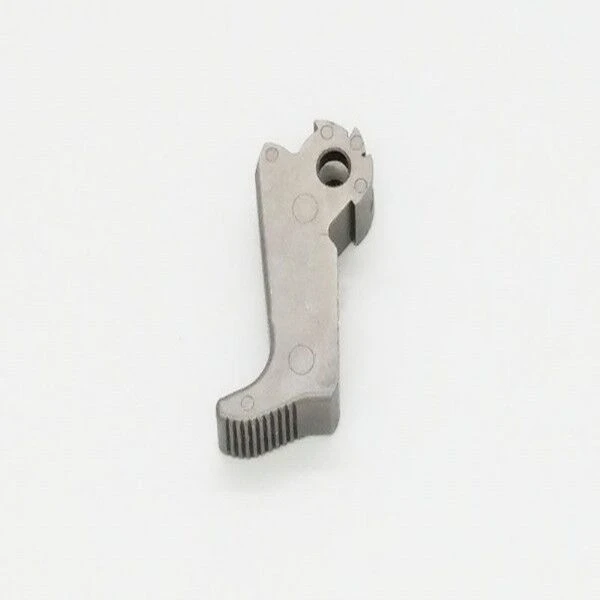

Pistol Trigger Metal Powder Injection Molded Parts
Pistol trigger metal powder injection molded parts are pistol trigger components manufactured using metal powder injection molding (MIM) technology. MIM is an advanced process that mixes metal powder with a binder and injects it to create parts with complex shapes.
Product Overview
Pistol trigger metal powder injection molded parts are pistol trigger components manufactured using metal powder injection molding (MIM) technology. MIM is an advanced process that mixes metal powder with a binder and injects it to create parts with complex shapes. This process combines the advantages of plastic injection molding and powder metallurgy, enabling the production of high-precision, high-strength, and complex-shaped metal parts.
Performance Characteristics
High Precision
MIM technology achieves very high dimensional accuracy and surface quality, meeting the stringent requirements of pistol triggers for dimensional accuracy and surface finish. This allows the trigger to fit perfectly with other components during assembly, ensuring the pistol's operational performance and reliability.
High Strength
By selecting appropriate metal powders and optimizing the sintering process, pistol trigger metal powder injection molded parts can possess high strength and hardness, capable of withstanding frequent operation and large forces without deformation or damage. This is crucial for ensuring the safety and lifespan of the pistol.
Complex Shapes
MIM technology can manufacture trigger parts with very complex shapes, achieving design requirements that are difficult to meet using traditional machining methods. This provides pistol designers with greater design freedom, allowing triggers to be optimized according to ergonomic principles, improving user grip comfort and ease of operation.
Material Diversity
Suitable metal powder materials, such as stainless steel, titanium alloys, and copper alloys, can be selected according to different needs. Different materials have different performance characteristics, meeting the performance requirements of pistol triggers under various environmental and usage conditions.
Manufacturing Process
Mixing
Metal powder and binder are mixed in a certain proportion to create a feedstock with good flowability. The binder's role is to give the metal powder plasticity during injection molding and to maintain the shape of the part after molding.
Injection Molding
The feedstock is heated to a certain temperature to achieve good flowability, and then injected into the mold cavity through an injection molding machine to form the trigger blank. The injection molding process requires precise control of parameters such as injection pressure, temperature, and speed to ensure the quality and dimensional accuracy of the blank.
Degreasing
The injection-molded blank undergoes degreasing treatment to remove the binder. Degreasing typically employs methods such as thermal degreasing, solvent degreasing, or catalytic degreasing to decompose the binder and remove it from the part.
Sintering
The degreased blank is sintered at high temperature, causing metallurgical bonding between the metal powder particles to form a dense metal part. The sintering process requires precise control of parameters such as sintering temperature, time, and atmosphere to ensure that the part's density, strength, and hardness meet requirements.
Post-processing
Sintered trigger parts may require post-processing steps such as surface treatment, heat treatment, and machining to further improve the part's performance and surface quality. Surface treatment improves the part's corrosion resistance and wear resistance, heat treatment improves its mechanical properties, and machining allows for precise correction of the part's dimensions and shape.
Quality Control
Raw Material Inspection: Rigorous inspection of raw materials such as metal powder and binder ensures their quality meets requirements. Inspection items include chemical composition, particle size distribution, and flowability.
Process Monitoring
Key process parameters are monitored and recorded in real time during injection molding, debinding, and sintering to ensure process stability and consistency. Simultaneously, regular sampling inspections are conducted on raw and finished parts to promptly identify and resolve quality issues.
Finished Product Inspection
A comprehensive inspection is performed on the final pistol trigger metal powder injection molded parts, including checks on dimensional accuracy, surface quality, mechanical properties, and corrosion resistance. Only parts that pass this rigorous inspection are deemed合格 (qualified) products.
Application Prospects
With the continuous development of pistol technology and the increasing demands on trigger performance, metal powder injection molding technology has a very broad application prospect in the field of pistol trigger manufacturing. This technology can improve the manufacturing precision and quality of triggers, reduce production costs, and provide more possibilities for pistol design innovation. Furthermore, metal powder injection molding technology can also be applied to the manufacturing of other firearm components, promoting the development of the firearms manufacturing industry.


Send Inquiry
