




Lost Foam Casting
The lost foam casting method and the dry sand negative pressure casting method respectively represent the two stages of the development of lost foam casting, and are also the two most widely used casting methods currently used by various lost foam casting steel manufacturers.
The lost foam casting method and the dry sand negative pressure casting method respectively represent the two stages of the development of lost foam casting, and are also the two most widely used casting methods currently used by various lost foam casting steel manufacturers. After more than ten years of precipitation, Qinhuangdao Zhongwei Precision Machinery Co., Ltd. has rich production experience in water glass lost wax precision casting, lost foam precision casting technology, silica sol precision casting technology, and shell sand casting technology. Expect manufacturers from various countries to inquire about Lost Foam Casting.
Product Description
Basic information about Lost Foam Casting
1.Implementation standards: The company strictly implements ISO9001 & TS 16949 certification.
2. Product material standards: ISO, GB, ASTM, SAE, ISO, EN, DIN, JIS, BS
3. Main processes: sand casting, silica sol investment casting, water glass investment casting,shell casting,deburring, sand blasting, machining, heat treatment, leak testing, surface treatment, etc.
4. Available materials:
Tin bronze, silicon bronze, aluminum bronze, brass, copper, titanium alloy, high manganese steel, high chromium steel, high nickel steel, carbon steel, alloy steel, stainless steel, gray iron, cast iron, cast steel, cast aluminum, etc. Customized according to customer requirements.
Lost Foam Casting Method
The lost foam casting method and the dry sand negative pressure casting method respectively represent the two stages of the development of lost foam casting, and are also the two most widely used casting methods currently used by various lost foam casting steel manufacturers.
1. Real casting method:
The solid mold casting method is to use the foamed polystyrene mold instead of the mold for modeling. The method is mainly to use chemical self-hardening sand to mold. A casting method for castings.
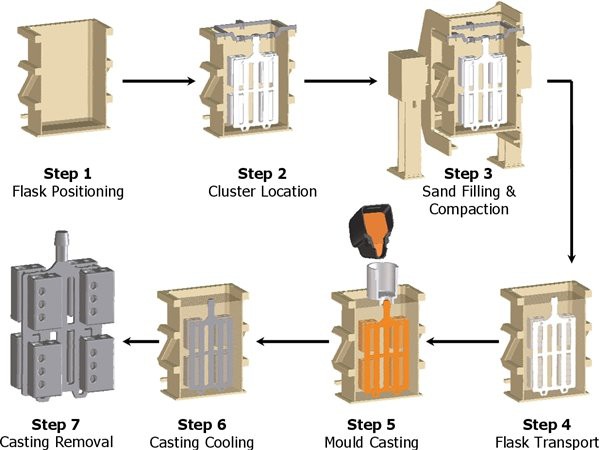
The process of this casting method is to use foam plastic to support the pattern, place it inside the sand box, fill in the modeling material and then tamp it. The pattern is not taken out to form a solid mold without a cavity. When the liquid is poured into the mold, the foam plastic mold will quickly vaporize, burn and disappear under the action of the high-temperature metal liquid. Perform casting.
2. Dry sand negative pressure casting method:
The dry sand negative pressure casting method is a new casting method formed by grafting the vacuum sealing molding method and the solid casting method, because it retains the main advantages of the vacuum sealing molding method and the solid casting method, and overcomes their respective differences. Shortcomings and limitations, so this is not only a new breakthrough in solid casting technology, but also a new development in the implementation of casting methods.
On the basis of the dry sand filling molding method, negative pressure pouring is adopted, which not only uses the pressure difference between the inside and outside of the sand box to make the dry sand compact, but also ensures that the foam mold is vaporized under vacuum, which greatly reduces the amount of gas generated. , the generated gas can also be discharged in time. Moreover, because the metal liquid is poured into the cavity under the vacuum state, the surface accuracy of the casting will be very high, and at the same time, the molding operation can be simplified. Easy to clean, there is no dust contamination in the factory, it also reduces pores, and eliminates casting defects caused by additives such as adhesives. At present, this casting method has become the most important casting method for lost foam casting steel manufacturers.

Post Casting Process
1. Heat treatment: annealing, carbonization, tempering, quenching, normalizing, surface tempering
2. Processing equipment: CNC, WEDM, lathe, milling machine, drilling machine, grinder, etc.;
3. Surface treatment: powder spraying, chrome plating, painting, sandblasting, nickel plating, galvanizing, blackening, polishing, bluing, etc.
Moulds and Inspection Fixtures
1. Mold service life: usually semi-permanent. (except for lost foam)
2. Mold delivery time: 10-25 days, (according to product structure and product size).
3. Tooling and mold maintenance: Zhongwei is responsible for precision parts.
Quality Control
1. Quality control: the defective rate is less than 0.1%.
2. Samples and trial run will be 100% inspected during production and before shipment, sample inspection for mass production according to ISDO standards or customer requirements
3. Testing equipment: flaw detection, spectrum analyzer, golden image analyzer, three-coordinate measuring machine, hardness testing equipment, tensile testing machine;
4. Provide after-sales service.
5. The quality can be traced back.
Application
Steel castings play a very important role in the industry. They are mainly alloys with iron and carbon as the main elements. What are the uses and types of steel castings?
Special steel castings are mainly plow side plates made of spheroidal graphite manganese cast iron, feed pelletizer die made of bainite and boron ductile iron through isothermal quenching, and feed mill hammers made of strong and tough white cast iron. , Ploughshares and rotary tiller machetes made of pearlitic malleable iron, and water pump impellers made of boron cast iron, all have high wear resistance under the condition of ensuring certain strength and toughness. Steel pipes and cold-formed steels are used for the frames of seeders and cultivators with small loads, commonly used square or rectangular cross-section mild steel welded steel pipes, and large load ploughs, chisel ploughs, disc ploughs and discs The frame of the rake is made of low-alloy manganese steel. The use of cold-formed channel steel or curled channel steel made of thin steel plates to manufacture frames such as seeders and cultivators can significantly reduce the weight compared with the use of hot-rolled steel frames.


Send Inquiry
