



FCD500 Ductile Iron Castings
When the casting is cooled, the surface and thin section often produce white holes. White tissue hard and brittle, poor processing performance, easy to flake. Therefore, the method of annealing (or normalizing) must be used to eliminate the white tissue. The annealing process is: heating to 550-950 ° C for 2 ~ 5h, and then cooling to 500-550 ° C and then air cooling.
Product Introduction
|
FCD500 Ductile Iron Castings |
|||||||
|
Item |
Material |
Production Process |
Sintering Temperature |
Mold |
Custom |
||
|
FCD500 Ductile Iron Castings |
FCD500 |
Molten mold casting |
1380℃ |
To be customized |
Yes |
||
|
Available Materials |
Carbon steel, alloy steel, aluminum alloy, low -carbon stainless steel, titanium alloy (TI, TC4), copper alloy, high temperature alloy (718, 713) |
||||||
|
Smoothness |
Dimensional accuracy |
Product density |
Appearance treatment |
Appropriate weight |
|||
|
Roughness 1~5μm |
(±0.1%~±0.5%) |
7.3-7.6/CM³ |
According to customer requirements |
0.03g~400g |
|||
FCD500 ductile iron lost wax investment casting
FCD500 ductile iron
When the casting is cooled, the surface and thin section often produce white holes. White tissue hard and brittle, poor processing performance, easy to flake. Therefore, the method of annealing (or normalizing) must be used to eliminate the white tissue. The annealing process is: heating to 550-950 ° C for 2 ~ 5h, and then cooling to 500-550 ° C and then air cooling. During the high temperature holding period, the free cementite, eutectic cementite and eutectoid cementite also decompose and graphitization occurs. The mechanical properties of castings are improved due to cementite. Sometimes normalizing is also the preparation of ductile iron surface quenching on the structure, normalizing high temperature normalizing and low temperature normalizing. The high temperature normalizing temperature is generally not more than 950 ~ 980℃, and the low temperature normalizing is generally heated to the co-folding temperature range of 820 ~ 860℃. After normalizing, it is generally necessary to carry out tempering treatment to eliminate the internal stress generated during normalizing, so as to achieve the high-temperature rocky desertification annealing of the white mouth of the casting.
Quenching and tempering of ductile iron
In order to improve the mechanical properties of ductile iron, the general casting is heated to 30 ~ 50℃ above Afc1 (Afc1 represents the final temperature formed by A when heating), and the martensitic structure is obtained after heat preservation. In order to properly reduce the residual stress after quenching, the general quenching should be tempered, and the low temperature tempering structure is tempered martensite plus residual bainite and spherical graphite. This kind of structure has good wear resistance and is used for parts requiring high wear resistance and high strength. The tempering temperature is 350-500℃, and the tempered structure is tempered troostenite and spherical graphite, which is suitable for thick parts that require good wear resistance and have certain effective stability and elasticity. The high-temperature tempering temperature is 500-60D℃, and the tempered structure is tempered Soxhlet as spherical graphite, which has a good comprehensive performance combining toughness and strength, so it is widely used in production.
The structure of cast iron depends on the degree of graphitization, in order to obtain the required structure, the key is to control the degree of graphitization. It has been proved that many factors such as the chemical composition of cast iron, the cooling rate of cast iron crystallization and the superheating and standing of molten iron affect the graphitization and microstructure of cast iron.
1. Influence of chemical composition
Among the common C, Si, Mn, P and S in cast iron, C and Si are elements that strongly promote graphitization, and S are elements that strongly hinder graphitization. In fact, the influence of each element on the graphitization ability of cast iron is very complicated. Its influence is related to the content of each element itself and whether it interacts with other elements, such as Ti, Zr, B, Ce, Mg, etc., which hinder graphitization, but if its content is very low (such as B, Ce<0.01%, Ti<0.08%), they also show a role in promoting graphitization.
2. The effect of cooling speed
Generally speaking, the cooling rate of the casting is slower, the more conducive to crystallization and transformation according to the Fe-G stable system state diagram, and the full graphitization; On the contrary, it is conducive to crystallization and transformation according to the Fe-Fe3C metastable system state diagram, and finally obtain white iron. Especially in the eutectoid phase of graphitization, due to the low temperature, increased cooling rate, atomic diffusion is difficult, so under normal circumstances, the eutectoid phase of graphitization is difficult to fully carry out.
The cooling rate of cast iron is a comprehensive factor, which is related to the casting temperature, the thermal conductivity of the transfer material and the wall thickness of the casting. And usually these factors are of two orders
The effect of the segment is basically the same.
Zhongwei Precision has the following services
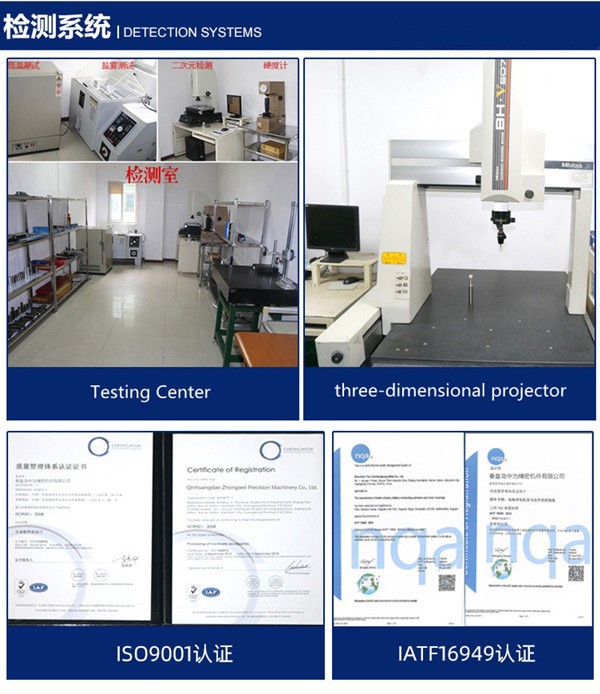
Detection Systems
Copper Silica Sol Investment Casting


We are the manufacturer of "FCD500 Ductile Iron Castings", if you need more information please contact us!


Send Inquiry
