



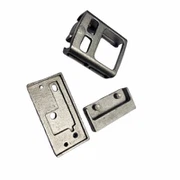
Earthwork Angle Water Glass Investment Casting
Earthwork angle water glass investment casting can be used in a variety of applications including earthmoving equipment, excavator attachments, trenching tools and mining machinery. They are also used in components in other industries, such as aerospace, automotive and medical device manufacturing.
Product Introduction
|
Earthwork angle water glass investment casting |
|||||||
|
Item |
Material |
Production Process |
Sintering Temperature |
Mold |
Custom |
||
|
Earthwork angle |
X2CrNi189 |
Investment casting |
1380℃ |
To be customized |
Yes |
||
|
Chemical composition |
C: ≤0.03 Si: ≤1 Mn: ≤2 P: ≤0.045 S: ≤0.015 Cr: 18-20 Ni: 10-12 N: 0.11 |
||||||
|
Available Materials |
Carbon Steel, Alloy Steel, Aluminum Alloy, Low Carbon Stainless Steel, Titanium Alloy (Ti, TC4), Copper Alloy, Superalloy (718, 713) |
||||||
|
Smoothness |
Dimensional accuracy |
Product density |
Appearance treatment |
Appropriate weight |
|||
|
Roughness 1~5μm |
(±0.1%~±0.5%) |
7.3-7.6/CM³ |
According to customer requirements |
0.03g~400kg |
|||
Earthwork angle water glass investment casting can be used in a variety of applications including earthmoving equipment, excavator attachments, trenching tools and mining machinery. They are also used in components in other industries, such as aerospace, automotive and medical device manufacturing.
Stainless Steel Casting Production Process
German standard (EN) X2CrNi18-9 stainless steel, implementation standard: DIN 17440-1979, belongs to austenitic stainless steel. The production process of austenitic stainless steel has good performance, especially chromium-nickel austenitic stainless steel. Conventional means of producing special steel can be used Smoothly produce plates, tubes, strips, wires, bars, as well as forgings and castings of various commonly used specifications.
Austenitic stainless steels can also be used to produce castings. In order to improve the fluidity of molten steel and improve casting performance, the alloy composition of cast steel should be adjusted: increase the silicon content, relax the range of chromium and nickel content, and increase the upper limit of the impurity element sulfur.
X2CrNi18-9 stainless steel, German DIN standard stainless steel. Corresponding to 022Cr19Ni10, the corresponding number we are more familiar with is 304L. Compared with ordinary 304, 304L has lower carbon content and there is not much difference in mechanical properties. Mainly used in welding, because the carbon content is relatively low, which can increase the ability to resist intergranular corrosion. (The carbon content of ordinary 304 is min. 0.15%, and that of 304L is min. 0.030%. 304L should be softer).
Brand: X2CrNi18-9
Standard: DIN 17400
chemical composition:
C:≤0.03
Si: ≤1.00
Mn: ≤2.00
P:≤0.045
S:≤0.015
Cr: 17.00~19.50
Mo: -
Ni: 8.00~10.50
N:≤0.11
Investment Casting Process
The investment casting process, simply put, is to use fusible materials (such as wax or plastic) to make a fusible model (referred to as investment mold or model), coated with several layers of special refractory coating, after drying and hardening to form an integral shell, and then use steam or hot water to melt the model from the shell, and then put the shell in the sand box, fill it with dry sand around it, and finally put the mold into the roasting furnace for high-temperature roasting (such as the use of high-strength shell, the demolded shell can be directly roasted without modeling), and the casting or shell is roasted, and the molten metal is poured into it to obtain the casting.
The dimensional accuracy of investment castings is high, generally up to CT4-6 (CT10~13 for sand casting, CT5~7 for die-casting), of course, due to the complex process of investment casting, there are many factors affecting the dimensional accuracy of castings, such as the shrinkage of the mold, the deformation of the investment mold, the linear change of the shell in the heating and cooling process, the shrinkage rate of the alloy and the deformation of the casting in the solidification process, etc., so although the dimensional accuracy of ordinary investment castings is higher, its consistency still needs to be improved (the use of medium, The dimensional consistency of castings with high-temperature wax is much improved).
When pressing the investment mold, the pressing profile with high cavity surface finish is used, so the surface finish of the investment mold is also relatively high. In addition, the shell is made by applying a refractory coating made of a special binder and refractory material that is resistant to high temperatures and applied to the investment mold, and the inner surface of the cavity in direct contact with the molten metal has a high finish. Therefore, the surface finish of investment castings is higher than that of general castings, which can generally reach Ra.1.6~3.2μm.
Detection Systems

Copper Silica Sol Investment Casting





Send Inquiry
