




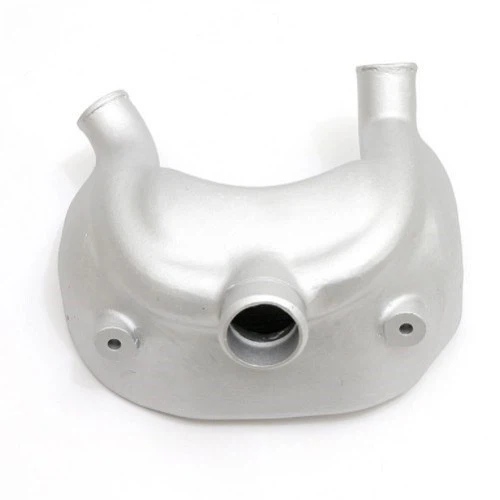

Lost Wax Investment Castings For Automotive Exhaust Manifolds
Early automobile engines had low power per unit weight, low fuel combustion efficiency, and the exhaust gas temperature did not exceed 500 °C. With the improvement of the efficiency of the automobile engine, the exhaust temperature is increased to 600~650 ℃. In recent years, developed countries have continuously improved automobile exhaust emission standards and the application of catalytic technology and turbocharging technology has significantly increased the operating temperature of the exhaust manifold, reaching above 750 °C.
Product Introduction
|
Lost Wax Investment Castings for Automotive Exhaust Manifolds |
||||||||
|
Item |
Material |
Production Process |
Sintering Temperature |
Mold |
Custom |
|||
|
Lost Wax Investment Castings for Automotive Exhaust Manifolds |
Customized according to customer requirements |
Investment Casting |
1680℃ |
To be customized |
Yes |
|||
|
Available Materials |
Carbon steel, alloy steel, aluminum alloy, low carbon stainless steel, titanium alloy (Ti, TC4), copper alloy, high temperature alloy (718, 713) |
|||||||
|
Smoothness |
Dimensional accuracy |
Product density |
Appearance treatment |
Appropriate weight |
||||
|
Roughness 1~5μm |
(±0.1%~±0.5%) |
7.8g/CM³ |
According to customer requirements |
3g~4kg) |
||||
Characteristics and requirements of exhaust manifold materials
Early automobile engines had low power per unit weight, low fuel combustion efficiency, and the exhaust gas temperature did not exceed 500 °C. With the improvement of the efficiency of the automobile engine, the exhaust temperature is increased to 600~650 ℃. In recent years, developed countries have continuously improved automobile exhaust emission standards and the application of catalytic technology and turbocharging technology has significantly increased the operating temperature of the exhaust manifold, reaching above 750 °C. With the further improvement of engine performance, the working temperature of the exhaust manifold will also increase. At the same time, with the advancement of engine technology, the structure of Lost Wax Investment Castings for Automotive Exhaust Manifolds is also complicated. In addition, it is required to work under the condition of cyclic and alternating temperature, which requires the exhaust manifold material not only to have good high-temperature performance but also to have good casting properties. Therefore, the exhaust manifold material must have the following characteristics.
1. Good high-temperature oxidation resistance
Exhaust manifolds work under high-temperature cycles and alternating conditions for a long time, and the oxidation resistance of materials at high temperatures directly affects the service life of exhaust manifolds. Ordinary cast iron obviously cannot meet the requirements, and alloy elements need to be added to the material to improve the high-temperature oxidation resistance of the material.
2. Stable Microstructure
In the range from room temperature to operating temperature, the material should have as little or no phase change as possible. Because the phase change will cause volume changes, causing internal stress or deformation, affecting the performance and life of the product. Therefore, the matrix material is preferably a stable ferrite or austenite structure. The damage form of cast iron parts working under high-temperature conditions is mainly manifested as corrosion under high-temperature conditions. After the constituent phases in the structure are oxidized (such as graphite carbon), the volume of the oxide is larger than the original volume, causing irreversible expansion of the casting.
Compared with the three graphite forms of flake, worm, and spherical graphite, cast iron with spherical graphite has the best high-temperature resistance. The reason is that during the solidification process of cast iron, flake graphite is the leading phase growth, and when the eutectic solidification ends, each graphite in the eutectic group forms a continuous branched three-dimensional shape. At high temperatures, when oxygen invades the interior of the metal after the graphite is oxidized, a microscopic channel is formed to accelerate the oxidation process. When spherical graphite nucleates, after growing to a certain size alone, it is surrounded by the matrix and exists as an isolated ball. After the graphite ball is oxidized, no channel will be formed, thus weakening the further progress of oxidation. Therefore, the high-temperature oxidation resistance of nodular cast iron It is better than other forms of graphite, and the oxidized pores have less effect on the high-temperature strength of cast iron than other forms of graphite, and vermicular graphite is in between.
3. Small coefficient of thermal expansion
A small coefficient of thermal expansion is beneficial to reduce the thermal stress and thermal deformation of the exhaust manifold, which is beneficial to improve the performance and service life of the product.
4. Excellent high-temperature strength
Must meet the necessary strength requirements when the product is used at high temperatures.
5. Good process performance and low cost
There are many types of heat-resistant and high-temperature-resistant metal materials, but due to the complex shape of the exhaust manifold, the material used to manufacture the exhaust manifold must have good manufacturability, and its cost must meet the needs of mass production in the automotive industry.
Detection Systems

Copper Silica Sol Investment Casting



Send Inquiry
