




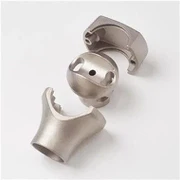
Car Lock Shaft Lost Wax Investment Casting
The structure of the door lock has the following aspects
1. Lock cylinder: a copper cylindrical lock cylinder, which can be locked or opened when turning. The lock cylinder is divided into an inner lock cylinder and an outer lock cylinder. The inner lock cylinder is where the key is inserted;
2. Pins: Copper pins are divided into inner pins and outer pins, cylindrical, with different lengths, installed in the round holes of the inner and outer lock cylinders;
3. Spring: installed in the round hole of the outer lock cylinder;
4. Lock tongue: the part that expands and contracts when unlocking;
5. Key: There are different heights of sawtooth corresponding to different lengths of marbles.
Product Introduction
|
Car Lock Shaft Lost Wax Investment Casting |
||||||||
|
Item |
Material |
Production Process |
Sintering Temperature |
Mold |
Custom |
|||
|
Car Lock Shaft Lost Wax Investment Casting |
Customized according to customer requirements |
Investment Casting |
1680℃ |
To be customized |
Yes |
|||
|
Available Materials |
Carbon steel, alloy steel, aluminum alloy, low carbon stainless steel, titanium alloy (Ti, TC4), copper alloy, high temperature alloy (718, 713) |
|||||||
|
Smoothness |
Dimensional accuracy |
Product density |
Appearance treatment |
Appropriate weight |
||||
|
Roughness 1~5μm |
(±0.1%~±0.5%) |
7.8g/CM³ |
According to customer requirements |
3g~4kg) |
||||
Door lock structure
The structure of the door lock has the following aspects
1. Lock cylinder: a copper cylindrical lock cylinder, which can be locked or opened when turning. The lock cylinder is divided into an inner lock cylinder and an outer lock cylinder. The inner lock cylinder is where the key is inserted;
2. Pins: Copper pins are divided into inner pins and outer pins, cylindrical, with different lengths, installed in the round holes of the inner and outer lock cylinders;
3. Spring: installed in the round hole of the outer lock cylinder;
4. Lock tongue: the part that expands and contracts when unlocking;
5. Key: There are different heights of sawtooth corresponding to different lengths of marbles.
Double glass door lock structure
1. Lock cylinder: a copper cylindrical lock cylinder, which can be locked or opened when turning. The lock cylinder is divided into an inner lock cylinder and an outer lock cylinder. The inner lock cylinder is where the key is inserted;
2. Pins: Copper pins are divided into inner pins and outer pins, cylindrical, with different lengths, installed in the round holes of the inner and outer lock cylinders;
3. Spring: installed in the round hole of the outer lock cylinder;
4. Lock tongue: the part that expands and contracts when unlocking;
5. Key: There are different heights of sawtooth corresponding to different lengths of marbles.
Maintenance of door locks
Usually, when the door lock is astringent or tight, some lubricating oil is often dripped into the keyhole, so that the whole body of the door lock may be smooth immediately, but because the oil is easy to stick to dust, it will be easy to lock in the keyhole in the future. Slowly accumulate dust and form greasy putty, which makes Car Lock Shaft Lost Wax Investment Casting more prone to failure;
The correct solution is: to cut some pencil crumbs or some candle crumbs, blow them into the lock cylinder through a thin tube, then insert the key and turn it repeatedly several times.
Ball-lock construction
The central point of the lock is the lock cylinder. In fact, the internal structure of the door lock is very simple, including the lock cylinder, extension spring, rotating shaft, lock body, rubber strip rebound force, lock hook, etc., mainly these parts.
Ball door lock removal method
1. On the door lock, you will find a small hole, between the handle and the chip inside, at the bottom, you will see a relatively sharp thing, use something to hold this sharp thing, and then keep moving left and right Twist the handle, then pull hard, and it will usually come off. If the door lock needs to be removed, it means that the door lock is broken, or it is not easy to open and close. At this time, you need to buy a new door lock and install it.
2. First, start from the inner handle, pry the inner disk loose, then turn it counterclockwise, and then hold the handle, which is the handle part, and twist it back and forth to see how many holes there are in the lock body and the door lock. , Then according to this hole, use a thin and thin thing to hold up the hole, and the door lock can be pulled. As long as you have personally touched the real door lock, it will be much easier to disassemble it. If you just rely on words to tell, the method of dismantling the door lock will become complicated.
Modern door lock construction
The internal structure of the door lock has:
1. Lock cylinder: a copper cylindrical lock cylinder, which can be locked or opened when turning. The lock cylinder is divided into an inner lock cylinder and an outer lock cylinder. The inner lock cylinder is where the key is inserted;
2. Pins: Copper pins are divided into inner pins and outer pins, cylindrical, with different lengths, installed in the round holes of the inner and outer lock cylinders;
3. Spring: installed in the round hole of the outer lock cylinder;
4. Lock tongue: the part that expands and contracts when unlocking;
5. Key: There are different heights of sawtooth corresponding to different lengths of marbles.
Maintenance of the door lock: Usually when the door lock is astringent or tight, some lubricating oil is often dripped into the keyhole, so that the whole body of the door lock may be smooth immediately, but because the oil is easy to stick to dust, In the future, dust will slowly accumulate in the keyhole and form greasy putty, which will make the door lock more prone to failure; the correct solution is: cut some pencil crumbs or some candle crumbs, and blow them into the lock through a thin tube. Inside the core, then insert the key and turn it several times repeatedly.
The detailed structure of the interior of the bedroom door lock
The internal structure of the bedroom door lock consists of a lock cylinder, a deadbolt, a handle shaft, and a handle structure.
Elantra door lock structure
The function of the electric door lock is to open or lock the door through an electromagnet mechanism or a motor mechanism. The structure of the Elantra door lock is composed of the main parts such as the door lock actuator and linkage mechanism, the door lock control switch, and the door lock control relay. At present, high-end cars generally adopt the automatic door lock type. On the basis of manually controlling the opening and closing of the door locks, the doors can also be automatically locked according to the speed of the car.
The internal structure of the tube well door lock
• Cam structure
The deadbolt mechanism is the executive mechanism for the closing and opening of the ball lock. It only needs to be composed of a large deadbolt, a small deadbolt, a large support body, a small support body, a pull piece, and a brake pad.
• Big back
The large support body is the main part that drives the movement of the large deadbolt and is the main body of the large deadbolt installation. The head of the large bracket body is the riveted part of the large lock tongue, the middle rectangular hole can be matched with the hanging lug on the pull tab, the outer step is the snap-in groove of the brake pad, and the lower part can be snapped into the slider jaw, which is convenient for the slider At the same time when the large support body is pushed and retracted, it will not be hindered by the jaws of the slider.
• Small body
The small support body is the main body of the small deadbolt installation and is the main component to control the self-locking of the big deadbolt. The head of the small bracket is used to assemble the small lock tongue, and the protruding triangular part in the middle is used to push the brake pads, so as to eliminate the self-locking of the brake pads to the large bracket body.
• Pull tab
The pull piece plays the role of positioning and releasing self-locking when the big bolt is pulled and retracted. The hanging lug on the top of the pull piece can be inserted into the rectangular hole in the middle of the large support body, so that the large support body can be pulled inward together, and can also slide in the rectangular hole when the large support body is pushed inward. The supporting angles on both sides of the pull tab can move the brake pads to release the self-locking of the brake pads to the large support body {when the large support body shrinks. The small circle in the middle of the pull tab is used for its own positioning, and the protrusions on both sides can make the large support body move in the formed groove, and the lower bayonet can be snapped into the jaw of the slider, and move under the control of the slider.
• Brake pads Brake pads
The big lock tongue is self-locking originally so that the big lock tongue can achieve the function of anti-prying. The two claws at the bottom are used for installation and positioning, the square hole in the middle can be used to install the spring piece, which provides power for the brake pad to reset, and the top plane is the braking plane, which can be snapped into the self-locking part of the large bracket.
• Lock mechanism
The lock body mechanism is a conversion mechanism that converts the rotation of the handball into the translation of the deadbolt to realize locking. The transmission parts mainly include a large lock tube, small tube, slider, hook block, button large tube, hook, and other parts. The large pipe of the lock end plays the role of fixing the lock end and transmitting torque and is the skeleton for installing the handball. The two shifting feet protruding from the head of the big tube of the lock head are used to move the slider, the two raised parts are used for axial positioning, and the three holes in the middle are used for installing the pin leaf spring and the big tube pin. The large pipe pin can be pressed to stop the movement of the handball, and it is the key to loading and unloading the handball. The two wide slots at the end of the large tube are used to install the lock head. When the large tube is round, there is a wide gap at the joint, which is used to cooperate with the inner convex rib of the handball to prevent the radial rotation of the handball on the large tube, and to cooperate with the hook to prevent the outer handball and the large tube Turn around threaded flange.
Ventilation door lock structure
A window ventilation lock. Technical background Nowadays, people have higher and higher requirements for quality of life. Being able to breathe fresh air and discharge indoor harmful gases is the top priority in life, and to meet these requirements must be met when the windows of the home are opened, but even if the windows Opening only a small slit for ventilation also provides an opportunity for thieves to break into the house, making people afraid to open the window to sleep. If the anti-theft fence is installed and the fire exit is broken, although the current social security situation is much better than in the past, thieves and robbers in society It is still difficult to disappear. Similar to "Spiderman", even some 20-30-story high-rise buildings can also climb up and steal. They mainly commit crimes through windows in places where people do not close the windows for ventilation. Media reports on this aspect Also quite a lot, for this reason, many people have also moved a lot of brains to prevent thieves from climbing in, so people have made a kind of simple and easy window lock that can prevent thieves from climbing in and also leaves a certain ventilation gap. It is locked when there is a certain ventilation gap, so as to prevent thieves from climbing in. However, there are still some disadvantages to this lock. First, the deadbolt is straight and inserted into the positioning hole of the positioning plate without any hooking position. As long as the thief Uses a tool to pry the positioning plate for a certain distance to withdraw the deadbolt from the positioning plate.
Goodyear door lock internal structure
The internal composition of the door lock is as follows:
1. Lock the cylinder
Cylindrical lock cylinder in brass that locks or unlocks when turned. The lock cylinder is divided into an inner lock cylinder and an outer lock cylinder, and the inner lock cylinder is where you insert the key.
2. Marbles
The copper marbles are divided into inner marbles and outer marbles, which are cylindrical and of different lengths and are installed in the round holes of the inner and outer lock cylinders. A lock has 3-5 groups of marbles.
3. Spring
Installed in the round hole of the outer lock cylinder. Hold the marbles.
4. Deadbolt
The part that expands and contracts when unlocking. When the cylindrical inner lock cylinder rotates, it drives the deadbolt. The padlock is driven by the lock "nose".
5. Key
There are "serrations" of different heights corresponding to marbles of different lengths.
502 door lock internal structure
There are lock cylinders, lock cylinders, screws, deadbolts, and lock structures.
Detection Systems

Copper Silica Sol Investment Casting



Send Inquiry
