




60-40-18 Ductile Iron Castings
The selection of appropriate chemical composition is to ensure that nodular cast iron to obtain good metallographic structure and high performance of the basic conditions, the selection of chemical composition is conducive to the nodular graphite and obtain satisfactory matrix, in order to obtain satisfactory performance, but also to make nodular cast iron has good casting performance.
Product Introduction
|
60-40-18 Ductile iron castings |
|||||||
|
Item |
Material |
Production Process |
Sintering Temperature |
Mold |
Custom |
||
|
60-40-18 Ductile iron castings |
60-40-18 |
Molten mold casting |
1380℃ |
To be customized |
Yes |
||
|
Available Materials |
Carbon steel, alloy steel, aluminum alloy, low -carbon stainless steel, titanium alloy (TI, TC4), copper alloy, high temperature alloy (718, 713) |
||||||
|
Smoothness |
Dimensional accuracy |
Product density |
Appearance treatment |
Appropriate weight |
|||
|
Roughness 1~5μm |
(±0.1%~±0.5%) |
7.3-7.6/CM³ |
According to customer requirements |
0.03g~40kg |
|||
60-40-18 lost wax investment casting parts of ductile iron
Chemical composition of ductile iron
The selection of appropriate chemical composition is to ensure that nodular cast iron to obtain good metallographic structure and high performance of the basic conditions, the selection of chemical composition is conducive to the nodular graphite and obtain satisfactory matrix, in order to obtain satisfactory performance, but also to make nodular cast iron has good casting performance.
1. Five Elements
Carbon and silicon:
Because the graphite ball has little weakening effect on the matrix, there is no obvious effect on the mechanical properties when the carbon content is 3.2-3.8%. When determining the carbon-silicon content of ductile iron, the carbon equivalent is selected around the eutectic composition in order to ensure the casting performance.
When the carbon content is too low, the casting is easy to shrink and crack; When the carbon equivalent is too high, it is easy to produce graphite floating phenomenon, resulting in the increase of inclusions. Silicon can improve the roundness of the graphite ball, refine the graphite, and reduce the tendency of crystallization supercooling and white mouth. It is generally believed that when the silicon content is greater than 2.8%, the toughness may be reduced, and the toughness to brittleness transition temperature will be increased.
Therefore, when selecting the carbon silicon content, the principle of high carbon and low silicon should be followed, and the silicon content of castings should be appropriately reduced when used in cold areas.
Ferrite C: 3.6-4.0% Si: 2.4-2.8%
Pearlite C: 3.4-3.8% Si: 2.2-2.4%
Manganese:
In nodular cast iron, manganese is not required to undertake this function because of the strong desulfurization ability of nodular elements. Manganese has a serious positive segregation tendency, which is often enriched in the eutectic group boundary, which will promote the formation of intergranular carbide and significantly reduce the toughness of ductile iron.
As-cast ferrite Mn: 0.3-0.4%
Pearlitic ductile iron Mn: 0.4-0.8%
Phosphorus:
Phosphorus has a strong segregation tendency in ductile iron, and has a tendency to increase the shrinkage of ductile iron, and is easy to form phosphorus eutectic at the grain boundary, which seriously reduces the toughness of ductile iron. For castings used in cold areas, it is easy to use the lower limit of phosphorus content.
The content of phosphorus is controlled below 0.04-0.06%.
Sulfur:
The combination ability of sulfur and nodular elements in nodular cast iron is very strong, resulting in sulfide or sulfur oxide, which not only consumes nodulating agent, causing nodulating instability and accelerating decline rate, but also increases the number of inclusions, resulting in defects in castings.
Foreign countries generally require that the sulfur content of liquid iron is less than 0.02%, due to the higher coke content in China's smelting conditions, often can not meet this standard, should be further improved melting conditions, conditions can be carried out outside the furnace desulfurization.
2. Alloy elements
The alloying elements of ductile iron mainly include molybdenum, copper, nickel, chromium, antimony, vanadium, bismuth and other metals.
The main function of these elements is to improve the strength of cast iron and stabilize the matrix structure.
Zhongwei Precision has the following services
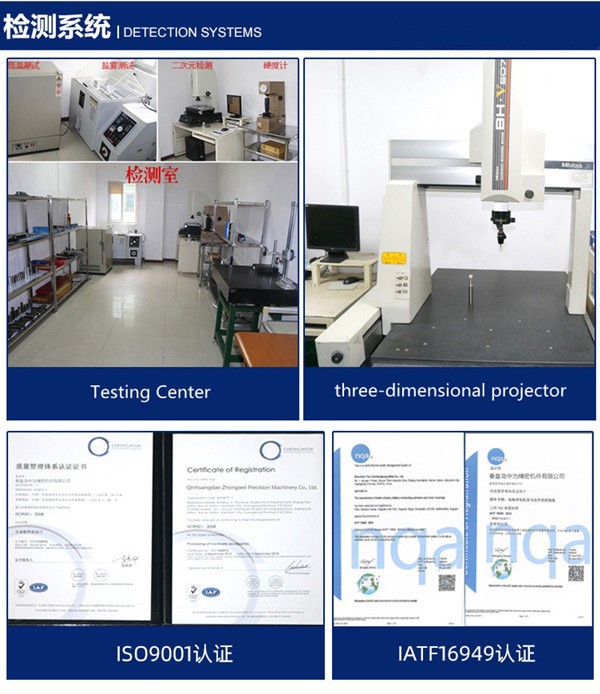
Detection Systems
Copper Silica Sol Investment Casting


We are the manufacturer of "60-40-18 Ductile iron castings", if you need more information please contact us!


Send Inquiry
