



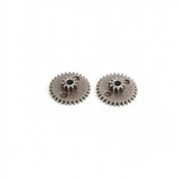
Planetary Gear PM Sintered Part
In the reduction mechanism family, the planetary reduction mechanism is characterized by its compact structure, small size, high transmission efficiency, wide deceleration range, stable and reliable operation, strong overload capacity, impact resistance, and small moment of inertia. It is suitable for frequent starting and forward and reverse operation, etc. Its advantages are widely used, and its role is to reduce the speed and increase the torque and reduce the moment of inertia ratio of the load/motor under the premise of ensuring precision transmission.
Product Introduction
|
Planetary gear PM sintered part |
||||||
|
Item |
Material |
Production Process |
Sintering Temperature |
Mold |
Custom |
|
|
Knurled nut powder metallurgy |
40rc |
Powder metallurgy |
1180℃ |
To be customized |
Yes |
|
|
Chemical composition |
C:0.37~0.44 Si:0.17~0.37 Mn:0.50~0.80 Cr:0.80~1.10 Ni:≤0.30 P:≤0.035 S:≤0.035 Cu:≤0.25 Mo:≤0.10 |
|||||
|
Available Materials |
Low carbon stainless steel, titanium alloy (Ti, TC4), copper alloy, tungsten alloy, hard alloy, high temperature alloy (718, 713) |
|||||
Product advantages
|
Smoothness |
Dimensional accuracy |
Product density |
Appearance treatment |
Appropriate weight |
|
Roughness 1~5μm |
(±0.1%~±0.5%) |
92~95% |
According to customer requirements |
0.03g~400g) |
|
Mechanical properties |
Sample blank size (mm): 25 heat treatment: Heating temperature for the first quenching (℃): 850; coolant: oil Second quenching heating temperature (°C):- Tempering heating temperature (°C): 520; Tensile strength (σb/MPa): ≥810 (when the actual hardness is 25HRC) Yield point (σs/MPa): ≥785 Elongation after break (δ5/%): ≥9 Reduction of area (ψ/%): ≥45 Impact absorption energy (Aku2/J): ≥47 Brinell hardness (100/3000HBW) (annealed or high temperature tempered state): ≤207 |
|||
Manufacturing method
Technical Field
The invention relates to a powder metallurgy production technology, in particular to a powder metallurgy planetary gear PM sintered part manufacturing method.
Background technique
In the reduction mechanism family, the planetary reduction mechanism is characterized by its compact structure, small size, high transmission efficiency, wide deceleration range, stable and reliable operation, strong overload capacity, impact resistance, and small moment of inertia. It is suitable for frequent starting and forward and reverse operation, etc. Its advantages are widely used, and its role is to reduce the speed and increase the torque and reduce the moment of inertia ratio of the load/motor under the premise of ensuring precision transmission.
The transmission shaft is the core component of the power output in the planetary reduction mechanism. Since the output force of the reducer is the product of the output force of the drive motor and the reduction ratio, the high power output of the reduction mechanism causes the transmission bearing to be easily broken due to the large torque. Therefore, in addition to requiring high dimensional and shape accuracy such as concentricity, there are also high requirements for its surface hardness, wear resistance, overall strength and toughness, and fatigue strength.
Powder metallurgy technology is a process technology for producing metal or using metal powder (or a mixture of metal powder and non-metal powder) as raw material, after forming and sintering, to manufacture metal materials, composites and various types of products. Powder metallurgy has the advantages of high raw material utilization rate (≥95%), low manufacturing cost, good material comprehensiveness, near-net shape, high product precision and stability, etc. It can also manufacture materials and materials that cannot be prepared by traditional casting methods and mechanical processing methods. Difficult to machine parts. Planetary gear transmission shafts are relatively complex parts, and the production of powder metallurgy technology can greatly reduce assembly and processing costs.
Figure 1 shows a powder metallurgy planetary gear transmission shaft. One end of the transmission shaft is a spline shaft 1 with a central hole 4, and the other end is a planetary wheel 2, and the planetary wheel 2 is pressed with evenly distributed planetary shaft hole 3. Due to the compact size of the planetary reduction mechanism, the size of the planetary wheel disc 2 of the planetary gear transmission shaft is certain, and it is also necessary to ensure that the planetary wheel shaft hole 3 has a certain wall thickness, and the contour line of the planetary wheel shaft hole 3 extends in its axial direction , must conflict with spline shaft 1. Figures 2 and 3 can clearly see this problem, specifically manifested as: along the axial direction of the spline shaft 1, the planet wheel shaft hole 3 partially overlaps with the spline shaft 1.
In powder metallurgy technology, the above part structure makes it difficult to directly press the planetary gear shaft hole of the planetary gear transmission shaft. In order to manufacture such a transmission shaft, the current method is: press the transmission shaft once, but the transmission shaft has no planetary shaft hole, and then process the planetary shaft hole 3 through subsequent processes, and finally obtain the transmission shaft with the planetary shaft hole 3.
However, the above-mentioned production process has the following problems: a plurality of planet wheel shaft holes 3 are not formed at one time, and it is difficult to ensure the dimensional accuracy and position accuracy of the planet wheel shaft holes 3 and the center line of the transmission shaft in the subsequent processing process: even if the planet wheel shaft holes 3 are mutually Not only have high parallelism and dimensional accuracy, but also have high parallelism and dimensional accuracy with the center line of the transmission shaft. The planetary gear shaft 5 is pressed into the planetary gear shaft hole 3 through interference fit to install the planetary gear. If the axial direction of the planetary gear shaft hole 3 cannot meet the above-mentioned size and position accuracy, it will seriously affect the meshing of the planetary gears, which will greatly affect the planetary gear during work. It will affect the power transmission and make a lot of noise. At the same time, the life of the planetary gear will be seriously reduced and the planetary reduction mechanism will be scrapped.
Contents of the invention
The technical problem to be solved by the present invention is to provide a method for manufacturing a planetary gear PM sintered part powder metallurgy planetary gear transmission shaft. The manufacturing method ensures the accuracy of the size, shape and position of the planetary shaft hole on the planetary gear transmission shaft.
In order to solve the above-mentioned technical problems, the technical solution of the present invention is: a method for manufacturing a powder metallurgy planetary gear transmission shaft, comprising the following steps:
(1) Powder metallurgy mold design: In order to ensure the compact structure of the planetary gear reducer, under the condition that the overall size of the planetary gear transmission shaft remains unchanged, by changing the structure of the powder metallurgy mold, the planetary gear of the compacted planetary gear transmission shaft after pressing The thickness of the disk is H+h, where H is the design thickness of the planetary wheel of the planetary gear transmission shaft, h is the thickness of the margin added on the planetary wheel; the planetary wheel has a planetary wheel shaft hole, and the planetary wheel shaft hole is blind The hole, which opens on the planetary gear mounting surface of the planetary wheel, has a depth of H1, where H≤H1<(H+h), and the thickness h of the margin is 0.8-1.5 times the thickness of the spline shaft compact . The above-mentioned limited design for the thickness range of the margin is conducive to obtaining a green compact with uniform density during pressing, and avoids the uneven pressing density of the green compact at the shaft hole of the planetary wheel due to the large difference in the wall thickness of the parts during the subsequent sintering process. Defects such as cracks occur.
(2) Mixed powder: uniformly mix the powder metallurgy iron-based powder with lubricants, forming agents and other auxiliary materials according to the ratio for use;
(3) Compression: Feed the quantitatively mixed powder into the mold cavity of the powder metallurgy planetary gear transmission shaft on the press, and press it into a planetary gear transmission shaft compact;
(4) Sintering: According to the set sintering process parameters, the planetary gear transmission shaft compact is sent to the decomposed ammonia or nitrogen atmosphere mesh belt sintering furnace for sintering;
(5) Machining: Remove the extra thickness h of the planetary wheel disc from the spline shaft side of the planetary gear transmission shaft, process the extra thickness h part into a spline shaft, and obtain the planetary wheel shaft hole as a through hole;
(6) Heat treatment: Carbonitriding in a box-type heat treatment furnace is used, then quenched in quenching oil, and finally tempered at low temperature to ensure the surface hardness and fatigue resistance of the powder metallurgy planetary gear drive shaft.
(7) Finishing; Grinding on a grinder to obtain a product with final dimensional accuracy.
The production process of the present invention solves the problem that the planetary gear transmission shaft mentioned in the present invention cannot be formed by one-time pressing, and directly presses the shaft hole of the planetary gear through powder metallurgy, so as to ensure the accuracy of size and shape position, and at the same time. In the traditional process, the shaft hole of the planetary wheel is formed by the subsequent processing technology, and the size and shape and position errors of the processing technology are inevitable, so the size and shape and position accuracy of the parts cannot be guaranteed. The shaft hole of the planetary wheel of the present invention is formed by direct pressing, which solves the problem of processing accuracy in subsequent processes, reduces manufacturing costs, and improves the efficiency of processing and production.
Metal Injection Molding Process

Detection Systems


Send Inquiry
